

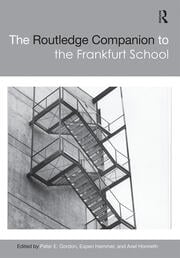
The Routledge Companion to the Frankfurt School / edited by Peter E. Gordon, Espen Hammer and Axel Honneth.
Erişim Adresi
ISBN
9780429443374(e-book : PDF)
Dil Kodu
İngilizce
Basım Bildirimi
First edition.
Yayın Bilgisi
Boca Raton, FL : Routledge, 2018.
Fiziksel Niteleme
1 online resource (596 pages) : 1 illustrations, text file, PDF.
Dizi
Routledge Philosophy Companions
Bibliyografi, vb. Notu
Includes bibliographical references and index.
İçindekiler Notu
Part I: Basic Concepts -- 1. The Idea of Instrumental Reason -- J.M. Bernstein -- 2. The Idea of the Culture Industry -- Juliane Rebentisch and Felix Trautmann -- 3. Psychoanalysis and Critical Theory -- Joel Whitebook -- 4. The Philosophy of History -- Martin Shuster -- 5. Discourse Ethics -- Maeve Cooke -- 6. The Theory of Recognition in the Frankfurt School -- Timo Jtten -- 7. History as Critique: Walter Benjamin -- Eli Friedlander -- 8. Topographies of Culture: Siegfried Kracauer -- Andreas Huyssen -- 9. History and Transcendence inAdornos Idea of Truth -- Lambert Zuidervaart -- Part II: Historical Themes -- 10. Ungrounded: Horkheimer and the Founding of the Frankfurt School -- Martin Jay -- 11. Revisiting Max Horkheimers Early Critical Theory -- John Abromeit -- 12. The Frankfurt School and the Assessment of Nazism -- Udi Greenberg -- 13. The Frankfurt School and Antisemitism -- Jack Jacobs -- 14. The Frankfurt School and the Experience of Exile -- Thomas Wheatland -- 15. Critical Theory and the Unfinished Project of Mediating Theory and Practice -- Robin Celikates -- 16. The Frankfurt School and the West German Student Movement -- Hans Kundnani -- Part III: Affinities and Contestations -- 17. Lukcs and the Frankfurt School -- Titus Stahl -- 18. Nietzsche and the Frankfurt School -- David Owen -- 19. Weber and the Frankfurt School -- Dana Villa -- 20. Heidegger and the Frankfurt School -- Cristina Lafont -- 21. Arendt and the Frankfurt School -- Seyla Benhabib and Clara Picker -- 22. Marcuse and the Problem of Repression -- Brian OConnor -- 23. Critical Theory and Poststructuralism -- Martin Saar -- 24. Habermas and Ordinary Language Philosophy -- Espen Hammer -- Part IV: Specifications -- 25. The Place of Mimesis in The Dialectic of Enlightenment -- Owen Hulatt -- 26. Adorno and Literature -- Iain Macdonald -- 27. Adorno, Music, and Philosopy -- Max Paddison -- 28. Schelling and the Frankfurt School -- Peter Dews -- 29. Critical Theory and Social Pathology -- Fabian Freyenhagen -- 30. The Self and Individual Autonomy in the Frankfurt School -- Kenneth Baynes -- 31. The HabermasRawls Debate -- James Gordon Finlayson -- Part V: Prospects -- 32. Idealism, Realism, and Critical Theory -- Fred Rush -- 33. Critical Theory and the Environment -- Arne Johan Vetlesen -- 34. Critical Theory and the Law -- William E. Scheuerman -- 35. Critical Theory and Postcolonialism -- James D. Ingram -- 36. Critical Theory and Religion -- Peter E. Gordon -- 37. Critical Theory and Feminism -- Amy Allen -- 38. Critique, Crisis, and the Elusive Tribunal -- Judith Butler -- 39. Critique and Communication: Philosophys Missions: A Conversation with Jrgen Habermas -- Interviewed by Michal Foessel.
Özet, vb.
The portentous terms and phrases associated with the first decades of the Frankfurt School – exile, the dominance of capitalism, fascism – seem as salient today as they were in theearly twentieth century. The Routledge Companion to the Frankfurt School addresses the many early concerns of critical theory and brings those concerns into direct engagement with our shared world today. In this volume, a distinguished group of international scholars from a variety of disciplines revisits the philosophical and political contributions of Theodor W. Adorno, Walter Benjamin, Max Horkheimer, Herbert Marcuse, Jürgen Habermas, Axel Honneth, and others. Throughout, the Companion’s focus is on the major ideas that have made the Frankfurt School such a consequential and enduring movement. It offers a crucial resource for those who are trying to make sense of the global and cultural crisis that has now seized our contemporary world.
Konu
Frankfurt school of sociology.
Critical theory.
Social sciences.
Electronic books.
Critical theory.
Social sciences.
Electronic books.
Diğer Yazarlar
Kurum Adı
Veritabanı
Eseri Alıntıla
Referansları kullanmadan önce gözden geçirmeniz ve varsa gerekli düzeltmeleri yapmanız önerilir.
Dijital Kaynak
MARC Görünümü
LEADER 05189nam a2200457Ii 4500
001 795035
003 TR_AnAIT
005 20260123004307
006 m o d
007 cr
008 190122s2018 fluab ob 001 0 eng d
020 |a9780429443374(e-book : PDF)
035 |a(OCoLC)1044778556
040 |aFlBoTFG|cFlBoTFG|erda
041 |aeng
049 |aTürk Tarih Kurumu Kütüphanesi
050 4|aHM467
072 7|aPHI|x000000 |2bisacsh
072 7|aHP |2bicscc
082 04|a301.01|223
245 04|aThe Routledge Companion to the Frankfurt School /|cedited by Peter E. Gordon, Espen Hammer and Axel Honneth.
250 |aFirst edition.
264 1|aBoca Raton, FL :|bRoutledge,|c2018.
300 |a1 online resource (596 pages) :|b1 illustrations, text file, PDF.
336 |atext|2rdacontent
337 |acomputer|2rdamedia
338 |aonline resource|2rdacarrier
490 1 |aRoutledge Philosophy Companions
504 |aIncludes bibliographical references and index.
505 00|tPart I: Basic Concepts -- 1. The Idea of Instrumental Reason -- J.M. Bernstein -- 2. The Idea of the Culture Industry -- Juliane Rebentisch and Felix Trautmann -- 3. Psychoanalysis and Critical Theory -- Joel Whitebook -- 4. The Philosophy of History -- Martin Shuster -- 5. Discourse Ethics -- Maeve Cooke -- 6. The Theory of Recognition in the Frankfurt School -- Timo Jtten -- 7. History as Critique: Walter Benjamin -- Eli Friedlander -- 8. Topographies of Culture: Siegfried Kracauer -- Andreas Huyssen -- 9. History and Transcendence inAdornos Idea of Truth -- Lambert Zuidervaart -- Part II: Historical Themes -- 10. Ungrounded: Horkheimer and the Founding of the Frankfurt School -- Martin Jay -- 11. Revisiting Max Horkheimers Early Critical Theory -- John Abromeit -- 12. The Frankfurt School and the Assessment of Nazism -- Udi Greenberg -- 13. The Frankfurt School and Antisemitism -- Jack Jacobs -- 14. The Frankfurt School and the Experience of Exile -- Thomas Wheatland -- 15. Critical Theory and the Unfinished Project of Mediating Theory and Practice -- Robin Celikates -- 16. The Frankfurt School and the West German Student Movement -- Hans Kundnani -- Part III: Affinities and Contestations -- 17. Lukcs and the Frankfurt School -- Titus Stahl -- 18. Nietzsche and the Frankfurt School -- David Owen -- 19. Weber and the Frankfurt School -- Dana Villa -- 20. Heidegger and the Frankfurt School -- Cristina Lafont -- 21. Arendt and the Frankfurt School -- Seyla Benhabib and Clara Picker -- 22. Marcuse and the Problem of Repression -- Brian OConnor -- 23. Critical Theory and Poststructuralism -- Martin Saar -- 24. Habermas and Ordinary Language Philosophy -- Espen Hammer -- Part IV: Specifications -- 25. The Place of Mimesis in The Dialectic of Enlightenment -- Owen Hulatt -- 26. Adorno and Literature -- Iain Macdonald -- 27. Adorno, Music, and Philosopy -- Max Paddison -- 28. Schelling and the Frankfurt School -- Peter Dews -- 29. Critical Theory and Social Pathology -- Fabian Freyenhagen -- 30. The Self and Individual Autonomy in the Frankfurt School -- Kenneth Baynes -- 31. The HabermasRawls Debate -- James Gordon Finlayson -- Part V: Prospects -- 32. Idealism, Realism, and Critical Theory -- Fred Rush -- 33. Critical Theory and the Environment -- Arne Johan Vetlesen -- 34. Critical Theory and the Law -- William E. Scheuerman -- 35. Critical Theory and Postcolonialism -- James D. Ingram -- 36. Critical Theory and Religion -- Peter E. Gordon -- 37. Critical Theory and Feminism -- Amy Allen -- 38. Critique, Crisis, and the Elusive Tribunal -- Judith Butler -- 39. Critique and Communication: Philosophys Missions: A Conversation with Jrgen Habermas -- Interviewed by Michal Foessel.
520 3 |aThe portentous terms and phrases associated with the first decades of the Frankfurt School – exile, the dominance of capitalism, fascism – seem as salient today as they were in theearly twentieth century. The Routledge Companion to the Frankfurt School addresses the many early concerns of critical theory and brings those concerns into direct engagement with our shared world today. In this volume, a distinguished group of international scholars from a variety of disciplines revisits the philosophical and political contributions of Theodor W. Adorno, Walter Benjamin, Max Horkheimer, Herbert Marcuse, Jürgen Habermas, Axel Honneth, and others. Throughout, the Companion’s focus is on the major ideas that have made the Frankfurt School such a consequential and enduring movement. It offers a crucial resource for those who are trying to make sense of the global and cultural crisis that has now seized our contemporary world.
530 |aAlso available in print format.
650 0|aFrankfurt school of sociology.
650 0|aCritical theory.
650 0|aSocial sciences.
655 0|aElectronic books.
700 1 |aGordon, Peter E.,|eeditor.
700 1 |aHammer, Espen,|eeditor.
700 1 |aHonneth, Axel,|eeditor.
710 2 |aTaylor and Francis.
776 08|iPrint version: |z9781138333246
830 0|aRoutledge Philosophy Companions.
856 40|uhttps://www.taylorfrancis.com/books/9780429443374|zClick here to view
901 |aTaylor & Francis
001 795035
003 TR_AnAIT
005 20260123004307
006 m o d
007 cr
008 190122s2018 fluab ob 001 0 eng d
020 |a9780429443374(e-book : PDF)
035 |a(OCoLC)1044778556
040 |aFlBoTFG|cFlBoTFG|erda
041 |aeng
049 |aTürk Tarih Kurumu Kütüphanesi
050 4|aHM467
072 7|aPHI|x000000 |2bisacsh
072 7|aHP |2bicscc
082 04|a301.01|223
245 04|aThe Routledge Companion to the Frankfurt School /|cedited by Peter E. Gordon, Espen Hammer and Axel Honneth.
250 |aFirst edition.
264 1|aBoca Raton, FL :|bRoutledge,|c2018.
300 |a1 online resource (596 pages) :|b1 illustrations, text file, PDF.
336 |atext|2rdacontent
337 |acomputer|2rdamedia
338 |aonline resource|2rdacarrier
490 1 |aRoutledge Philosophy Companions
504 |aIncludes bibliographical references and index.
505 00|tPart I: Basic Concepts -- 1. The Idea of Instrumental Reason -- J.M. Bernstein -- 2. The Idea of the Culture Industry -- Juliane Rebentisch and Felix Trautmann -- 3. Psychoanalysis and Critical Theory -- Joel Whitebook -- 4. The Philosophy of History -- Martin Shuster -- 5. Discourse Ethics -- Maeve Cooke -- 6. The Theory of Recognition in the Frankfurt School -- Timo Jtten -- 7. History as Critique: Walter Benjamin -- Eli Friedlander -- 8. Topographies of Culture: Siegfried Kracauer -- Andreas Huyssen -- 9. History and Transcendence inAdornos Idea of Truth -- Lambert Zuidervaart -- Part II: Historical Themes -- 10. Ungrounded: Horkheimer and the Founding of the Frankfurt School -- Martin Jay -- 11. Revisiting Max Horkheimers Early Critical Theory -- John Abromeit -- 12. The Frankfurt School and the Assessment of Nazism -- Udi Greenberg -- 13. The Frankfurt School and Antisemitism -- Jack Jacobs -- 14. The Frankfurt School and the Experience of Exile -- Thomas Wheatland -- 15. Critical Theory and the Unfinished Project of Mediating Theory and Practice -- Robin Celikates -- 16. The Frankfurt School and the West German Student Movement -- Hans Kundnani -- Part III: Affinities and Contestations -- 17. Lukcs and the Frankfurt School -- Titus Stahl -- 18. Nietzsche and the Frankfurt School -- David Owen -- 19. Weber and the Frankfurt School -- Dana Villa -- 20. Heidegger and the Frankfurt School -- Cristina Lafont -- 21. Arendt and the Frankfurt School -- Seyla Benhabib and Clara Picker -- 22. Marcuse and the Problem of Repression -- Brian OConnor -- 23. Critical Theory and Poststructuralism -- Martin Saar -- 24. Habermas and Ordinary Language Philosophy -- Espen Hammer -- Part IV: Specifications -- 25. The Place of Mimesis in The Dialectic of Enlightenment -- Owen Hulatt -- 26. Adorno and Literature -- Iain Macdonald -- 27. Adorno, Music, and Philosopy -- Max Paddison -- 28. Schelling and the Frankfurt School -- Peter Dews -- 29. Critical Theory and Social Pathology -- Fabian Freyenhagen -- 30. The Self and Individual Autonomy in the Frankfurt School -- Kenneth Baynes -- 31. The HabermasRawls Debate -- James Gordon Finlayson -- Part V: Prospects -- 32. Idealism, Realism, and Critical Theory -- Fred Rush -- 33. Critical Theory and the Environment -- Arne Johan Vetlesen -- 34. Critical Theory and the Law -- William E. Scheuerman -- 35. Critical Theory and Postcolonialism -- James D. Ingram -- 36. Critical Theory and Religion -- Peter E. Gordon -- 37. Critical Theory and Feminism -- Amy Allen -- 38. Critique, Crisis, and the Elusive Tribunal -- Judith Butler -- 39. Critique and Communication: Philosophys Missions: A Conversation with Jrgen Habermas -- Interviewed by Michal Foessel.
520 3 |aThe portentous terms and phrases associated with the first decades of the Frankfurt School – exile, the dominance of capitalism, fascism – seem as salient today as they were in theearly twentieth century. The Routledge Companion to the Frankfurt School addresses the many early concerns of critical theory and brings those concerns into direct engagement with our shared world today. In this volume, a distinguished group of international scholars from a variety of disciplines revisits the philosophical and political contributions of Theodor W. Adorno, Walter Benjamin, Max Horkheimer, Herbert Marcuse, Jürgen Habermas, Axel Honneth, and others. Throughout, the Companion’s focus is on the major ideas that have made the Frankfurt School such a consequential and enduring movement. It offers a crucial resource for those who are trying to make sense of the global and cultural crisis that has now seized our contemporary world.
530 |aAlso available in print format.
650 0|aFrankfurt school of sociology.
650 0|aCritical theory.
650 0|aSocial sciences.
655 0|aElectronic books.
700 1 |aGordon, Peter E.,|eeditor.
700 1 |aHammer, Espen,|eeditor.
700 1 |aHonneth, Axel,|eeditor.
710 2 |aTaylor and Francis.
776 08|iPrint version: |z9781138333246
830 0|aRoutledge Philosophy Companions.
856 40|uhttps://www.taylorfrancis.com/books/9780429443374|zClick here to view
901 |aTaylor & Francis
Materyaller
Depodan talep edilen materyal sadece kütüphane içerisinde kullanılmaktadır.
Materyal dışarıya ödünç verilmemektedir.
Materyal dışarıya ödünç verilmemektedir.
