LEADER 03703cam a22005418i 4500
001 795178
003 TR_AnAIT
005 20260123004556
006 m o d
007 cr |||||||||||
008 210728s2022 enk ob 001 0 eng
020 |a9781003139249|q(ebook)
020 |a1003139248
020 |a9781000515008|q(electronic bk. : PDF)
020 |a1000515001|q(electronic bk. : PDF)
020 |a9781000515022|q(electronic bk. : EPUB)
020 |a1000515028|q(electronic bk. : EPUB)
020 |z9780367688332|q(hardback)
020 |z9780367688349|q(paperback)
024 7 |a10.4324/9781003139249|2doi
035 |a(OCoLC)1262692453
035 |a(OCoLC-P)1262692453
040 |aOCoLC-P|beng|erda|cOCoLC-P
041 |aeng
049 |aTürk Tarih Kurumu Kütüphanesi
050 00|aHG8054.5
072 7|aBUS|x004000|2bisacsh
072 7|aBUS|x033070|2bisacsh
072 7|aBUS|x045000|2bisacsh
072 7|aKF|2bicssc
082 00|a338.5|223
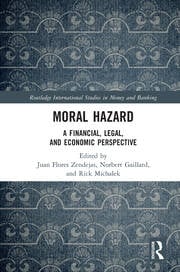
245 00|aMoral hazard :|ba financial, legal, and economic perspective /|cedited by Juan Flores Zendejas, Norbert Gaillard and Rick Michalek.
264 1|aAbingdon, Oxon ;|aNew York, NY :|bRoutledge,|c2022.
300 |a1 online resource.
336 |atext|btxt|2rdacontent
337 |acomputer|bc|2rdamedia
338 |aonline resource|bcr|2rdacarrier
490 0 |aRoutledge international studies in money and banking
520 |a"Moral Hazard is a core concept in economics. In a nutshell, moral hazard reflects the reduced incentive to protect against risk where an entity is (or believes it will be) protected from its consequences, whether through an insurance arrangement or an implicit or explicit guarantee system. It is fundamentally driven by information asymmetry, arises in all sectors of the economy, including banking, medical insurance, financial insurance, and governmental support, undermines the stability of our economic systems and has burdened taxpayers in all developed countries, resulting in significant costs to the community. Despite the seriousness and pervasiveness of moral hazard, policymakers and scholars have failed to address this issue. This book fills this gap. It covers 200 years of moral hazard: from its origins in the 19th century to the bailouts announced in the aftermath of the COVID-19 outbreak. The book is divided into three parts. Part I deals with the ethics and other fundamental issues connected to moral hazard. Part II provides historical and empirical evidence on moral hazard in international finance. It examines in turn the role of the export credit industry, the international lender of last resort, and the IMF. Finally, Part III examines specific sectors such as automobile, banking, and the US industry at large. This is the first book to provide an interdisciplinary analysis of moral hazard and explain why addressing this issue has become crucial today. As such, it will attract interest from scholars across different fields, including economists, political scientists and lawyers"--|cProvided by publisher.
588 |aOCLC-licensed vendor bibliographic record.
650 0|aMoral hazard.
650 0|aRisk.
650 7|aBUSINESS & ECONOMICS / Banks & Banking|2bisacsh
650 7|aBUSINESS & ECONOMICS / Insurance / Risk Assessment & Management|2bisacsh
650 7|aBUSINESS & ECONOMICS / Money & Monetary Policy|2bisacsh
700 1 |aFlores Zendejas, Juan Huitzilihuitl,|eeditor.
700 1 |aGaillard, Norbert,|eeditor.
700 1 |aMichalek, Rick,|eeditor.
856 40|3Taylor & Francis|uhttps://www.taylorfrancis.com/books/9781003139249
856 42|3OCLC metadata license agreement|uhttp://www.oclc.org/content/dam/oclc/forms/terms/vbrl-201703.pdf
901 |aTaylor & Francis