

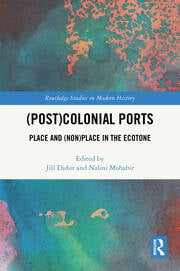
(Post)colonial ports : place and (non)place in the ecotone / edited by Jill Didur and Nalini Mohabir.
ISBN
9781040346433 epub
104034643X
9781040346372 (electronic bk. : PDF)
1040346375 (electronic bk. : PDF)
9781032427195 hbk
9781003363941 ebk
1003363946
9781032427201 pbk
104034643X
9781040346372 (electronic bk. : PDF)
1040346375 (electronic bk. : PDF)
9781032427195 hbk
9781003363941 ebk
1003363946
9781032427201 pbk
Dil Kodu
İngilizce
Yayın Bilgisi
New York : Routledge Taylor & Francis Group, 2025.
Fiziksel Niteleme
1 online resource.
Dizi
Routledge Studies in Modern History
İçindekiler Notu
Introduction: Wading into 'the Wake' Section 1: Trans-Port 1. 'Fantasy in the Hold': The Logistics of Container Architecture, Transivity, and Queer Port Urbanisms 2. The Azulejo as Symbol of Colonial Power Structures: A Deconstruction Through Sugar and Art 3. Life and Death in the Port: Petromodernity and Fossil Capital in Abdelrahman Munif's Cities of Salt 4. Lost in Transit: Behrouz Boochani's No Friend but the Mountains: Writing from Manus Prison Section 2: Passages, Partings, Terminus 5. Placing and Dis/placing the Port: Towards a Critical Literary Geography of the Caribbean Port 6. Georgetown: Ecotonal Lessons of 'Secret Histories' 7. Going Against the Flow: Customs and Apartheid Censorship 8. Pèpè Ports: Haitian Women's Labour and Resistant Mobility in Cap-Haïtien's Second-hand Clothing Trade Section 3: Environmental Insecurities and Flows of Power 9. Where the Ozama Meets the Caribbean Sea: Dominican Art and Social Advocacy in the Ecotone 10. The Frontier and the Wasteland: 21st Century Gentrification Landscapes in Saint-Henri, Montreal 11. Watery Places and Relations: The Burial of a River and Modern Wasting Practices 12. Precious Water and Urban Practices in Ondjaki's Transparent City
Özet, vb.
"This book examines the role of (post)colonial ports in creating and shaping the ecotonal, cultural, historical, material, environmental, socio-political and economic contexts in formerly colonized regions, spanning the Caribbean, Africa, North America, Europe and the Pacific. The essays assess the role that literature, visual culture, architecture, archives, and ethnography can play in enriching our understanding of the complex histories of ports and port cities. They present the relation between ports and colonial infrastructure such as immigration checkpoints, detention centers, mines, plantations, shipping containers, canals, sewers, and rivers, and their impact on human and more-than-human environments. The volume approaches (post)colonial ports through the "ecotone," a concept borrowed from geography and ecology to describe a transition zone where two biological communities meet and mix-such as a forest and a grassland-to bring attention to port (non)spaces as a hinge between their environments, communities, and colonial infrastructure. It foregrounds postcolonial and decolonial approaches to the ecotone to draw attention to the cultural, ecological, and geographical dynamics that inform the social fabric of contemporary ports and port cities in the wake of empire. This volume is aimed at scholars and postgraduates across disciplines such as literature, geography, fine arts, cultural studies, and history"-- Provided by publisher.
Konu
Harbors __ History.
Diğer Yazarlar
Veritabanı
Eseri Alıntıla
Referansları kullanmadan önce gözden geçirmeniz ve varsa gerekli düzeltmeleri yapmanız önerilir.
Dijital Kaynak
MARC Görünümü
LEADER 05516cam a22007218i 4500
001 795341
003 TR_AnAIT
005 20260123004855
006 m o d
007 cr |||||||||||
008 250318s2025 nyu ob 001 0 eng
020 |a9781040346433|qepub
020 |a104034643X
020 |a9781040346372|q(electronic bk. : PDF)
020 |a1040346375|q(electronic bk. : PDF)
020 |z9781032427195|qhbk
020 |a9781003363941|qebk
020 |a1003363946
020 |z9781032427201|qpbk
024 8 |aCIPO000194293
024 7 |a10.4324/9781003363941|2doi
035 |a(OCoLC)1510365535
035 |a(OCoLC-P)1510365535
040 |aOCoLC-P|beng|erda|cOCoLC-P
041 |aeng
049 |aTürk Tarih Kurumu Kütüphanesi
050 00|aHE551
072 7|aHBTB|2bicssc
072 7|aHBTQ|2bicssc
072 7|aHBG|2bicssc
072 7|aHBTK|2bicssc
072 7|aHBA|2bicssc
072 7|aJFC|2bicssc
072 7|aDSBH5|2bicssc
072 7|aRPC|2bicssc
072 7|aRN|2bicssc
072 7|aRGC|2bicssc
072 7|aGT|2bicssc
072 7|aHIS037030|2bisacsh
072 7|aHIS054000|2bisacsh
072 7|aHIS037000|2bisacsh
072 7|aHIS000000|2bisacsh
082 00|a387.1|223/eng/20250319
245 00|a(Post)colonial ports :|bplace and (non)place in the ecotone /|cedited by Jill Didur and Nalini Mohabir.
264 1|aNew York :|bRoutledge Taylor & Francis Group,|c2025.
300 |a1 online resource.
334 |asingle unit|bmono|0http://id.loc.gov/vocabulary/issuance/mono
336 |atext|btxt|2rdacontent
337 |acomputer|bc|2rdamedia
338 |aonline resource|bcr|2rdacarrier
353 |abibliography|bbibliography|0http://id.loc.gov/vocabulary/msupplcont/bibliography
353 |aindex|bindex|0http://id.loc.gov/vocabulary/msupplcont/index
490 1 |aRoutledge Studies in Modern History
505 0 |aIntroduction: Wading into 'the Wake' Section 1: Trans-Port 1. 'Fantasy in the Hold': The Logistics of Container Architecture, Transivity, and Queer Port Urbanisms 2. The Azulejo as Symbol of Colonial Power Structures: A Deconstruction Through Sugar and Art 3. Life and Death in the Port: Petromodernity and Fossil Capital in Abdelrahman Munif's Cities of Salt 4. Lost in Transit: Behrouz Boochani's No Friend but the Mountains: Writing from Manus Prison Section 2: Passages, Partings, Terminus 5. Placing and Dis/placing the Port: Towards a Critical Literary Geography of the Caribbean Port 6. Georgetown: Ecotonal Lessons of 'Secret Histories' 7. Going Against the Flow: Customs and Apartheid Censorship 8. Pèpè Ports: Haitian Women's Labour and Resistant Mobility in Cap-Haïtien's Second-hand Clothing Trade Section 3: Environmental Insecurities and Flows of Power 9. Where the Ozama Meets the Caribbean Sea: Dominican Art and Social Advocacy in the Ecotone 10. The Frontier and the Wasteland: 21st Century Gentrification Landscapes in Saint-Henri, Montreal 11. Watery Places and Relations: The Burial of a River and Modern Wasting Practices 12. Precious Water and Urban Practices in Ondjaki's Transparent City
520 |a"This book examines the role of (post)colonial ports in creating and shaping the ecotonal, cultural, historical, material, environmental, socio-political and economic contexts in formerly colonized regions, spanning the Caribbean, Africa, North America, Europe and the Pacific. The essays assess the role that literature, visual culture, architecture, archives, and ethnography can play in enriching our understanding of the complex histories of ports and port cities. They present the relation between ports and colonial infrastructure such as immigration checkpoints, detention centers, mines, plantations, shipping containers, canals, sewers, and rivers, and their impact on human and more-than-human environments. The volume approaches (post)colonial ports through the "ecotone," a concept borrowed from geography and ecology to describe a transition zone where two biological communities meet and mix-such as a forest and a grassland-to bring attention to port (non)spaces as a hinge between their environments, communities, and colonial infrastructure. It foregrounds postcolonial and decolonial approaches to the ecotone to draw attention to the cultural, ecological, and geographical dynamics that inform the social fabric of contemporary ports and port cities in the wake of empire. This volume is aimed at scholars and postgraduates across disciplines such as literature, geography, fine arts, cultural studies, and history"-- Provided by publisher.
588 |aOCLC-licensed vendor bibliographic record.
650 0|aHarbors|xHistory.
653 |acolonial infrastructure;port cities;ecology;decolonial approaches;immigration checkpoints
700 1 |aDidur, Jill,|d1965-|eeditor.|4http://id.loc.gov/vocabulary/relators/edt|1https://id.oclc.org/worldcat/entity/E39PCjv7vVtV3HTwX9DRbY89WC|1http://id.loc.gov/rwo/agents/no2006031495
700 1 |aMohabir, Nalini|eeditor|4http://id.loc.gov/vocabulary/relators/edt|1http://id.loc.gov/rwo/agents/no2020112264.
758 |1http://id.loc.gov/resources/instances/24091656
758 |4http://id.loc.gov/ontologies/bibframe/instanceOf|1http://id.loc.gov/resources/works/24091656
830 0|aRoutledge studies in modern history.
856 40|3Taylor & Francis|uhttps://www.taylorfrancis.com/books/9781003363941
856 42|3OCLC metadata license agreement|uhttp://www.oclc.org/content/dam/oclc/forms/terms/vbrl-201703.pdf
901 |aTaylor & Francis
001 795341
003 TR_AnAIT
005 20260123004855
006 m o d
007 cr |||||||||||
008 250318s2025 nyu ob 001 0 eng
020 |a9781040346433|qepub
020 |a104034643X
020 |a9781040346372|q(electronic bk. : PDF)
020 |a1040346375|q(electronic bk. : PDF)
020 |z9781032427195|qhbk
020 |a9781003363941|qebk
020 |a1003363946
020 |z9781032427201|qpbk
024 8 |aCIPO000194293
024 7 |a10.4324/9781003363941|2doi
035 |a(OCoLC)1510365535
035 |a(OCoLC-P)1510365535
040 |aOCoLC-P|beng|erda|cOCoLC-P
041 |aeng
049 |aTürk Tarih Kurumu Kütüphanesi
050 00|aHE551
072 7|aHBTB|2bicssc
072 7|aHBTQ|2bicssc
072 7|aHBG|2bicssc
072 7|aHBTK|2bicssc
072 7|aHBA|2bicssc
072 7|aJFC|2bicssc
072 7|aDSBH5|2bicssc
072 7|aRPC|2bicssc
072 7|aRN|2bicssc
072 7|aRGC|2bicssc
072 7|aGT|2bicssc
072 7|aHIS037030|2bisacsh
072 7|aHIS054000|2bisacsh
072 7|aHIS037000|2bisacsh
072 7|aHIS000000|2bisacsh
082 00|a387.1|223/eng/20250319
245 00|a(Post)colonial ports :|bplace and (non)place in the ecotone /|cedited by Jill Didur and Nalini Mohabir.
264 1|aNew York :|bRoutledge Taylor & Francis Group,|c2025.
300 |a1 online resource.
334 |asingle unit|bmono|0http://id.loc.gov/vocabulary/issuance/mono
336 |atext|btxt|2rdacontent
337 |acomputer|bc|2rdamedia
338 |aonline resource|bcr|2rdacarrier
353 |abibliography|bbibliography|0http://id.loc.gov/vocabulary/msupplcont/bibliography
353 |aindex|bindex|0http://id.loc.gov/vocabulary/msupplcont/index
490 1 |aRoutledge Studies in Modern History
505 0 |aIntroduction: Wading into 'the Wake' Section 1: Trans-Port 1. 'Fantasy in the Hold': The Logistics of Container Architecture, Transivity, and Queer Port Urbanisms 2. The Azulejo as Symbol of Colonial Power Structures: A Deconstruction Through Sugar and Art 3. Life and Death in the Port: Petromodernity and Fossil Capital in Abdelrahman Munif's Cities of Salt 4. Lost in Transit: Behrouz Boochani's No Friend but the Mountains: Writing from Manus Prison Section 2: Passages, Partings, Terminus 5. Placing and Dis/placing the Port: Towards a Critical Literary Geography of the Caribbean Port 6. Georgetown: Ecotonal Lessons of 'Secret Histories' 7. Going Against the Flow: Customs and Apartheid Censorship 8. Pèpè Ports: Haitian Women's Labour and Resistant Mobility in Cap-Haïtien's Second-hand Clothing Trade Section 3: Environmental Insecurities and Flows of Power 9. Where the Ozama Meets the Caribbean Sea: Dominican Art and Social Advocacy in the Ecotone 10. The Frontier and the Wasteland: 21st Century Gentrification Landscapes in Saint-Henri, Montreal 11. Watery Places and Relations: The Burial of a River and Modern Wasting Practices 12. Precious Water and Urban Practices in Ondjaki's Transparent City
520 |a"This book examines the role of (post)colonial ports in creating and shaping the ecotonal, cultural, historical, material, environmental, socio-political and economic contexts in formerly colonized regions, spanning the Caribbean, Africa, North America, Europe and the Pacific. The essays assess the role that literature, visual culture, architecture, archives, and ethnography can play in enriching our understanding of the complex histories of ports and port cities. They present the relation between ports and colonial infrastructure such as immigration checkpoints, detention centers, mines, plantations, shipping containers, canals, sewers, and rivers, and their impact on human and more-than-human environments. The volume approaches (post)colonial ports through the "ecotone," a concept borrowed from geography and ecology to describe a transition zone where two biological communities meet and mix-such as a forest and a grassland-to bring attention to port (non)spaces as a hinge between their environments, communities, and colonial infrastructure. It foregrounds postcolonial and decolonial approaches to the ecotone to draw attention to the cultural, ecological, and geographical dynamics that inform the social fabric of contemporary ports and port cities in the wake of empire. This volume is aimed at scholars and postgraduates across disciplines such as literature, geography, fine arts, cultural studies, and history"-- Provided by publisher.
588 |aOCLC-licensed vendor bibliographic record.
650 0|aHarbors|xHistory.
653 |acolonial infrastructure;port cities;ecology;decolonial approaches;immigration checkpoints
700 1 |aDidur, Jill,|d1965-|eeditor.|4http://id.loc.gov/vocabulary/relators/edt|1https://id.oclc.org/worldcat/entity/E39PCjv7vVtV3HTwX9DRbY89WC|1http://id.loc.gov/rwo/agents/no2006031495
700 1 |aMohabir, Nalini|eeditor|4http://id.loc.gov/vocabulary/relators/edt|1http://id.loc.gov/rwo/agents/no2020112264.
758 |1http://id.loc.gov/resources/instances/24091656
758 |4http://id.loc.gov/ontologies/bibframe/instanceOf|1http://id.loc.gov/resources/works/24091656
830 0|aRoutledge studies in modern history.
856 40|3Taylor & Francis|uhttps://www.taylorfrancis.com/books/9781003363941
856 42|3OCLC metadata license agreement|uhttp://www.oclc.org/content/dam/oclc/forms/terms/vbrl-201703.pdf
901 |aTaylor & Francis
Materyaller
Depodan talep edilen materyal sadece kütüphane içerisinde kullanılmaktadır.
Materyal dışarıya ödünç verilmemektedir.
Materyal dışarıya ödünç verilmemektedir.
