LEADER 03265cam a2200325Ii 4500
001 795818
003 TR_AnAIT
005 20260123005644
008 180706s2014 enkad ob 001 0 eng d
020 |a9781315816784|q(e-book : PDF)
020 |a9781317811657|q(e-book: Mobi)
020 |a9781317811664|q(e-book: ePub)
020 |z9780415739238|q(hardback)
024 7 |a10.4324/9781315816784 |2doi
035 |a(OCoLC)878113683
041 |aeng
043 |aae-----
049 |aTürk Tarih Kurumu Kütüphanesi
050 4|aHC460.5|b.O644 2014
082 04|a330.95|bO611
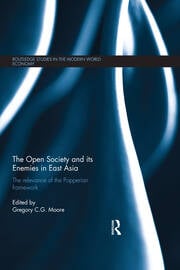
245 04|aThe Open Society and its enemies in East Asia :|bthe relevance of the Popperian framework /|cedited by Gregory G.C. Moore.
264 1|aAbingdon, Oxon ;|aNew York :|bRoutledge,|c2014.
300 |a1 online resource (xiv, 164 pages)
490 1 |aRoutledge studies in the modern world economy ;|v130
505 0 |a1. Karl Popper and the idea of an open society / Jeremy Shearmur -- 2. Karl Popper and Thailand's political crisis : the monarchy as the problem for an 'open society' / Patrick Jory -- 3. Thai populism and the middle-income trap / Peter Warr -- 4. Least free : the economic consequences of fifty years of totalitarian rule in Burma / Sean Turnell -- 5. Development and freedom in Burma / Ronald E. Findlay -- 6. The rise and robustness of economic freedom in China / Rod Tyers -- 7. Singapore : Plato's other republic? / Jeremy Shearmur -- 8. Popular despotism : an economist's explanation / William Coleman.
520 |a"The ideas contained in Karl Popper's The Open Society and Its Enemies--one of the most important tracts in political philosophy in the twentieth century--are relevant to anyone seeking to understand the recent history of the East Asian economies. Even though Popper wrote his tract to provide an explanation for both the rise and objectionable nature of totalitarian regimes in Europe in the twentieth century, many of the arguments that he advanced in this European context also explain the social, political and economic relationships that are seen in modern South Eastern Asian economies. The narrative of this book is driven by a research agenda that is inter-disciplinary in nature, since to make the link between the Popperian framework and East Asian socio-economic relationships the contributing authors needed to draw upon research fields as far apart as political philosophy and East-Asian studies. With one or two exceptions, however, nearly all of the contributing authors have a background in economics, and this background is reflected in the way that they have sought to tackle the research question. This book is, in short, an inter-disciplinary exercise undertaken from an economics perspective, and hence it may best be described as an exercise in political economy rather than pure analytical economics"--|cProvided by publisher.
600 10|aPopper, Karl R.|q(Karl Raimund),|d1902-1994.|tOpen society and its enemies.
650 0|aEconomics|xPolitical aspects|zEast Asia.
651 0|aEast Asia|xEconomic conditions.
651 0|aEast Asia|xEconomic policy.
700 1 |aMoore, Gregory G. C.
776 08|iPrint version: |z9780415739238|w(DLC) 2013045852
830 0|aRoutledge studies in the modern world economy ;|v130.
856 40|uhttps://www.taylorfrancis.com/books/9781315816784|zClick here to view.
901 |aTaylor & Francis