

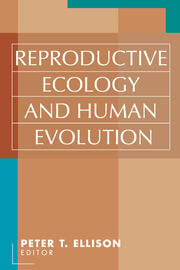
Reproductive Ecology and Human Evolution / Peter T. Ellison.
ISBN
9781351493505 (EPUB)
1351493507 (EPUB)
1315128462
9781315128467
9781351493499 (electronic bk. : Mobipocket)
1351493493 (electronic bk. : Mobipocket)
9781351493512 (electronic bk. : PDF)
1351493515 (electronic bk. : PDF)
1351493507 (EPUB)
1315128462
9781315128467
9781351493499 (electronic bk. : Mobipocket)
1351493493 (electronic bk. : Mobipocket)
9781351493512 (electronic bk. : PDF)
1351493515 (electronic bk. : PDF)
Dil Kodu
İngilizce
Basım Bildirimi
1st.
Yayın Bilgisi
Routledge, 2017.
Fiziksel Niteleme
1 online resource (478 pages)
Dizi
Evolutionary foundations of human behavior
İçindekiler Notu
PHYSIOLOGICAL CONTEXT -- Pregnancy Loss and Fecundability in Women /Darryl J. Holman and James W. Wood -- The Evolutionary and Ecological Context of Human Pregnancy /Ivy L. Pike -- Why Energy Expenditure Causes Reproductive Suppression in Women: An Evolutionary and Bioenergetic Perspective /Grazyna Jasienska -- Lactation, Energetics, and Postpartum Fecundity /Claudia R. Valeggia and Peter T. Ellison -- Reproductive Physiology of the Human Male: An Evolutionary and Life History Perspective /Richard G. Bribiescas -- ECOLOGICAL CONTEXT -- Reproductive Filtering and the Social Environment /Samuel K. Wasser and Ned J. Place -- Reproductive Ecology of Male Immune Function and Gonadal Function /Benjamin C. Campbell, William D. Lukas, and Kenneth L. Campbell -- Why Not So Great Is Still Good Enough: Flexible Responsiveness in Human Reproductive Functioning /Virginia J. Vitzthum.
Fertility Changes with the Prehistoric Transition to Agriculture: Perspectives from Reproductive Ecology and Paleodemography /Gillian R. Bentley, Richard R. Paine, and Jesper L. Boldsen -- DEVELOPMENTAL CONTEXT -- Metabolism, Maturation, and Ovarian Function /Susan F. Lipson -- Child Survival and the Modulation of Parental Investment: Physiological and Hormonal Considerations /Helen Ball and Catherine Panter-Brick -- Aging and Reproductive Senescence /Lynnette Leidy Sievert -- The Embodied Capital Theory of Human Evolution /Hillard Kaplan, Kim Hill, A. Magdelena Hurtado, and Jane Lancaster -- COMPARATIVE CONTEXT -- Strepsirrhine Reproductive Ecology /Patricia L. Whitten and Diane K. Brockman -- Reproductive Ecology of New World Monkeys /Karen B. Strier -- Reproductive Ecology of Old World Monkeys /Fred B. Bercovitch -- The Reproductive Ecology of Male Hominoids /Martin N. Muller and Richard W. Wrangham -- Female Reproductive Ecology of the Apes: Implicationsfor Human Evolution /Cheryl Knott.
Fertility Changes with the Prehistoric Transition to Agriculture: Perspectives from Reproductive Ecology and Paleodemography /Gillian R. Bentley, Richard R. Paine, and Jesper L. Boldsen -- DEVELOPMENTAL CONTEXT -- Metabolism, Maturation, and Ovarian Function /Susan F. Lipson -- Child Survival and the Modulation of Parental Investment: Physiological and Hormonal Considerations /Helen Ball and Catherine Panter-Brick -- Aging and Reproductive Senescence /Lynnette Leidy Sievert -- The Embodied Capital Theory of Human Evolution /Hillard Kaplan, Kim Hill, A. Magdelena Hurtado, and Jane Lancaster -- COMPARATIVE CONTEXT -- Strepsirrhine Reproductive Ecology /Patricia L. Whitten and Diane K. Brockman -- Reproductive Ecology of New World Monkeys /Karen B. Strier -- Reproductive Ecology of Old World Monkeys /Fred B. Bercovitch -- The Reproductive Ecology of Male Hominoids /Martin N. Muller and Richard W. Wrangham -- Female Reproductive Ecology of the Apes: Implicationsfor Human Evolution /Cheryl Knott.
Özet, vb.
The study of human reproductive ecology represents an important new development in human evolutionary biology. Its focus is on the physiology of human reproduction and evidence of adaptation, and hence the action of natural selection, in that domain. But at the same time the study of human reproductive ecology provides an important perspective on the historical process of human evolution, a lens through which we may view the forces that have shaped us as a species. In the end, all actions of natural selection can be reduced to variation in the reproductive success of individuals.Peter Ellison is one of the pioneers in the fast growing area of reproductive ecology. He has collected for this volume the research of thirty-one of the most active and influential scientists in the field. Thanks to recent noninvasive techniques, these contributors can present direct empirical data on the effect of a broad array of ecological, behavioral, and constitutional variables on the reproductive processes of humans as well as wild primates. Because biological evolution is cumulative, however, organisms in the present must be viewed as products of the selective forces of past environments. The study of adaptation thus often involves inferences about formative ecological relationships that may no longer exist, or not in the same form. Making such inferences depends on carefully weighing a broad range of evidence drawn from studies of contemporary ecological variation, comparative studies of related taxonomies, and paleontological and genetic evidence of evolutionary history. The result of this inquiry sheds light not only on the functional aspects of an organism's contemporary biology but also on its evolutionary history and the selective forces that have shaped it through time.Encompassing a range of viewpoints--controversy along with consensus--this far-ranging collection offers an indispensable guide for courses in biological anthropology, human biology, and primatology, along with
Konu
Reproduction.
Human evolution.
Human ecology.
SOCIAL SCIENCE / Anthropology / General __ bisacsh
SOCIAL SCIENCE / Anthropology / Physical __ bisacsh
Human evolution.
Human ecology.
SOCIAL SCIENCE / Anthropology / General __ bisacsh
SOCIAL SCIENCE / Anthropology / Physical __ bisacsh
Diğer Yazarlar
Veritabanı
Eseri Alıntıla
Referansları kullanmadan önce gözden geçirmeniz ve varsa gerekli düzeltmeleri yapmanız önerilir.
Dijital Kaynak
MARC Görünümü
LEADER 05661cam a2200529Mi 4500
001 795862
003 TR_AnAIT
005 20260123005726
006 m o d
007 cr |||||||||||
008 170905s2017 xx go 000 0 eng d
020 |a9781351493505|q(EPUB)
020 |a1351493507|q(EPUB)
020 |a1315128462
020 |a9781315128467
020 |a9781351493499|q(electronic bk. : Mobipocket)
020 |a1351493493|q(electronic bk. : Mobipocket)
020 |a9781351493512|q(electronic bk. : PDF)
020 |a1351493515|q(electronic bk. : PDF)
035 |a(OCoLC)1003865379
035 |a(OCoLC-P)1003865379
040 |aOCoLC-P|beng|erda|cOCoLC-P
041 |aeng
049 |aTürk Tarih Kurumu Kütüphanesi
050 4|aQP251
072 7|aSOC|x002000|2bisacsh
072 7|aSOC|x002020|2bisacsh
072 7|aJHM|2bicssc
082 04|a612.6|221
245 00|aReproductive Ecology and Human Evolution /|cPeter T. Ellison.
250 |a1st.
264 1|bRoutledge,|c2017.
300 |a1 online resource (478 pages)
336 |atext|btxt|2rdacontent
337 |acomputer|bc|2rdamedia
338 |aonline resource|bcr|2rdacarrier
490 1 |aEvolutionary foundations of human behavior
505 0 |aPHYSIOLOGICAL CONTEXT -- Pregnancy Loss and Fecundability in Women /Darryl J. Holman and James W. Wood -- The Evolutionary and Ecological Context of Human Pregnancy /Ivy L. Pike -- Why Energy Expenditure Causes Reproductive Suppression in Women: An Evolutionary and Bioenergetic Perspective /Grazyna Jasienska -- Lactation, Energetics, and Postpartum Fecundity /Claudia R. Valeggia and Peter T. Ellison -- Reproductive Physiology of the Human Male: An Evolutionary and Life History Perspective /Richard G. Bribiescas -- ECOLOGICAL CONTEXT -- Reproductive Filtering and the Social Environment /Samuel K. Wasser and Ned J. Place -- Reproductive Ecology of Male Immune Function and Gonadal Function /Benjamin C. Campbell, William D. Lukas, and Kenneth L. Campbell -- Why Not So Great Is Still Good Enough: Flexible Responsiveness in Human Reproductive Functioning /Virginia J. Vitzthum.
505 0 |aFertility Changes with the Prehistoric Transition to Agriculture: Perspectives from Reproductive Ecology and Paleodemography /Gillian R. Bentley, Richard R. Paine, and Jesper L. Boldsen -- DEVELOPMENTAL CONTEXT -- Metabolism, Maturation, and Ovarian Function /Susan F. Lipson -- Child Survival and the Modulation of Parental Investment: Physiological and Hormonal Considerations /Helen Ball and Catherine Panter-Brick -- Aging and Reproductive Senescence /Lynnette Leidy Sievert -- The Embodied Capital Theory of Human Evolution /Hillard Kaplan, Kim Hill, A. Magdelena Hurtado, and Jane Lancaster -- COMPARATIVE CONTEXT -- Strepsirrhine Reproductive Ecology /Patricia L. Whitten and Diane K. Brockman -- Reproductive Ecology of New World Monkeys /Karen B. Strier -- Reproductive Ecology of Old World Monkeys /Fred B. Bercovitch -- The Reproductive Ecology of Male Hominoids /Martin N. Muller and Richard W. Wrangham -- Female Reproductive Ecology of the Apes: Implicationsfor Human Evolution /Cheryl Knott.
520 |aThe study of human reproductive ecology represents an important new development in human evolutionary biology. Its focus is on the physiology of human reproduction and evidence of adaptation, and hence the action of natural selection, in that domain. But at the same time the study of human reproductive ecology provides an important perspective on the historical process of human evolution, a lens through which we may view the forces that have shaped us as a species. In the end, all actions of natural selection can be reduced to variation in the reproductive success of individuals.Peter Ellison is one of the pioneers in the fast growing area of reproductive ecology. He has collected for this volume the research of thirty-one of the most active and influential scientists in the field. Thanks to recent noninvasive techniques, these contributors can present direct empirical data on the effect of a broad array of ecological, behavioral, and constitutional variables on the reproductive processes of humans as well as wild primates. Because biological evolution is cumulative, however, organisms in the present must be viewed as products of the selective forces of past environments. The study of adaptation thus often involves inferences about formative ecological relationships that may no longer exist, or not in the same form. Making such inferences depends on carefully weighing a broad range of evidence drawn from studies of contemporary ecological variation, comparative studies of related taxonomies, and paleontological and genetic evidence of evolutionary history. The result of this inquiry sheds light not only on the functional aspects of an organism's contemporary biology but also on its evolutionary history and the selective forces that have shaped it through time.Encompassing a range of viewpoints--controversy along with consensus--this far-ranging collection offers an indispensable guide for courses in biological anthropology, human biology, and primatology, along with
588 |aOCLC-licensed vendor bibliographic record.
650 0|aReproduction.
650 0|aHuman evolution.
650 0|aHuman ecology.
650 7|aSOCIAL SCIENCE / Anthropology / General|2bisacsh
650 7|aSOCIAL SCIENCE / Anthropology / Physical|2bisacsh
700 1 |aEllison, Peter Thorpe,|eeditor.
856 40|3Taylor & Francis|uhttps://www.taylorfrancis.com/books/9781315128467
856 42|3OCLC metadata license agreement|uhttp://www.oclc.org/content/dam/oclc/forms/terms/vbrl-201703.pdf
901 |aTaylor & Francis
001 795862
003 TR_AnAIT
005 20260123005726
006 m o d
007 cr |||||||||||
008 170905s2017 xx go 000 0 eng d
020 |a9781351493505|q(EPUB)
020 |a1351493507|q(EPUB)
020 |a1315128462
020 |a9781315128467
020 |a9781351493499|q(electronic bk. : Mobipocket)
020 |a1351493493|q(electronic bk. : Mobipocket)
020 |a9781351493512|q(electronic bk. : PDF)
020 |a1351493515|q(electronic bk. : PDF)
035 |a(OCoLC)1003865379
035 |a(OCoLC-P)1003865379
040 |aOCoLC-P|beng|erda|cOCoLC-P
041 |aeng
049 |aTürk Tarih Kurumu Kütüphanesi
050 4|aQP251
072 7|aSOC|x002000|2bisacsh
072 7|aSOC|x002020|2bisacsh
072 7|aJHM|2bicssc
082 04|a612.6|221
245 00|aReproductive Ecology and Human Evolution /|cPeter T. Ellison.
250 |a1st.
264 1|bRoutledge,|c2017.
300 |a1 online resource (478 pages)
336 |atext|btxt|2rdacontent
337 |acomputer|bc|2rdamedia
338 |aonline resource|bcr|2rdacarrier
490 1 |aEvolutionary foundations of human behavior
505 0 |aPHYSIOLOGICAL CONTEXT -- Pregnancy Loss and Fecundability in Women /Darryl J. Holman and James W. Wood -- The Evolutionary and Ecological Context of Human Pregnancy /Ivy L. Pike -- Why Energy Expenditure Causes Reproductive Suppression in Women: An Evolutionary and Bioenergetic Perspective /Grazyna Jasienska -- Lactation, Energetics, and Postpartum Fecundity /Claudia R. Valeggia and Peter T. Ellison -- Reproductive Physiology of the Human Male: An Evolutionary and Life History Perspective /Richard G. Bribiescas -- ECOLOGICAL CONTEXT -- Reproductive Filtering and the Social Environment /Samuel K. Wasser and Ned J. Place -- Reproductive Ecology of Male Immune Function and Gonadal Function /Benjamin C. Campbell, William D. Lukas, and Kenneth L. Campbell -- Why Not So Great Is Still Good Enough: Flexible Responsiveness in Human Reproductive Functioning /Virginia J. Vitzthum.
505 0 |aFertility Changes with the Prehistoric Transition to Agriculture: Perspectives from Reproductive Ecology and Paleodemography /Gillian R. Bentley, Richard R. Paine, and Jesper L. Boldsen -- DEVELOPMENTAL CONTEXT -- Metabolism, Maturation, and Ovarian Function /Susan F. Lipson -- Child Survival and the Modulation of Parental Investment: Physiological and Hormonal Considerations /Helen Ball and Catherine Panter-Brick -- Aging and Reproductive Senescence /Lynnette Leidy Sievert -- The Embodied Capital Theory of Human Evolution /Hillard Kaplan, Kim Hill, A. Magdelena Hurtado, and Jane Lancaster -- COMPARATIVE CONTEXT -- Strepsirrhine Reproductive Ecology /Patricia L. Whitten and Diane K. Brockman -- Reproductive Ecology of New World Monkeys /Karen B. Strier -- Reproductive Ecology of Old World Monkeys /Fred B. Bercovitch -- The Reproductive Ecology of Male Hominoids /Martin N. Muller and Richard W. Wrangham -- Female Reproductive Ecology of the Apes: Implicationsfor Human Evolution /Cheryl Knott.
520 |aThe study of human reproductive ecology represents an important new development in human evolutionary biology. Its focus is on the physiology of human reproduction and evidence of adaptation, and hence the action of natural selection, in that domain. But at the same time the study of human reproductive ecology provides an important perspective on the historical process of human evolution, a lens through which we may view the forces that have shaped us as a species. In the end, all actions of natural selection can be reduced to variation in the reproductive success of individuals.Peter Ellison is one of the pioneers in the fast growing area of reproductive ecology. He has collected for this volume the research of thirty-one of the most active and influential scientists in the field. Thanks to recent noninvasive techniques, these contributors can present direct empirical data on the effect of a broad array of ecological, behavioral, and constitutional variables on the reproductive processes of humans as well as wild primates. Because biological evolution is cumulative, however, organisms in the present must be viewed as products of the selective forces of past environments. The study of adaptation thus often involves inferences about formative ecological relationships that may no longer exist, or not in the same form. Making such inferences depends on carefully weighing a broad range of evidence drawn from studies of contemporary ecological variation, comparative studies of related taxonomies, and paleontological and genetic evidence of evolutionary history. The result of this inquiry sheds light not only on the functional aspects of an organism's contemporary biology but also on its evolutionary history and the selective forces that have shaped it through time.Encompassing a range of viewpoints--controversy along with consensus--this far-ranging collection offers an indispensable guide for courses in biological anthropology, human biology, and primatology, along with
588 |aOCLC-licensed vendor bibliographic record.
650 0|aReproduction.
650 0|aHuman evolution.
650 0|aHuman ecology.
650 7|aSOCIAL SCIENCE / Anthropology / General|2bisacsh
650 7|aSOCIAL SCIENCE / Anthropology / Physical|2bisacsh
700 1 |aEllison, Peter Thorpe,|eeditor.
856 40|3Taylor & Francis|uhttps://www.taylorfrancis.com/books/9781315128467
856 42|3OCLC metadata license agreement|uhttp://www.oclc.org/content/dam/oclc/forms/terms/vbrl-201703.pdf
901 |aTaylor & Francis
Materyaller
Depodan talep edilen materyal sadece kütüphane içerisinde kullanılmaktadır.
Materyal dışarıya ödünç verilmemektedir.
Materyal dışarıya ödünç verilmemektedir.
