

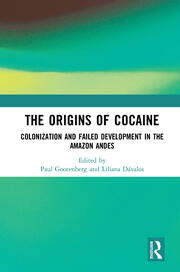
The origins of cocaine : colonization and failed development in the amazon andes / edited by Paul Gootenberg and Liliana M. Dávalos.
Erişim Adresi
ISBN
9780429951749 (e-book: PDF) (e-book : PDF)
Dil Kodu
İngilizce
Basım Bildirimi
First edition.
Yayın Bilgisi
Boca Raton, FL : Routledge, an imprint of Taylor and Francis, 2018.
Fiziksel Niteleme
1 online resource (190 pages) : 39 illustrations
İçindekiler Notu
chapter 1 Introduction: Orphans of development: the unanticipated rise of illicit coca in the Amazon Andes, 1950–1990 / PAUL GOOTENBERG -- chapter 2 The ghosts of development past: deforestation and coca in western Amazonia / LILIANA M. DÁVALOS -- chapter 3 Ideas of modernization and territorial transformation: the case of the Upper Huallaga Valley of Peru / MARITZA PAREDES -- chapter 4 Creating coca frontiers and cocaleros in Chapare: Bolivia, 1940 to 1990 / ANDREW C. MILLINGTON -- chapter 5 Economic development policies in Colombia (1960s–1990s) and the turn to coca in the Andes Amazon / JENNIFER S. HOLMES -- chapter 6 The making of a coca frontier: the case of Ariari, Colombia / MARÍA-CLARA TORRES -- chapter 7 Epilogue: will governments confront coca cultivation, or its causes? / ADAM ISACSON.
Özet, vb.
In the 1960s, the governments of Colombia, Peru, and Bolivia launched agricultural settlement programs in each country’s vast Amazonian frontier lowlands. Two decades later, these exact same zones had transformed into the centers of the illicit cocaine boom of the Americas. Drawing on concepts from both history and anthropology, The Origins of Cocaine explores how three countries with divergent different mid-century political trajectories ended up with parallel outcomes in illicit frontier economies and cocalero cultures. Bringing together transnational, national, and local analyses, the volume provides an in-depth examination of the deep origins of drug economics in the Americas. As the first substantial study on the shift from agrarian colonization to narcotization, The Origins of Cocaine will appeal to scholars and postgraduate students of Latin American history, anthropology, globalization, development and environmental studies.
Konu
Cocaine industry __ Peru __ History.
Cocaine industry.
Drug traffic __ Peru.
Drug traffic.
BUSINESS & ECONOMICS / Industries / General. __ bisacsh
Cocaine industry.
Drug traffic __ Peru.
Drug traffic.
BUSINESS & ECONOMICS / Industries / General. __ bisacsh
Diğer Yazarlar
Kurum Adı
Veritabanı
