LEADER 03583cam a2200337Ii 4500
001 796361
003 TR_AnAIT
005 20260123010627
008 180706s2018 enk ob 000 0 eng d
020 |a9781315177229|q(e-book : PDF)
020 |a9781351709699|q(e-book: Mobi)
020 |z9781138038714|q(hardback)
020 |z9781138038721|q(paperback)
024 7 |a10.4324/9781315177229 |2doi
035 |a(OCoLC)993959662
041 |aeng
043 |ae------
049 |aTürk Tarih Kurumu Kütüphanesi
050 4|aCB203|b.D37 2018
082 04|a303.482094|bD337
100 1 |aDelanty, Gerard,|eauthor.
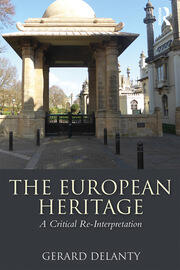
245 14|aThe European heritage :|ba critical re-interpretation /|cby Gerard Delanty.
264 1|aMilton Park, Abingdon, Oxon ;|aNew York, NY :|bRoutledge,|c2018.
300 |a1 online resource
504 |aIncludes bibliographical references.
505 0 |aIntroduction: The past in the present, part I : making sense of a transnational world -- Transnationalism in historical and sociological analysis -- Modernity and the plurality of Europe -- Europe unbounded : critical cosmopolitanism and the problem of Eurocentrism, part II : encounters, routes, transfers and entanglements -- Cultural encounters and European civilisation -- Europe and modernity as reference cultures -- The making of European society and the entanglement of capitalism and democracy -- The legacy of European integration : Europe in the world, part III : looking to the future -- Solidarity as a political legacy for Europe today -- Making sense of Brexit : a divided nation in a divided Europe -- Europe beyond the crisis : re-inventing the European heritage I : making sense of a transnational world.
520 |a"Gerard Delanty offers a critical interpretation of the European heritage today in light of recent developments in the human and social sciences, and in view of a mood of crisis in Europe that compels us to re-think the European past. One of the main insights informing this book is that a transnational and global perspective on European history can reorient the European heritage in a direction that offers a more viable way for contemporary Europe to articulate an intercultural identity in keeping with the emerging shape of Europe, and with its own often acknowledged past. He argues that the European heritage is based less on a universalistic conception of culture than on a plurality of interconnecting narratives, and the inclusion of new voices and is being forged in new spaces of critical dialogue. Such a perspective opens up new directions for scholarship and public debate on heritage that are guided by critical cosmopolitan considerations that highlight contention, resistances, competition and dissonance. He argues that the specificity of the European dimension of culture is in the entanglement of many cultures rather than in an original culture. The cultures of Europe are not separated but have been shaped in close interaction with each other and with the non-European world. Nations are not therefore unique, exceptional or fundamentally different from each other. The outcome of such intermingling is a multiplicity of ideas of Europe that serve as shared cultural reference points"--Provided by publisher.
650 0|aGroup identity|zEurope.
650 0|aCultural pluralism|zEurope.
650 0|aTransnationalism|xSocial aspects|zEurope.
650 0|aGlobalization|xSocial aspects|zEurope.
651 0|aEurope|xCivilization|xPhilosophy.
651 0|aEurope|xHistory|xPhilosophy.
776 08|iPrint version: |z9781138038714|w(DLC) 2017017280
856 40|uhttps://www.taylorfrancis.com/books/9781315177229|zClick here to view.
901 |aTaylor & Francis