LEADER 03248cam a2200433Ii 4500
001 796531
003 TR_AnAIT
005 20260123010851
008 180706s2017 xx o 000 0 eng d
020 |a9781315637822|q(e-book : PDF)
020 |a9781317269175|q(e-book: Mobi)
020 |z9781138638402|q(hardback)
024 7 |a10.4324/9781315637822 |2doi
035 |a(OCoLC)994343223
040 |aFlBoTFG|cFlBoTFG|erda
041 |aeng
049 |aTürk Tarih Kurumu Kütüphanesi
050 4|aQA13|b.D539 2017
082 04|a510.71073
100 1 |aDiaz, Jennifer D.,|eauthor.
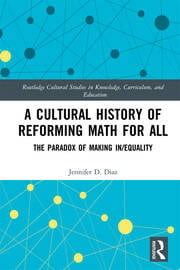
245 12|aA Cultural History of Reforming Math for All :|bThe Paradox of Making In/equality /|cJennifer D. Diaz.
250 |aFirst edition.
264 1|aLondon :|bTaylor and Francis,|c2017.
300 |a1 online resource (144 pages)
336 |atext|2rdacontent
337 |acomputer|2rdamedia
338 |aonline resource|2rdacarrier
490 0 |aRoutledge Cultural Studies in Knowledge, Curriculum, and Education
505 00|tchapter 1 Introduction -- |tThe Study of School Mathematics Is Not About Mathematics /|r Jennifer D. Diaz -- |tchapter 2 The Cultural Politics of School Math -- |tThe Problem of In/Equality in the Equal Sign /|r Jennifer D. Diaz -- |tchapter 3 Postwar Planning, Reforming Mathematics, and the Cultural (Re)Production of Children /|r Jennifer D. Diaz -- |tchapter 4 Creating the Great Society -- |tMaking New Math, the Mathematical Citizen, and the Problem of Disadvantage /|r Jennifer D. Diaz -- |tchapter 5 Civil Rights, Fears of Failure, and the Motivation of Basic Skills -- |tFabricating the Mathematically Dis/Abled Individual /|r Jennifer D. Diaz -- |tchapter 6 Planning the 21st-Century Future -- |tStandardizing Mathematical Kinds of People to Manage Risk /|r Jennifer D. Diaz -- |tchapter 7 The Alchemy of School Subjects and the Im/Possibilities of Reform /|r Jennifer D. Diaz.
520 2 |a"While many accept that math is a universal, culturally indifferent subject in school, this book demonstrates that this is anything but true. Building off of a historically conscious understanding of school reform, Diaz makes the case that the language of mathematics, and the symbols through which it is communicated, is not merely about the alleged cultural indifference of mathematical thinking; rather, mathematical teaching relates to historical, cultural, political, and social understandings of equality that order who the child is and should be. Focusing on elementary math for all education reforms in America since the mid-twentieth century, Diaz offers an alternative way of thinking about the subject that recognizes the historical making of contemporary notions of inequality and difference. "--Provided by publisher.
650 0|aCurriculum change.
650 0|aEducational equalization.
650 0|aMathematics|xStudy and teaching.
650 0|aUnited States.
650 04|aEducation Policy & Politics
650 04|aHistory of Education
650 04|aMathematics
650 04|aSocial & Cultural History
650 04|aSociology of Education
650 07|aEDUCATION / Curricula|2bisacsh
650 07|aEDUCATION / Elementary|2bisacsh
776 08|iPrint version: |z9781138638402|w(DLC) 2017017486
856 40|uhttps://www.taylorfrancis.com/books/9781315637822|zClick here to view.
901 |aTaylor & Francis