

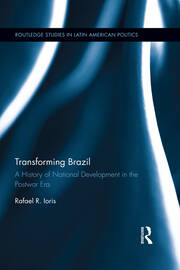
Transforming Brazil : a history of national development in the postwar era / Rafael R. Ioris.
Erişim Adresi
ISBN
9781315772974 (e-book : PDF)
9781317680017 (e-book: Mobi)
9781317680024 (e-book: ePub)
9781138776890 (hardback)
9781138651500 (paperback)
9781317680017 (e-book: Mobi)
9781317680024 (e-book: ePub)
9781138776890 (hardback)
9781138651500 (paperback)
Dil Kodu
İngilizce
Yazar
Yayın Bilgisi
New York : Routledge, 2014.
Fiziksel Niteleme
1 online resource (x, 266 pages)
Dizi
Routledge studies in Latin American politics ; 10
Bibliyografi, vb. Notu
Includes bibliographical references (pages [227]-249) and index.
İçindekiler Notu
1. State planning and national development : political devices for turbulent times -- 2. Development in a global perspective and Brazil's international search for a new historical course -- 3. The targets plan and the Council of Development : the technocratic path to development promotion -- 4. The Higher Institute of Brazilian Studies versus the technocrats : development as state-led social inclusion or as market-based policies -- 5. Economic prosperity, consumerism and the business world : development as market-led growth -- 6. National development and industrial labor : metalworkers, Carestia, and the basis for a popular path of development.
Özet, vb.
"In this book, Rafael R. Ioris critically revisits the postwar context in Brazil to reexamine traditional questions and notions pertaining to the nature of Latin America's political culture and institutions. It was in this period that the region lived some of its most intense and successful experiences of fast economic growth, which was paradoxically marred by heightened ideological divisions, political disruptions, and the emergence of widespread authoritarian rule. Combining original sources of political, diplomatic, intellectual, cultural, and labor histories, Ioris provides a comprehensive history of the fruitful debates concerning national development in postwar Brazil, a time when the so-called country of the future faced one of its best moments for consolidating political democracy and economic prosperity. He argues that traditional views on political instability have been excessively grounded on an institutional focus, which should be replaced by in-depth analysis of events on the ground. In so doing, he reveals that as national development meant very different things to multiple different social segments of the Brazilian society, no unified support could have been provided to the democratically elected political regime when things rapidly became socially and politically divisive early in the 1960s"-- Provided by publisher.
Konu
Economic development __ Brazil __ History __ 20th century.
Political culture __ Brazil __ History __ 20th century.
Brazil __ Economic conditions __ 1945-1964.
Brazil __ Economic policy __ 20th century.
Brazil __ Politics and government __ 1945-1954.
Brazil __ Politics and government __ 1954-1964.
Political culture __ Brazil __ History __ 20th century.
Brazil __ Economic conditions __ 1945-1964.
Brazil __ Economic policy __ 20th century.
Brazil __ Politics and government __ 1945-1954.
Brazil __ Politics and government __ 1954-1964.
Veritabanı
