LEADER 03864cam a2200457Ii 4500
001 796634
003 TR_AnAIT
005 20260123011009
008 180706s2014 nyuab ob 001 0 eng d
020 |a9781315852140|q(e-book : PDF)
020 |a9781317917793|q(e-book: Mobi)
020 |a9781317917809|q(e-book: ePub)
020 |z9780415727570|q(hardback)
020 |z9781138643321|q(paperback)
024 7 |a10.4324/9781315852140 |2doi
035 |a(OCoLC)864787757
040 |aFlBoTFG|cFlBoTFG|erda
041 1 |aeng|hpor
041 |aeng
043 |aa-ja---
049 |aTürk Tarih Kurumu Kütüphanesi
050 4|aDS822.2|b.F6613 2014
082 04|a952.024|bF929
100 1 |aFrois, Luis,|d-1597.,|eauthor.
240 10|aTratado em que se contem muito susinta- e abreviadamente algumas contradicoes e derencas de custumes entre a gente de Europa e esta provincia de Japao.|lEnglish
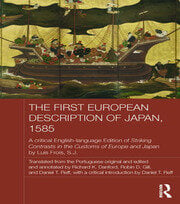
245 14|aThe first European description of Japan, 1585 :|ba critical English-language edition of striking contrasts in the customs of Europe and Japan /|cby Luis Frois, S.J. ; translated from the Portuguese original and edited and annotated by Richard K.
264 1|aNew York :|bRoutledge,|c2014.
300 |a1 online resource (xi, 299 pages)
336 |atext|2rdacontent
337 |acomputer|2rdamedia
338 |aonline resource|2rdacarrier
490 1 |aJapan anthropology workshop series ;|vVolume 25
505 0 |a1. Concerning men, their persons, and their clothing -- 2. Women, their persons and customs -- 3. Concerning children and their customs -- 4. Concerning the bonzes and their customs -- 5. Concerning [Buddhist] temples, images and things pertaining to the practice of their religion -- 6. The Japanese way of eating and drinking -- 7. Japanese offensive and defensive weapons and warfare -- 8. Concerning horses -- 9. Diseases, doctors, and medicines -- 10. Japanese writing and their books, paper, ink, and letters -- 11. Houses, construction, gardens and fruits -- 12. Ships, seafaring and dogus -- 13. Japanese plays, farces, dances, singing and musical instruments -- 14. Various and extraordinary things that do not fit neatly in the preceding chapters.
520 |a"In 1585, at the height of the Jesuit missionary activity in Japan, which was begun by Francis Xavier in 1549, Luis Frois, a long-time missionary in Japan, drafted the earliest systematic comparison of Western and Japanese cultures. This book constitutes the first critical English-language edition of the 1585 work, the original of which was discovered in the Royal Academy of History in Madrid after the Second World War. The book provides a translation of the text, which is not a continuous narrative, but rather more than 600 distichs or brief couplets on subjects such as gender, child rearing, religion, medicine, eating, horses, writing, ships and seafaring, architecture, and music and drama. In addition, the book includes a substantive introduction and other editorial material to explain the background and also to make comparisons with present-day Japanese life. Overall, the book represents an important primary source for understanding a particularly challenging period of Japanese history and culture. "--|cProvided by publisher.
651 0|aEurope|xCivilization|y16th century|vEarly works to 1800.
651 0|aEurope|xSocial life and customs|y16th century|vEarly works to 1800.
651 0|aJapan|xCivilization|y1568-1600|vEarly works to 1800.
651 0|aJapan|xDescription and travel|vEarly works to 1800.
651 0|aJapan|xSocial life and customs|y1185-1600|vEarly works to 1800.
700 1 |aDanford, Richard K.,|d1964-
700 1 |aGill, Robin,|d1951-
700 1 |aReff, Daniel T.,|d1949-
776 08|iPrint version: |z9780415727570|w(DLC) 2013034113
830 0|aJapan anthropology workshop series ;|vVolume 25.
856 40|uhttps://www.taylorfrancis.com/books/9781315852140|zClick here to view.
901 |aTaylor & Francis