LEADER 03794cam a2200349Ii 4500
001 796678
003 TR_AnAIT
005 20260123011049
008 180706s20172012flu b ob 001 0 eng d
020 |a9781351192231|q(e-book : PDF)
020 |a9781351192200|q(e-book: Mobi)
020 |z9781907975462|q(paperback)
024 7 |a10.4324/9781351192231 |2doi
035 |a(OCoLC)1011107848
040 |aFlBoTFG|cFlBoTFG|erda
041 |aeng
049 |aTürk Tarih Kurumu Kütüphanesi
050 4|aDA880.S25
072 7|aSOC|x003000 |2bisacsh
082 04|a936.1135|223
100 1 |aBarrowman, Rachel C.,|eauthor.
245 14|aThe chapel and burial ground on St Ninian's Isle, Shetland: excavations past and present|nVolume 32 :|bexcavations past and present /|cby Rachel C. Barrowman.
250 |aFirst edition.
264 1|aBoca Raton, FL :|bRoutledge, an imprint of Taylor and Francis,|c[2017].
264 4|c©2012
300 |a1 online resource (256 pages)
336 |atext|2rdacontent
337 |acomputer|2rdamedia
338 |aonline resource|2rdacarrier
505 00|tchapter 1 Introduction and background -- chapter 2 An ogham-inscribed slab from St Ninian's Isle, found in 1876 (by Katherine Forsyth) -- chapter 3 An assessment of the 1955 to 1959 excavations -- chapter 4 Excavations to the south of the chapel in 1999 and 2000 -- chapter 5 Discussion -- chapter Appendix 1. Finds in the Shetland Museum from O'Dell's excavations in 1958-59 -- chapter Appendix 2. Features excavated in 1958 and 1959 with the corresponding finds labels and find from the Small Collection, Shetland Museum -- chapter Appendix 3. CoarsepotteryheldintheShetlandMuseum (Small collection). A19.1998 and A21.2000 -- chapter Appendix 4. St Ninians Isle, Shetland 1999-2000. Context descriptions -- chapter Appendix 5. Finds from the 19992000 excavations by phase, context and small find number -- chapter 1999 2000 excavations -- chapter 1999 2000 excavations by phase, context and small find number -- chapter Appendix 8. The TIC chromatogram of SF 329 -- chapter Appendix 9. Element and quantification codes used in fish bone identification -- chapter Abbreviations.
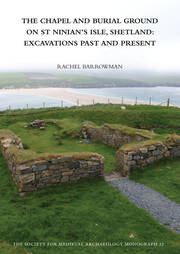
520 3 |a"This volume is the definitive account of the excavation which led to the discovery of the magnificent hoard of 28 pieces of Pictish silverware on St Ninian's Isle, Shetland in 1958. It includes a reassessment of the original archives and finds, including an ogham stone found on the site in 1876 and a fantastic collection of glass beads, as well as several new small-scale excavations on the site of the chapel and its burial ground. Taken together, this work reveals a long sequence of settlement beginning in the Iron Age. The first church was built on the site in the 8th century, and accompanied by a long cist cemetery with cross-incised stones and shrine sculpture. The church may have continued in use into the 9th or 10th centuries, and the recent work has confirmed that the famous hoard was buried into its floor. There was a degree of continuity between the pre-Christian and Christian burials, with evidence that the site was a special place for burial before the advent of Christianity. The report describes these burials in detail, ending the story sometime between the 11th and end of the 12th centuries, when an adult male who had died a violent death was moved to be buried on the site. Thereafter the site was inundated with wind-blown sand. A new chapel with an accompanying long cist cemetery was then built above the earlier church, and a chancel was added later. The associated graveyard continued in use until around 1840, long after the building was demolished."
650 0|aAntiquities.
650 0|aPicts.
710 2 |aTaylor and Francis.
776 08|iPrint version: |z9781907975462
856 40|uhttps://www.taylorfrancis.com/books/9781351192231|zClick here to view.
901 |aTaylor & Francis