

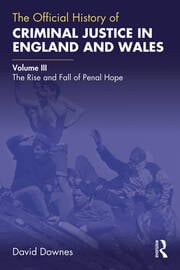
The official history of criminal justice in England and Wales. Volume III, The rise and fall of penal hope / David Downes.
ISBN
9781003129271 (ebook)
1003129277
9781000373615 (electronic bk. : PDF)
1000373614 (electronic bk. : PDF)
9781000373653 (electronic bk. : EPUB)
1000373657 (electronic bk. : EPUB)
9780367653958 (hardback)
1003129277
9781000373615 (electronic bk. : PDF)
1000373614 (electronic bk. : PDF)
9781000373653 (electronic bk. : EPUB)
1000373657 (electronic bk. : EPUB)
9780367653958 (hardback)
Dil Kodu
İngilizce
Yazar
Basım Bildirimi
1 Edition.
Yayın Bilgisi
New York : Routldege, 2021.
Fiziksel Niteleme
1 online resource.
Dizi
Whitehall histories: government official history series
Özet, vb.
"Volume III of The Official History of Criminal Justice in England and Wales draws on archival sources and individual accounts to offer a history of penal policymaking in England and Wales between 1959 and 1997. The book studies the changes underlying penal policymaking in the period, from a belief in the rehabilitative potential of imprisonment to a reaffirmation in 1993 that 'Prison Works' as a deterrent to crime. A need to curb the rising prison population initially focussed on developing alternatives to prison and a new system of parole; however, their relative ineffectiveness led to sentencing becoming the key to penal reform. A slackening of faith in rehabilitation led to pressure for greater emphasis on humane containment and the rebalancing of security, order and justice in prison regimes. Thus, 1991 was the climactic year for what became largely unfulfilled hopes for lasting penal reform. Escapes, riots and prison occupations were prime catalysts for changes, often highly contentious, in penal policymaking. Notably, there was no simple equation between political party, minister and policy choice. Both Labour and Conservative governments had distinctly liberal Home Secretaries and, after 1992, both parties took a more punitive approach. This book will be of much interest to students of criminology and British history, politics and law"-- Provided by publisher.
Konu
Justice, Administration of __ England __ History.
Justice, Administration of __ Wales __ History.
LAW / General __ bisacsh
POLITICAL SCIENCE / Political Freedom & Security / Civil Rights __ bisacsh
Justice, Administration of __ Wales __ History.
LAW / General __ bisacsh
POLITICAL SCIENCE / Political Freedom & Security / Civil Rights __ bisacsh
Veritabanı
