LEADER 03771cam a22005538i 4500
001 797216
003 TR_AnAIT
005 20260123011957
006 m o d
007 cr |||||||||||
008 250104s2025 enk ob 001 0 eng
020 |a9781003600831|q(ebook)
020 |a1003600832|q(ebook)
020 |a9781040325674|q(electronic bk. : EPUB)
020 |a104032567X|q(electronic bk. : EPUB)
020 |a9781040325667|q(electronic bk. : PDF)
020 |a1040325661|q(electronic bk. : PDF)
020 |z9781032435190|q(hardback)
020 |z9781032988276|q(paperback)
024 7 |a10.4324/9781003600831|2doi
035 |a(OCoLC)1484693855
035 |a(OCoLC-P)1484693855
040 |aOCoLC-P|beng|erda|cOCoLC-P
041 |aeng
049 |aTürk Tarih Kurumu Kütüphanesi
050 00|aBL1138.26
072 7|aSOC|x032000|2bisacsh
072 7|aLIT|x000000|2bisacsh
072 7|aSOC|x064000|2bisacsh
072 7|a1F|2bicssc
082 00|a294.5/923046|223/eng/20250220
100 1 |aSinha, Seema,|eauthor.
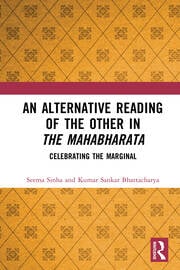
245 13|aAn alternative reading of the other in the Mahabharata :|bcelebrating the marginal /|cSeema Sinha and Kumar Sankar Bhattacharya.
264 1|aAbingdon, Oxon ;|aNew York, NY :|bRoutledge,|c2025.
300 |a1 online resource
336 |atext|btxt|2rdacontent
337 |acomputer|bc|2rdamedia
338 |aonline resource|bcr|2rdacarrier
505 0 |aThe Crocodilian females of the 'Nari Tirtha' -- Renuka and Ahalya who lusted after other men -- The wild women of the Madrakas and the Balhikas -- Ulupi, the warrior princess of the nagas -- Chitrangada, the androgynous queen of Manipur -- Hidimba, the demon-bride of Bhima -- Yuvanashwa, the pregnant king -- Shikhandi, the transgender prince of Panchala -- Yogini Sulabha who challenged King Janaka -- Vidula, the firebrand queen mother -- Kunti : the mother of Karna -- Krishnaa' Draupadi : 'in her will rise many fears!'.
520 |a"This book studies gender, sexuality, and representation in The Mahabharata. Drawing on Feminist theory, Queer theory and Deconstructivist theory, it revisits the epic as a saga of agency, empowerment, and subversion, and examines how it gives the gendered marginal - the women and the queer - a voice. The authors argue that in a fluid text like The Mahabharata, there is ample scope for contradiction and conformation, as well as conflict and resolution, which gives the marginal an opportunity to document resistance. They analyse the stories of Draupadi, Kunti, Renuka, Ulupi, and Hidimba within an anti-patriarchal, non-normative, post-modern theoretical framework. They also examine liminal figures like Shikhandi, Yuvanashwa, Sudyumna and Bhangashwan, who are uniquely placed in conversation involving queer space, marginalization, and resistance. An important addition to the study of Indian epics, this book will be indispensable for scholars and researchers of cultural studies, subaltern studies, Indian literature, English literature, gender studies, sexuality studies, queer studies, women's studies, exclusion studies, and postcolonial studies"--|cProvided by publisher.
588 |aOCLC-licensed vendor bibliographic record.
630 00|aMahābhārata|xCriticism, interpretation, etc.
650 0|aWomen in literature.
650 0|aSexual minorities in literature.
650 0|aFeminist criticism.
650 0|aSanskrit literature|xHistory and criticism.
650 7|aSOCIAL SCIENCE / Gender Studies|2bisacsh
650 7|aLITERARY CRITICISM / General|2bisacsh
700 1 |aBhattacharya, Kumar Sankar,|eauthor.
856 40|3Taylor & Francis|uhttps://www.taylorfrancis.com/books/9781003600831
856 42|3OCLC metadata license agreement|uhttp://www.oclc.org/content/dam/oclc/forms/terms/vbrl-201703.pdf
901 |aTaylor & Francis