LEADER 03428cam a22006018i 4500
001 797233
003 TR_AnAIT
005 20260123012023
006 m o d
007 cr |||||||||||
008 250716s2026 enka o 000 0 eng d
020 |a9781040437728|qePub ebook
020 |a1040437729
020 |a9781003649786|q(electronic bk.)
020 |a1003649785|q(electronic bk.)
020 |a9781040437698|q(electronic bk. : PDF)
020 |a1040437699|q(electronic bk. : PDF)
024 8 |aCIPO000265191
024 7 |a10.4324/9781003649786|2doi
035 |a(OCoLC)1533766728
035 |a(OCoLC-P)1533766728
040 |aOCoLC-P|beng|erda|epn|cOCoLC-P
041 |aeng
049 |aTürk Tarih Kurumu Kütüphanesi
050 4|aHQ1181.A35
072 7|aGPS|2bicssc
072 7|aSOC008010|2bisacsh
072 7|aGTB|2bicssc
072 7|aJP|2bicssc
072 7|aHPS|2bicssc
072 7|aJHM|2bicssc
072 7|aJHB|2bicssc
072 7|aJFFK|2bicssc
072 7|aJFSJ1|2bicssc
072 7|aSOC032000|2bisacsh
082 04|a305.42096|223/eng/20250917
100 1 |aOjong, Vivian,|eauthor.
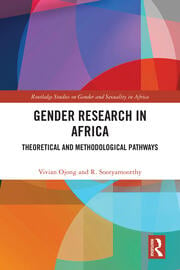
245 10|aGender research in Africa :|btheoretical and methodological pathways /|cVivian Ojong, R. Sooryamoorthy.
264 1|aLondon :|bRoutledge,|c2026.
300 |a1 online resource (226 pages) :|billustrations (black and white).
336 |atext|2rdacontent
336 |astill image|2rdacontent
337 |acomputer|2rdamedia
338 |aonline resource|2rdacarrier
490 0 |aRoutledge studies on gender and sexuality in Africa
520 |aThis book considers how methodologies, theories and analytical frameworks from gender studies can be applied to African societies' cultural, social, and historical contexts.The book advocates for the importance of feminist research practices which highlight women and their lived experiences within a gendered world in Africa. Gender studies has grown in prominence over recent decades, rooted in an awareness that gender is no longer just an issue in the margins but core to the analysis of the interaction of power, identity, and social relations in the world. This book considers how the field can evolve further in a postcolonial context, integrating indigenous and local knowledge systems and practices. Covering how gender is contested in African settings, the book outlines how researchers can approach the ways in which social and racial categories, class, ethnicity, and socioeconomic status intersect to produce gender-based violence.Overall, this book shows how gender-sensitive methodologies can help researchers to gain deeper insights into discrimination, inequalities, and gender-based violence, and thus contribute to better-adapted social and legal reforms.
588 |aOCLC-licensed vendor bibliographic record.
650 0|aWomen's studies|zAfrica|xMethodology.
650 0|aSex role|xResearch|zAfrica|xMethodology.
650 0|aSexual minorities|xResearch|zAfrica|xMethodology.
650 0|aWomen|xSocial conditions|xResearch|zAfrica|xMethodology.
650 0|aFeminist theory|zAfrica.
700 1 |aSooryamoorthy, R.,|eauthor.|1https://id.oclc.org/worldcat/entity/E39PCjw7tD8pkc3bpFrVgPJybb|1https://isni.org/isni/0000000053268781
856 40|3Taylor & Francis|uhttps://www.taylorfrancis.com/books/9781003649786
856 42|3OCLC metadata license agreement|uhttp://www.oclc.org/content/dam/oclc/forms/terms/vbrl-201703.pdf
901 |aTaylor & Francis