LEADER 03926cam a2200577Ii 4500
001 797445
003 TR_AnAIT
005 20260123012344
008 180706s2018 xx a o 000 0 eng d
020 |a9781315561479|q(e-book : PDF)
020 |a9781317201441|q(e-book: Mobi)
020 |a9781317201458|q(e-book: ePub)
020 |z9781138674172|q(hardback)
024 7 |a10.4324/9781315561479 |2doi
035 |a(OCoLC)1027756486
040 |aFlBoTFG|cFlBoTFG|erda
041 |aeng
049 |aTürk Tarih Kurumu Kütüphanesi
050 4|aHN39.M8|bN466 2018
072 7|aPOL041000|2bisacsh
072 7|aREL000000|2bisacsh
072 7|aSOC042000|2bisacsh
100 1 |aNgo, May,|eauthor.
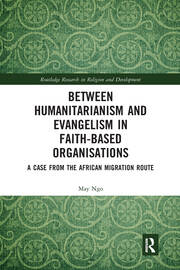
245 10|aBetween Humanitarianism and Evangelism in Faith-based Organisations :|bA Case from the African Migration Route /|cMay Ngo.
250 |aFirst edition.
264 1|aLondon :|bTaylor and Francis,|c2018.
300 |a1 online resource
336 |atext|2rdacontent
337 |acomputer|2rdamedia
338 |aonline resource|2rdacarrier
490 0 |aRoutledge Research in Religion and Development
505 00|tchapter 1 Introduction /|r May Ngo -- |tchapter 2 Reflections on an ethnography -- |tFaith and migration /|r May Ngo -- |tchapter 3 Transnational faith communities -- |tImprovisation and invention /|r May Ngo -- |tchapter 4 External relations -- |t“If God is for us, who can attack us?” /|r May Ngo -- |tchapter 5 Organisational mission and identity -- |t“They are one” /|r May Ngo -- |tchapter 6 Internal dynamics -- |tStaff precariousness and staff misconduct /|r May Ngo -- |tchapter 7 Conclusion /|r May Ngo.
520 2 |a"Religion has always played an important, if often contested, role in the public domain. This book focuses on how faith-based organisations (FBOs) interact with the public sphere, showing how faith-based actors are themselves shaped by wider processes and global forces such as globalisation, migration, foreign policy and neoliberal markets.Focusing on a case study of an FBO in Morocco which gives aid to sub-Saharan African irregular migrants, the book reveals some of the challenges the organisation faces as it tries to negotiate at once local, national and international contexts through their particular Christian values. This book contends that the contradictions, tensions and ambiguities that arise are primarily a result of the organisation having to negotiate a normative global secular liberalism which requires a strict demarcation between religion and politics, and religion and the secular. Faith-based actors, particularly within humanitarianism, have to constantly navigate this divide and in examining the question of how religious values translate into humanitarian and development practices, categories such as religion, the secular and politics and the boundaries between them will need to be interrogated. This book explores the diversity and complexity of the work of FBOs and will be of great interest to students and researchers working at the intersections of humanitarianism and development studies, politics and religion."--Provided by publisher.
650 0|aChild development.
650 0|aEconomic development|xPolitical aspects.
650 0|aEconomic development|xStudy and teaching.
650 0|aEconomic development.
650 0|aEconomic geography.
650 0|aEmigration and immigration.
650 0|aEthnology.
650 0|aInternational agencies.
650 0|aMethodology.
650 0|aReligion.
650 0|aSocialization.
650 04|aDevelopment - Soc Sci
650 04|aDevelopment Geography
650 04|aDevelopment Policy
650 04|aDevelopment Studies
650 04|aEthnography & Methodology
650 04|aInternational Organizations
650 04|aMigration & Diaspora
650 04|aPolitics & Development
650 04|aReligion
776 08|iPrint version: |z9781138674172
856 40|uhttps://www.taylorfrancis.com/books/9781315561479|zClick here to view.
901 |aTaylor & Francis