

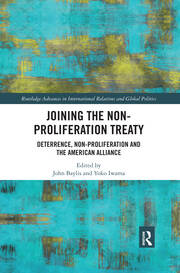
Joining the non-proliferation treaty : deterrence, non-proliferation and the American alliance / edited by John Baylis and Yoko Iwama.
Erişim Adresi
ISBN
9780203702802 (e-book : PDF)
Dil Kodu
İngilizce
Basım Bildirimi
First edition.
Yayın Bilgisi
Boca Raton, FL : Routledge, an imprint of Taylor and Francis, 2018.
Fiziksel Niteleme
1 online resource (224 pages) : 1 illustrations.
Dizi
Interdisciplinary Research in Gender
İçindekiler Notu
chapter Introduction / YOKO IWAMA -- chapter 1 Nuclear proliferation and conceptions of national interest: the US case, 1960–1967 / WILLIAM BURR -- chapter 2 After the hegemony of the “Atoms for Peace” programme: multilateral non-proliferation policy under the Nixon and Ford administrations / SHINSUKE TOMOTSUGU -- chapter 3 Britain, the deterrence/non-proliferation dilemma and the NPT / JOHN BAYLIS -- chapter 4 France’s relationship to the NATO defense strategy and the Western non-proliferation regime / DOMINIQUE MONGIN -- chapter 5 Problem solved? The German Nuclear Question and West Germany’s accession to the NPT (1967–1975) / ANDREAS LUTSCH -- chapter 6 Canada’s affair with nuclear weapons: building, debating, acquiring, retiring / DON MUNTON -- chapter 7 Japan’s nuclear disarmament and non-proliferation diplomacy during the Cold War: the myth and reality of a nuclear bombed country / AKIRA KUROSAKI -- chapter 8 The Japanese Ministry of Foreign Affairs and the decision to join the Non-Proliferation Treaty / YOKO IWAMA -- chapter 9 In the shadow of China’s bomb: nuclear consultation, commitment reconfirmation, and missile defence in the US-Japan alliance, 1962–1968 / SHINGO YOSHIDA.
Özet, vb.
What were the calculations made by the US and its major allies in the 1960s when they faced the signing of the Non-Proliferation Treaty (NPT)? These were all states with the technological and financial capabilities to develop and possess nuclear weapons should they wish to do so. In the end, only the United Kingdom and France became nuclear weapon states. Eventually, all of them joined the non-proliferation regime.Leading American, British, Canadian, French, German and Japanese scholars consider key questions that faced the signatories to the NPT:How imperative was nuclear deterrence in facing the perceived threat to their country?How reliable did they think the US extended deterrence was, and how costly would an independent deterrent be both financially and politically?Was there a regional option?How much future was there in the civilian nuclear energy sector for their country and what role would the NPT play in this area?What capabilities needed to be preserved for the country’s future and how could this be made compatible with the NPT?What were the determining factors of deciding whether to join the NPT?.
Konu
Treaty on the Non-proliferation of Nuclear Weapons __ (1968 June 12)
Nuclear nonproliferation __ Government policy __ United States.
Nuclear nonproliferation __ International cooperation.
Nuclear nonproliferation.
POLITICAL SCIENCE / Government / International. __ bisacsh
POLITICAL SCIENCE / International Relations / General. __ bisacsh
Nuclear arms control __ International cooperation __ History.
Nuclear energy __ Law and legislation __ History.
Nuclear nonproliferation __ International cooperation __ History.
Nuclear nonproliferation __ Government policy __ United States.
Nuclear nonproliferation __ International cooperation.
Nuclear nonproliferation.
POLITICAL SCIENCE / Government / International. __ bisacsh
POLITICAL SCIENCE / International Relations / General. __ bisacsh
Nuclear arms control __ International cooperation __ History.
Nuclear energy __ Law and legislation __ History.
Nuclear nonproliferation __ International cooperation __ History.
Diğer Yazarlar
Kurum Adı
Veritabanı
Eseri Alıntıla
Referansları kullanmadan önce gözden geçirmeniz ve varsa gerekli düzeltmeleri yapmanız önerilir.
Dijital Kaynak
MARC Görünümü
LEADER 04280nam a2200433Ii 4500
001 797697
003 TR_AnAIT
005 20260123012716
008 180813s2018 fluab ob 001 0 eng d
020 |a9780203702802|q(e-book : PDF)
035 |a(OCoLC)1044733578
040 |aFlBoTFG|cFlBoTFG|erda
041 |aeng
049 |aTürk Tarih Kurumu Kütüphanesi
050 4|aKZ5670|b.J65 2018
072 7|aSOC|x008000 |2bisacsh
072 7|aJPSD |2bicscc
082 04|a327.1/747|223
245 00|aJoining the non-proliferation treaty :|bdeterrence, non-proliferation and the American alliance /|cedited by John Baylis and Yoko Iwama.
250 |aFirst edition.
264 1|aBoca Raton, FL :|bRoutledge, an imprint of Taylor and Francis,|c2018.
300 |a1 online resource (224 pages) :|b1 illustrations.
336 |atext|2rdacontent
337 |acomputer|2rdamedia
338 |aonline resource|2rdacarrier
490 1 |aInterdisciplinary Research in Gender
505 00|tchapter Introduction /|rYOKO IWAMA -- |tchapter 1 Nuclear proliferation and conceptions of national interest: the US case, 1960–1967 /|rWILLIAM BURR -- |tchapter 2 After the hegemony of the “Atoms for Peace” programme: multilateral non-proliferation policy under the Nixon and Ford administrations /|rSHINSUKE TOMOTSUGU -- |tchapter 3 Britain, the deterrence/non-proliferation dilemma and the NPT /|rJOHN BAYLIS -- |tchapter 4 France’s relationship to the NATO defense strategy and the Western non-proliferation regime /|rDOMINIQUE MONGIN -- |tchapter 5 Problem solved? The German Nuclear Question and West Germany’s accession to the NPT (1967–1975) /|rANDREAS LUTSCH -- |tchapter 6 Canada’s affair with nuclear weapons: building, debating, acquiring, retiring /|rDON MUNTON -- |tchapter 7 Japan’s nuclear disarmament and non-proliferation diplomacy during the Cold War: the myth and reality of a nuclear bombed country /|rAKIRA KUROSAKI -- |tchapter 8 The Japanese Ministry of Foreign Affairs and the decision to join the Non-Proliferation Treaty /|rYOKO IWAMA -- |tchapter 9 In the shadow of China’s bomb: nuclear consultation, commitment reconfirmation, and missile defence in the US-Japan alliance, 1962–1968 /|rSHINGO YOSHIDA.
520 3 |aWhat were the calculations made by the US and its major allies in the 1960s when they faced the signing of the Non-Proliferation Treaty (NPT)? These were all states with the technological and financial capabilities to develop and possess nuclear weapons should they wish to do so. In the end, only the United Kingdom and France became nuclear weapon states. Eventually, all of them joined the non-proliferation regime.Leading American, British, Canadian, French, German and Japanese scholars consider key questions that faced the signatories to the NPT:How imperative was nuclear deterrence in facing the perceived threat to their country?How reliable did they think the US extended deterrence was, and how costly would an independent deterrent be both financially and politically?Was there a regional option?How much future was there in the civilian nuclear energy sector for their country and what role would the NPT play in this area?What capabilities needed to be preserved for the country’s future and how could this be made compatible with the NPT?What were the determining factors of deciding whether to join the NPT?.
630 00|aTreaty on the Non-proliferation of Nuclear Weapons|d(1968 June 12)
650 0|aNuclear nonproliferation|xGovernment policy|zUnited States.
650 0|aNuclear nonproliferation|xInternational cooperation.
650 0|aNuclear nonproliferation.
650 7|aPOLITICAL SCIENCE / Government / International.|2bisacsh
650 7|aPOLITICAL SCIENCE / International Relations / General.|2bisacsh
650 0|aNuclear arms control|xInternational cooperation|xHistory.
650 0|aNuclear energy|xLaw and legislation|xHistory.
650 0|aNuclear nonproliferation|xInternational cooperation|xHistory.
700 1 |aBaylis, John,|d1946-|eeditor.
700 1 |aIwama, Yōko,|d1964-|eeditor.,|eeditor.
710 2 |aTaylor and Francis.
776 08|iPrint version: |z9781138571457|w(DLC) 2018014781
830 0|aRoutledge advances in international relations and global politics.
856 40|uhttps://www.taylorfrancis.com/books/9780203702802|zClick here to view.
901 |aTaylor & Francis
001 797697
003 TR_AnAIT
005 20260123012716
008 180813s2018 fluab ob 001 0 eng d
020 |a9780203702802|q(e-book : PDF)
035 |a(OCoLC)1044733578
040 |aFlBoTFG|cFlBoTFG|erda
041 |aeng
049 |aTürk Tarih Kurumu Kütüphanesi
050 4|aKZ5670|b.J65 2018
072 7|aSOC|x008000 |2bisacsh
072 7|aJPSD |2bicscc
082 04|a327.1/747|223
245 00|aJoining the non-proliferation treaty :|bdeterrence, non-proliferation and the American alliance /|cedited by John Baylis and Yoko Iwama.
250 |aFirst edition.
264 1|aBoca Raton, FL :|bRoutledge, an imprint of Taylor and Francis,|c2018.
300 |a1 online resource (224 pages) :|b1 illustrations.
336 |atext|2rdacontent
337 |acomputer|2rdamedia
338 |aonline resource|2rdacarrier
490 1 |aInterdisciplinary Research in Gender
505 00|tchapter Introduction /|rYOKO IWAMA -- |tchapter 1 Nuclear proliferation and conceptions of national interest: the US case, 1960–1967 /|rWILLIAM BURR -- |tchapter 2 After the hegemony of the “Atoms for Peace” programme: multilateral non-proliferation policy under the Nixon and Ford administrations /|rSHINSUKE TOMOTSUGU -- |tchapter 3 Britain, the deterrence/non-proliferation dilemma and the NPT /|rJOHN BAYLIS -- |tchapter 4 France’s relationship to the NATO defense strategy and the Western non-proliferation regime /|rDOMINIQUE MONGIN -- |tchapter 5 Problem solved? The German Nuclear Question and West Germany’s accession to the NPT (1967–1975) /|rANDREAS LUTSCH -- |tchapter 6 Canada’s affair with nuclear weapons: building, debating, acquiring, retiring /|rDON MUNTON -- |tchapter 7 Japan’s nuclear disarmament and non-proliferation diplomacy during the Cold War: the myth and reality of a nuclear bombed country /|rAKIRA KUROSAKI -- |tchapter 8 The Japanese Ministry of Foreign Affairs and the decision to join the Non-Proliferation Treaty /|rYOKO IWAMA -- |tchapter 9 In the shadow of China’s bomb: nuclear consultation, commitment reconfirmation, and missile defence in the US-Japan alliance, 1962–1968 /|rSHINGO YOSHIDA.
520 3 |aWhat were the calculations made by the US and its major allies in the 1960s when they faced the signing of the Non-Proliferation Treaty (NPT)? These were all states with the technological and financial capabilities to develop and possess nuclear weapons should they wish to do so. In the end, only the United Kingdom and France became nuclear weapon states. Eventually, all of them joined the non-proliferation regime.Leading American, British, Canadian, French, German and Japanese scholars consider key questions that faced the signatories to the NPT:How imperative was nuclear deterrence in facing the perceived threat to their country?How reliable did they think the US extended deterrence was, and how costly would an independent deterrent be both financially and politically?Was there a regional option?How much future was there in the civilian nuclear energy sector for their country and what role would the NPT play in this area?What capabilities needed to be preserved for the country’s future and how could this be made compatible with the NPT?What were the determining factors of deciding whether to join the NPT?.
630 00|aTreaty on the Non-proliferation of Nuclear Weapons|d(1968 June 12)
650 0|aNuclear nonproliferation|xGovernment policy|zUnited States.
650 0|aNuclear nonproliferation|xInternational cooperation.
650 0|aNuclear nonproliferation.
650 7|aPOLITICAL SCIENCE / Government / International.|2bisacsh
650 7|aPOLITICAL SCIENCE / International Relations / General.|2bisacsh
650 0|aNuclear arms control|xInternational cooperation|xHistory.
650 0|aNuclear energy|xLaw and legislation|xHistory.
650 0|aNuclear nonproliferation|xInternational cooperation|xHistory.
700 1 |aBaylis, John,|d1946-|eeditor.
700 1 |aIwama, Yōko,|d1964-|eeditor.,|eeditor.
710 2 |aTaylor and Francis.
776 08|iPrint version: |z9781138571457|w(DLC) 2018014781
830 0|aRoutledge advances in international relations and global politics.
856 40|uhttps://www.taylorfrancis.com/books/9780203702802|zClick here to view.
901 |aTaylor & Francis
Materyaller
Depodan talep edilen materyal sadece kütüphane içerisinde kullanılmaktadır.
Materyal dışarıya ödünç verilmemektedir.
Materyal dışarıya ödünç verilmemektedir.
