

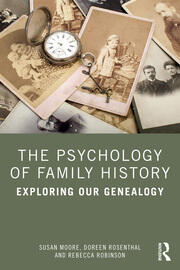
The psychology of family history : exploring our genealogy / Susan Moore, Doreen Rosenthal and Rebecca Robinson.
ISBN
9781000196429 (ePub ebook)
1000196429 (ePub ebook)
9781000196412 (Mobipocket ebook)
1000196410 (Mobipocket ebook)
9781003011576 (ebook)
1003011578 (ebook)
9781000196405 (electronic bk. : PDF)
1000196402 (electronic bk. : PDF)
0367820420
9780367820428
9780367820411 (hbk.)
1000196429 (ePub ebook)
9781000196412 (Mobipocket ebook)
1000196410 (Mobipocket ebook)
9781003011576 (ebook)
1003011578 (ebook)
9781000196405 (electronic bk. : PDF)
1000196402 (electronic bk. : PDF)
0367820420
9780367820428
9780367820411 (hbk.)
Dil Kodu
İngilizce
Yazar
Basım Bildirimi
1st edition.
Yayın Bilgisi
London : Routledge, 2021.
Fiziksel Niteleme
1 online resource.
İçindekiler Notu
Cover -- Endorsement -- Half Title -- Title Page -- Copyright Page -- Table of contents -- Boxes -- Acknowledgements -- Chapter 1 Family history: Passion and popularity -- Genealogy vs. family history -- A brief history of family history -- The process of family history -- Is family history real history? -- Our own research: motives and profiles of family historians -- Chapter 2 Spiritual and religious underpinnings of genealogy -- Ancestor veneration: from mystic mediators to blessed bloodlines -- Genealogies in the Hebrew Bible: who begat whom? -- Churches and record-keeping
Genealogy and religion: a match made in heaven or hell? -- Chapter 3 Identity: Who do I think I am? -- What is identity? -- How does family history influence identity? -- Anchoring -- Reworking on the basis of new information -- Connecting with your tribe or clan -- Shaping and enriching the life narrative -- Making meaning as an imperative for older age groups -- Success and self-perception -- Exploring the self via family history -- Chapter 4 Biological realities: Who am I genetically? -- Adoptees searching for their roots -- Who searches and why -- Inter-country adoption
Family formation using assisted reproductive technologies -- Donor conception -- Surrogacy -- Where to next for the family historian? -- Chapter 5 Beyond the self: Altruistic and intergenerational motives -- Generativity and altruism -- What our family historians said -- Helping others practically -- Helping others psychologically -- Promoting family cohesion and relationships: intergenerational narratives -- Leaving or continuing a legacy -- Acknowledging the past/honouring the ancestors -- Oversharing? -- Finally ... -- Chapter 6 Family history as therapy -- Personal healing -- Managing grief
'Forgiving' the past/breaking maladaptive patterns -- Life review -- Family communication and resilience -- Personal growth -- Some therapeutic techniques using family history approaches -- Genograms -- Autobiographical and biographical writing -- Structured interviews/facilitated reminiscence -- Chapter 7 The genealogical detective: Cognitive motives for family history research -- Family history detective work in fiction and non-fiction -- The thrill of the chase -- Genealogy as an intellectual challenge and a learning opportunity -- Cognitive challenge and happiness
Chapter 8 Health: What are my inherited health risks? -- Sources of information -- 'It runs in the family' -- Genetic testing -- Ethnic variation -- To test or not to test? -- Who do I tell? -- Implications of online 'direct to consumer' (DTC) genetic testing -- Chapter 9 Ethical dilemmas: What should I do now? -- Sensitivity -- Privacy -- Informed consent -- Who owns the research? -- Access to data: expectations of availability and accuracy -- Ethical considerations with minority communities -- Chapter 10 Conclusion: Family historians and their future challenges -- References -- Index
Genealogy and religion: a match made in heaven or hell? -- Chapter 3 Identity: Who do I think I am? -- What is identity? -- How does family history influence identity? -- Anchoring -- Reworking on the basis of new information -- Connecting with your tribe or clan -- Shaping and enriching the life narrative -- Making meaning as an imperative for older age groups -- Success and self-perception -- Exploring the self via family history -- Chapter 4 Biological realities: Who am I genetically? -- Adoptees searching for their roots -- Who searches and why -- Inter-country adoption
Family formation using assisted reproductive technologies -- Donor conception -- Surrogacy -- Where to next for the family historian? -- Chapter 5 Beyond the self: Altruistic and intergenerational motives -- Generativity and altruism -- What our family historians said -- Helping others practically -- Helping others psychologically -- Promoting family cohesion and relationships: intergenerational narratives -- Leaving or continuing a legacy -- Acknowledging the past/honouring the ancestors -- Oversharing? -- Finally ... -- Chapter 6 Family history as therapy -- Personal healing -- Managing grief
'Forgiving' the past/breaking maladaptive patterns -- Life review -- Family communication and resilience -- Personal growth -- Some therapeutic techniques using family history approaches -- Genograms -- Autobiographical and biographical writing -- Structured interviews/facilitated reminiscence -- Chapter 7 The genealogical detective: Cognitive motives for family history research -- Family history detective work in fiction and non-fiction -- The thrill of the chase -- Genealogy as an intellectual challenge and a learning opportunity -- Cognitive challenge and happiness
Chapter 8 Health: What are my inherited health risks? -- Sources of information -- 'It runs in the family' -- Genetic testing -- Ethnic variation -- To test or not to test? -- Who do I tell? -- Implications of online 'direct to consumer' (DTC) genetic testing -- Chapter 9 Ethical dilemmas: What should I do now? -- Sensitivity -- Privacy -- Informed consent -- Who owns the research? -- Access to data: expectations of availability and accuracy -- Ethical considerations with minority communities -- Chapter 10 Conclusion: Family historians and their future challenges -- References -- Index
Özet, vb.
This important book examines the motives that drive family historians and explores whether those who research their ancestral pedigrees have distinct personalities, demographics or family characteristics. It describes genealogists' experiences as they chart their family trees including their insights, dilemmas and the fascinating, sometimes disturbing and often surprising, outcomes of their searches. Drawing on theory and research from psychology and other humanities disciplines, as well as from the authors' extensive survey data collected from over 800 amateur genealogists, the authors present the experiences of family historians, including personal insights, relationship changes, mental health benefits and ethical dilemmas. The book emphasises the motivation behind this exploration, including the need to acknowledge and tell ancestral stories, the spiritual and health-related aspects of genealogical research, the addictiveness of the detective work, the lifelong learning opportunities and the passionate desire to find lost relatives. With its focus on the role of family history in shaping personal identity and contemporary culture, this is fascinating reading for anyone studying genealogy and family history, professional genealogists and those researching their own history.
Konu
Genealogy.
Genealogists __ Psychology.
PSYCHOLOGY / General __ bisacsh
Genealogists __ Psychology.
PSYCHOLOGY / General __ bisacsh
Diğer Yazarlar
Veritabanı
Eseri Alıntıla
Referansları kullanmadan önce gözden geçirmeniz ve varsa gerekli düzeltmeleri yapmanız önerilir.
Dijital Kaynak
MARC Görünümü
LEADER 06199cam a2200601Ki 4500
001 797871
003 TR_AnAIT
005 20260123012956
006 m o d
007 cr |||||||||||
008 200620s2021 enk gob 000 0 eng d
020 |a9781000196429|q(ePub ebook)
020 |a1000196429|q(ePub ebook)
020 |a9781000196412|q(Mobipocket ebook)
020 |a1000196410|q(Mobipocket ebook)
020 |a9781003011576|q(ebook)
020 |a1003011578|q(ebook)
020 |a9781000196405|q(electronic bk. : PDF)
020 |a1000196402|q(electronic bk. : PDF)
020 |z0367820420
020 |z9780367820428
020 |z9780367820411 (hbk.)
024 7 |a10.4324/9781003011576|2doi
035 |a(OCoLC)1196197582|z(OCoLC)1192309338|z(OCoLC)1193125924
035 |a(OCoLC-P)1196197582
040 |aOCoLC-P|beng|erda|cOCoLC-P
041 |aeng
049 |aTürk Tarih Kurumu Kütüphanesi
050 4|aCS16
072 7|aPSY|x000000|2bisacsh
072 7|aJMH|2bicssc
082 04|a929.1|223
100 1 |aMoore, Susan,|eauthor.
245 14|aThe psychology of family history :|bexploring our genealogy /|cSusan Moore, Doreen Rosenthal and Rebecca Robinson.
250 |a1st edition.
264 1|aLondon :|bRoutledge,|c2021.
300 |a1 online resource.
336 |atext|2rdacontent
336 |astill image|2rdacontent
337 |acomputer|2rdamedia
338 |aonline resource|2rdacarrier
505 0 |aCover -- Endorsement -- Half Title -- Title Page -- Copyright Page -- Table of contents -- Boxes -- Acknowledgements -- Chapter 1 Family history: Passion and popularity -- Genealogy vs. family history -- A brief history of family history -- The process of family history -- Is family history real history? -- Our own research: motives and profiles of family historians -- Chapter 2 Spiritual and religious underpinnings of genealogy -- Ancestor veneration: from mystic mediators to blessed bloodlines -- Genealogies in the Hebrew Bible: who begat whom? -- Churches and record-keeping
505 8 |aGenealogy and religion: a match made in heaven or hell? -- Chapter 3 Identity: Who do I think I am? -- What is identity? -- How does family history influence identity? -- Anchoring -- Reworking on the basis of new information -- Connecting with your tribe or clan -- Shaping and enriching the life narrative -- Making meaning as an imperative for older age groups -- Success and self-perception -- Exploring the self via family history -- Chapter 4 Biological realities: Who am I genetically? -- Adoptees searching for their roots -- Who searches and why -- Inter-country adoption
505 8 |aFamily formation using assisted reproductive technologies -- Donor conception -- Surrogacy -- Where to next for the family historian? -- Chapter 5 Beyond the self: Altruistic and intergenerational motives -- Generativity and altruism -- What our family historians said -- Helping others practically -- Helping others psychologically -- Promoting family cohesion and relationships: intergenerational narratives -- Leaving or continuing a legacy -- Acknowledging the past/honouring the ancestors -- Oversharing? -- Finally ... -- Chapter 6 Family history as therapy -- Personal healing -- Managing grief
505 8 |a'Forgiving' the past/breaking maladaptive patterns -- Life review -- Family communication and resilience -- Personal growth -- Some therapeutic techniques using family history approaches -- Genograms -- Autobiographical and biographical writing -- Structured interviews/facilitated reminiscence -- Chapter 7 The genealogical detective: Cognitive motives for family history research -- Family history detective work in fiction and non-fiction -- The thrill of the chase -- Genealogy as an intellectual challenge and a learning opportunity -- Cognitive challenge and happiness
505 8 |aChapter 8 Health: What are my inherited health risks? -- Sources of information -- 'It runs in the family' -- Genetic testing -- Ethnic variation -- To test or not to test? -- Who do I tell? -- Implications of online 'direct to consumer' (DTC) genetic testing -- Chapter 9 Ethical dilemmas: What should I do now? -- Sensitivity -- Privacy -- Informed consent -- Who owns the research? -- Access to data: expectations of availability and accuracy -- Ethical considerations with minority communities -- Chapter 10 Conclusion: Family historians and their future challenges -- References -- Index
520 |aThis important book examines the motives that drive family historians and explores whether those who research their ancestral pedigrees have distinct personalities, demographics or family characteristics. It describes genealogists' experiences as they chart their family trees including their insights, dilemmas and the fascinating, sometimes disturbing and often surprising, outcomes of their searches. Drawing on theory and research from psychology and other humanities disciplines, as well as from the authors' extensive survey data collected from over 800 amateur genealogists, the authors present the experiences of family historians, including personal insights, relationship changes, mental health benefits and ethical dilemmas. The book emphasises the motivation behind this exploration, including the need to acknowledge and tell ancestral stories, the spiritual and health-related aspects of genealogical research, the addictiveness of the detective work, the lifelong learning opportunities and the passionate desire to find lost relatives. With its focus on the role of family history in shaping personal identity and contemporary culture, this is fascinating reading for anyone studying genealogy and family history, professional genealogists and those researching their own history.
588 |aOCLC-licensed vendor bibliographic record.
650 0|aGenealogy.
650 0|aGenealogists|xPsychology.
650 7|aPSYCHOLOGY / General|2bisacsh
700 1 |aRosenthal, Doreen,|d1938-|eauthor.
700 1 |aRobinson, Rebecca,|eauthor.
856 40|3Taylor & Francis|uhttps://www.taylorfrancis.com/books/9781003011576
856 42|3OCLC metadata license agreement|uhttp://www.oclc.org/content/dam/oclc/forms/terms/vbrl-201703.pdf
901 |aTaylor & Francis
001 797871
003 TR_AnAIT
005 20260123012956
006 m o d
007 cr |||||||||||
008 200620s2021 enk gob 000 0 eng d
020 |a9781000196429|q(ePub ebook)
020 |a1000196429|q(ePub ebook)
020 |a9781000196412|q(Mobipocket ebook)
020 |a1000196410|q(Mobipocket ebook)
020 |a9781003011576|q(ebook)
020 |a1003011578|q(ebook)
020 |a9781000196405|q(electronic bk. : PDF)
020 |a1000196402|q(electronic bk. : PDF)
020 |z0367820420
020 |z9780367820428
020 |z9780367820411 (hbk.)
024 7 |a10.4324/9781003011576|2doi
035 |a(OCoLC)1196197582|z(OCoLC)1192309338|z(OCoLC)1193125924
035 |a(OCoLC-P)1196197582
040 |aOCoLC-P|beng|erda|cOCoLC-P
041 |aeng
049 |aTürk Tarih Kurumu Kütüphanesi
050 4|aCS16
072 7|aPSY|x000000|2bisacsh
072 7|aJMH|2bicssc
082 04|a929.1|223
100 1 |aMoore, Susan,|eauthor.
245 14|aThe psychology of family history :|bexploring our genealogy /|cSusan Moore, Doreen Rosenthal and Rebecca Robinson.
250 |a1st edition.
264 1|aLondon :|bRoutledge,|c2021.
300 |a1 online resource.
336 |atext|2rdacontent
336 |astill image|2rdacontent
337 |acomputer|2rdamedia
338 |aonline resource|2rdacarrier
505 0 |aCover -- Endorsement -- Half Title -- Title Page -- Copyright Page -- Table of contents -- Boxes -- Acknowledgements -- Chapter 1 Family history: Passion and popularity -- Genealogy vs. family history -- A brief history of family history -- The process of family history -- Is family history real history? -- Our own research: motives and profiles of family historians -- Chapter 2 Spiritual and religious underpinnings of genealogy -- Ancestor veneration: from mystic mediators to blessed bloodlines -- Genealogies in the Hebrew Bible: who begat whom? -- Churches and record-keeping
505 8 |aGenealogy and religion: a match made in heaven or hell? -- Chapter 3 Identity: Who do I think I am? -- What is identity? -- How does family history influence identity? -- Anchoring -- Reworking on the basis of new information -- Connecting with your tribe or clan -- Shaping and enriching the life narrative -- Making meaning as an imperative for older age groups -- Success and self-perception -- Exploring the self via family history -- Chapter 4 Biological realities: Who am I genetically? -- Adoptees searching for their roots -- Who searches and why -- Inter-country adoption
505 8 |aFamily formation using assisted reproductive technologies -- Donor conception -- Surrogacy -- Where to next for the family historian? -- Chapter 5 Beyond the self: Altruistic and intergenerational motives -- Generativity and altruism -- What our family historians said -- Helping others practically -- Helping others psychologically -- Promoting family cohesion and relationships: intergenerational narratives -- Leaving or continuing a legacy -- Acknowledging the past/honouring the ancestors -- Oversharing? -- Finally ... -- Chapter 6 Family history as therapy -- Personal healing -- Managing grief
505 8 |a'Forgiving' the past/breaking maladaptive patterns -- Life review -- Family communication and resilience -- Personal growth -- Some therapeutic techniques using family history approaches -- Genograms -- Autobiographical and biographical writing -- Structured interviews/facilitated reminiscence -- Chapter 7 The genealogical detective: Cognitive motives for family history research -- Family history detective work in fiction and non-fiction -- The thrill of the chase -- Genealogy as an intellectual challenge and a learning opportunity -- Cognitive challenge and happiness
505 8 |aChapter 8 Health: What are my inherited health risks? -- Sources of information -- 'It runs in the family' -- Genetic testing -- Ethnic variation -- To test or not to test? -- Who do I tell? -- Implications of online 'direct to consumer' (DTC) genetic testing -- Chapter 9 Ethical dilemmas: What should I do now? -- Sensitivity -- Privacy -- Informed consent -- Who owns the research? -- Access to data: expectations of availability and accuracy -- Ethical considerations with minority communities -- Chapter 10 Conclusion: Family historians and their future challenges -- References -- Index
520 |aThis important book examines the motives that drive family historians and explores whether those who research their ancestral pedigrees have distinct personalities, demographics or family characteristics. It describes genealogists' experiences as they chart their family trees including their insights, dilemmas and the fascinating, sometimes disturbing and often surprising, outcomes of their searches. Drawing on theory and research from psychology and other humanities disciplines, as well as from the authors' extensive survey data collected from over 800 amateur genealogists, the authors present the experiences of family historians, including personal insights, relationship changes, mental health benefits and ethical dilemmas. The book emphasises the motivation behind this exploration, including the need to acknowledge and tell ancestral stories, the spiritual and health-related aspects of genealogical research, the addictiveness of the detective work, the lifelong learning opportunities and the passionate desire to find lost relatives. With its focus on the role of family history in shaping personal identity and contemporary culture, this is fascinating reading for anyone studying genealogy and family history, professional genealogists and those researching their own history.
588 |aOCLC-licensed vendor bibliographic record.
650 0|aGenealogy.
650 0|aGenealogists|xPsychology.
650 7|aPSYCHOLOGY / General|2bisacsh
700 1 |aRosenthal, Doreen,|d1938-|eauthor.
700 1 |aRobinson, Rebecca,|eauthor.
856 40|3Taylor & Francis|uhttps://www.taylorfrancis.com/books/9781003011576
856 42|3OCLC metadata license agreement|uhttp://www.oclc.org/content/dam/oclc/forms/terms/vbrl-201703.pdf
901 |aTaylor & Francis
Materyaller
Depodan talep edilen materyal sadece kütüphane içerisinde kullanılmaktadır.
Materyal dışarıya ödünç verilmemektedir.
Materyal dışarıya ödünç verilmemektedir.
