LEADER 04149cam a22006138i 4500
001 797886
003 TR_AnAIT
005 20260123013013
006 m d u
007 cr |||||||||||
008 201028s2021 enk ob 001 0 eng
020 |a9781003036937|q(ebook)
020 |a1003036937
020 |a9781000375008|q(ePub ebook)
020 |a1000375005
020 |a9781000374971|q(PDF ebook)
020 |a1000374971
020 |z9780367478551|q(hardback)
024 7 |a10.4324/9781003036937|2doi
035 |a(OCoLC)1224043111
035 |a(OCoLC-P)1224043111
040 |aOCoLC-P|beng|erda|cOCoLC-P
041 |aeng
049 |aTürk Tarih Kurumu Kütüphanesi
050 00|aJZ6369
072 7|aHIS|x026000|2bisacsh
072 7|aLAW|x000000|2bisacsh
072 7|aLAW|x013000|2bisacsh
072 7|aLB|2bicssc
082 00|a341.5/84|223
100 1 |aGozzi, Gustavo,|d1947-|eauthor.
240 10|aUmano, non umano.|lEnglish
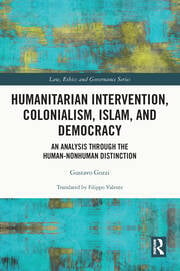
245 10|aHumanitarian intervention, colonialism, Islam, and democracy :|ban analysis through the human-nonhuman distinction /|cGustavo Gozzi ; translated by Filippo Valente.
264 1|aMilton Park, Abingdon, Oxon ;|aNew York, NY :|bRoutledge,|c2021.
300 |a1 online resource.
336 |atext|btxt|2rdacontent
337 |acomputer|bn|2rdamedia
338 |aonline resource|bnc|2rdacarrier
490 0 |aLaw, ethics and governance
505 0 |aThe origins of humanitarian intervention -- Civilization and power : developing the colonial paradigm -- Deconstructing the concepts of humanity and human nature -- The responsibility to protect, humanitarian intervention, and neocolonial policies -- Anticolonial nationalism and Arab nationalism -- The system of Arab states and the persistence of traditional social structures -- Colonial law and the formation of the nation-state -- Democracy in Islam and Western democracy : convergences and divergences -- Tunisia and Egypt : two constitutional models -- The Arab springs : an analysis of its roots and causes -- Democratization and development in the Arab countries of the Mediterranean area.
520 |a"This book offers a critical analysis of the European colonial heritage in the Arab countries and highlights the way its legacy is still with us today, informing the current state of relations between Europe and the formerly colonized states. The work analyses the fraught relationship between the Western powers and the Arab countries that have been subject to their colonial rule. It does so by looking at this relationship from two vantage points. On the one hand is that of humanitarian intervention-a paradigm under which colonial rule coexisted alongside "humanitarian" policies pursued on the dual assumption that the colonized were "barbarous" peoples who wanted to be civilized and that the West could lay a claim of superiority over an inferior humanity. On the other hand is the Arab view, from which the humanitarian paradigm does not hold up, and which accordingly offers its own insights into the processes through which the Arab countries have sought to wrest themselves from colonial rule. In unpacking this analysis the book traces a history of international and colonial law, to this end also using the tools offered by the history of political thought"--|cProvided by publisher.
588 |aOCLC-licensed vendor bibliographic record.
647 7|aArab Spring|d(2010-)|2fast|0(OCoLC)fst01896290
650 0|aHumanitarian intervention|xHistory.
650 0|aImperialism|xHistory.
650 0|aArab Spring, 2010-
650 0|aDemocracy|xReligious aspects|xIslam.
650 7|aHISTORY / Middle East / General|2bisacsh
650 7|aLAW / General|2bisacsh
650 7|aLAW / Civil Rights|2bisacsh
651 0|aEurope|xColonies|xHistory.
651 0|aEurope|xForeign relations|zMediterranean Region.
651 0|aMediterranean Region|xForeign relations|zEurope.
700 1 |aValente, Filippo,|etranslator.
856 40|3Taylor & Francis|uhttps://www.taylorfrancis.com/books/9781003036937
856 42|3OCLC metadata license agreement|uhttp://www.oclc.org/content/dam/oclc/forms/terms/vbrl-201703.pdf
901 |aTaylor & Francis