LEADER 03686cam a2200553 i 4500
001 798086
003 TR_AnAIT
005 20260123013337
006 m o d
007 cr cnu---unuuu
008 220816t20232023nyua ob 001 0 eng
020 |a9781003323785|qelectronic book
020 |a1003323782|qelectronic book
020 |a1000785084|qelectronic book
020 |a9781000785098|qelectronic book
020 |a1000785092|qelectronic book
020 |a9781000785081|q(electronic bk.)
020 |z9781032340647|qhardcover
020 |z9781032347738|qpaperback
024 7 |a10.4324/9781003323785|2doi
035 |a(OCoLC)1342254898
035 |a(OCoLC-P)1342254898
040 |aOCoLC-P|beng|erda|cOCoLC-P
041 |aeng
049 |aTürk Tarih Kurumu Kütüphanesi
050 04|aD16.3|b.J335 2023
072 7|aEDU|x000000|2bisacsh
072 7|aEDU|x007000|2bisacsh
072 7|aJNA|2bicssc
082 00|a907.1/209764|223/eng/20220822
100 1 |aJackson, Stephen J.,|eauthor.
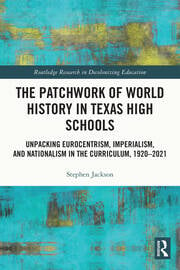
245 14|aThe patchwork of world history in Texas high schools :|bunpacking Eurocentrism, imperialism, and nationalism in the curriculum, 1920-2021 /|cStephen Jackson.
264 1|aNew York, NY :|bRoutledge,|c2023.
264 4|c©2023
300 |a1 online resource (xi, 208 pages) :|billustrations.
336 |atext|btxt|2rdacontent
337 |acomputer|bc|2rdamedia
338 |aonline resource|bcr|2rdacarrier
490 1 |aRoutledge research in decolonizing education
520 |a"This book traces the historical development of the World History course as it has been taught in high school classrooms in Texas, a populous and nationally influential state, over the last hundred years. Arguing that the course is a result of a patchwork of competing groups and ideas that have intersected over the past century, with each new framework patched over but never completely erased or replaced, the author crucially examines themes of imperialism, Eurocentrism, and nationalism in both textbooks and the curriculum more broadly. The first part of the book presents an overview of the World History course supported by numerical analysis of textbook content and public documents, whilst the second focuses on the depiction of non-Western peoples, and persistent narratives of Eurocentrism and nationalism. It ultimately offers that a more global, accurate and balanced curriculum is possible, despite the tension between the ideas of professional world historians, who often de-center the nation-state in their quest for a truly global approach to the subject, and the historical core rationale of state-sponsored education in the United States: to produce loyal citizens. Offering a new, conceptual understanding of how colonial themes in world history curriculum have been dealt with in the past and are now engaged with in contemporary times, it provides essential context for scholars and educators with interests in the history of education, curriculum studies, and the teaching of World History in the United States"--|cProvided by publisher.
588 |aOCLC-licensed vendor bibliographic record.
650 0|aHistory|xStudy and teaching (Secondary)|zTexas.
650 0|aHistory|xTextbooks|xEvaluation.
650 0|aImperialism|xStudy and teaching (Secondary)
650 0|aNationalism|zTexas.
650 0|aEurocentrism|zTexas.
650 7|aEDUCATION / General|2bisacsh
650 7|aEDUCATION / Curricula|2bisacsh
830 0|aRoutledge research in decolonizing education.
856 40|3Taylor & Francis|uhttps://www.taylorfrancis.com/books/9781003323785
856 42|3OCLC metadata license agreement|uhttp://www.oclc.org/content/dam/oclc/forms/terms/vbrl-201703.pdf
901 |aTaylor & Francis