

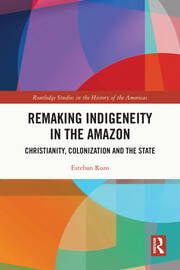
Remaking indigeneity in the Amazon : Christianity, colonization and the state / Esteban Rozo.
ISBN
9781000963113 (epub)
100096311X
9781003370215 (ebook)
1003370217
9781000963038 (adobe pdf)
1000963039
9781032440583 (hardback)
9781032440590 (paperback)
100096311X
9781003370215 (ebook)
1003370217
9781000963038 (adobe pdf)
1000963039
9781032440583 (hardback)
9781032440590 (paperback)
Dil Kodu
İngilizce
Yazar
Yayın Bilgisi
New York, NY : Routledge, 2024.
Fiziksel Niteleme
1 online resource.
Dizi
Routledge studies in the history of the Americas ; 37
İçindekiler Notu
The making of an Amazonian frontier -- Conversion under dispute : evangelical Christianity and the state -- Between rupture and continuity : the politics of conversion -- Christianity, materiality, and the critique of modernity -- Indigeneity, development and extractivism.
Özet, vb.
"Drawing on archival and ethnographic work, this book analyses how indigeneity, Christianity, and state-making became intertwined in the Colombian Amazon throughout the 20th century. At the end of the 19th century the state gave Catholic missionaries tutelage over Indigenous groups and their territories, but, in the case of the Colombian Amazon, this tutelage was challenged by evangelical missionaries that arrived in the region in the 1940s with different ideas of civilization and social change. Indigenous conversion to evangelical Christianity caused frictions with other actors, while Indigenous groups perceived conversion to evangelical Christianity as way of leverage with settlers. This book shows how evangelical Christianity shaped new forms of indigeneity that did not coincide entirely with the ideas of civilization or development that Catholic missionaries and the state promoted in the region. Since the 1960s, the state adapted development policies and programs to Indigenous realities and practices, while Indigenous societies appropriated evangelical Christianity in order to navigate the changes brought on by colonization and state-formation. This study demonstrates that not all projects of civilization were the same in Amazonia, nor was missionization of Indigenous groups always subordinate to the state or resource extraction"-- Provided by publisher.
Konu
Catholic Church __ Missions __ Colombia.
New Tribes Mission.
Missions __ Social aspects __ Colombia.
Indigenous peoples __ Colombia __ Religion.
Conversion __ Christianity __ Social aspects.
Church and state __ Colombia __ History __ 20th century.
HISTORY / Latin America / General __ bisacsh
HISTORY / Modern / General __ bisacsh
HISTORY / Social History __ bisacsh
Colombia __ Religion.
Colombia __ Social conditions.
New Tribes Mission.
Missions __ Social aspects __ Colombia.
Indigenous peoples __ Colombia __ Religion.
Conversion __ Christianity __ Social aspects.
Church and state __ Colombia __ History __ 20th century.
HISTORY / Latin America / General __ bisacsh
HISTORY / Modern / General __ bisacsh
HISTORY / Social History __ bisacsh
Colombia __ Religion.
Colombia __ Social conditions.
Veritabanı
