LEADER 03691cam a22005538i 4500
001 798124
003 TR_AnAIT
005 20260123013420
006 m o d
007 cr |||||||||||
008 230130s2023 nyu ob 001 0 eng
020 |a9781003382218|q(ebook)
020 |a1003382215
020 |a9781000880557|q(electronic bk. : PDF)
020 |a1000880559|q(electronic bk. : PDF)
020 |a9781000880571|q(electronic bk. : EPUB)
020 |a1000880575|q(electronic bk. : EPUB)
020 |z9781032465449|q(hardback)
020 |z9781032465470|q(paperback)
024 7 |a10.4324/9781003382218|2doi
035 |a(OCoLC)1368011776
035 |a(OCoLC-P)1368011776
040 |aOCoLC-P|beng|erda|cOCoLC-P
041 |aeng
049 |aTürk Tarih Kurumu Kütüphanesi
050 00|aHG229
072 7|aBUS|x039000|2bisacsh
072 7|aBUS|x069030|2bisacsh
072 7|aBUS|x023000|2bisacsh
072 7|aKCB|2bicssc
082 00|a332.4/1|223/eng/20230130
100 1 |aRazzak, Weshah,|eauthor.
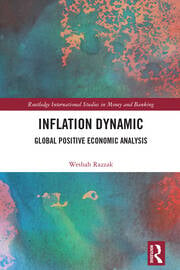
245 10|aInflation dynamic :|bglobal positive economic analysis /|cWeshah Razzak.
250 |a1 Edition.
264 1|aNew York, NY :|bRoutledge,|c2023.
300 |a1 online resource.
336 |atext|btxt|2rdacontent
337 |acomputer|bc|2rdamedia
338 |aonline resource|bcr|2rdacarrier
490 1 |aRoutledge international studies in money and banking
520 |a"This book explains inflation dynamic, using time series data from 1960 for 42 countries. These countries are different in every aspect, historically, culturally, socially, politically, institutionally, and economically. They are chosen on the basis of the data availability only and cover the Middle East and North Africa (MENA) region, Africa, Asia, the Caribbean, Europe, Australasia, and the United States. Inflation reached double digits in the developed countries in the 1970s and 80s, and then central banks, successfully stabilized it by anchoring inflation expectations for decades, until now. Conditional on common and country-specific shocks such as oil price shocks, financial and banking and political crises, wars, pandemics, natural disasters etc., the book tests various theoretical models about the long and short run relationships between money and prices, money growth and inflation, money growth and real output, expected inflation; the output gap, fiscal policy, and inflation, using a number of parametric and non-parametric methods, and pays attention to specifications and estimations problems. In addition, it explains why policymakers in inflation - targeting countries, e.g. the U.S., failed to anticipate the recent sudden rise in inflation. And, it examines the fallibility of the Modern Monetary Theory's policy prescription to reduce inflation by raising taxes. This is a unique and innovative book, which will find an audience among students, academics, researchers, policy makers, analysts in corporations, private and central banks and international monetary institutions"--|cProvided by publisher.
588 |aOCLC-licensed vendor bibliographic record.
650 0|aInflation (Finance)|vCase studies.
650 0|aInflation (Finance)|xEconometric models.
650 0|aMacroeconomics.
650 7|aBUSINESS & ECONOMICS / Economics / Macroeconomics|2bisacsh
650 7|aBUSINESS & ECONOMICS / Economics / Theory|2bisacsh
650 7|aBUSINESS & ECONOMICS / Economic History|2bisacsh
830 0|aRoutledge international studies in money and banking.
856 40|3Taylor & Francis|uhttps://www.taylorfrancis.com/books/9781003382218
856 42|3OCLC metadata license agreement|uhttp://www.oclc.org/content/dam/oclc/forms/terms/vbrl-201703.pdf
901 |aTaylor & Francis