LEADER 03964cam a22005177i 4500
001 798181
003 TR_AnAIT
005 20260123013527
006 m o d
007 cr cnu---unuuu
008 250917s2026 enka o 000 0 eng d
020 |a9781003491064|q(electronic bk.)
020 |a1003491065|q(electronic bk.)
020 |a9781040433423|q(electronic bk. : PDF)
020 |a1040433421|q(electronic bk. : PDF)
020 |a9781040433485|q(electronic bk. : EPUB)
020 |a1040433480|q(electronic bk. : EPUB)
020 |z9781032792200
020 |z1032792205
024 7 |a10.4324/9781003491064|2doi
035 |a(OCoLC)1536517150
035 |a(OCoLC-P)1536517150
040 |aOCoLC-P|beng|erda|epn|cOCoLC-P
041 |aeng
049 |aTürk Tarih Kurumu Kütüphanesi
050 4|aD463
072 7|aHBJD|2bicssc
072 7|aHIS027090|2bisacsh
072 7|aHBWN|2bicssc
072 7|aHIS037070|2bisacsh
072 7|aHIS045000|2bisacsh
082 04|a305.800956109042|223/eng/20251015
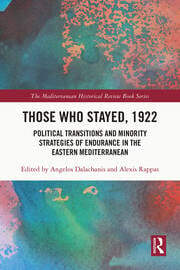
245 00|aThose who stayed, 1922 :|bpolitical transitions and minority strategies of endurance in the Eastern Mediterranean /|cedited by Angelos Dalachanis, Alexis Rappas.
264 1|aLondon :|bRoutledge,|c2026.
300 |a1 online resource (264 pages) :|billustrations (black and white).
336 |atext|btxt|2rdacontent
337 |acomputer|bc|2rdamedia
338 |aonline resource|bcr|2rdacarrier
490 0 |aThe Mediterranean historical review book series
520 |aThe year 1922 marks a major turning point in Eastern Mediterranean history, with the abolition of the Ottoman Sultanate concluding a long period of upheaval known as the "Eastern Question." As the empire gave way to European colonization and the nation-state model, its once multicultural societies were homogenized through violence, population transfers, and treaties. The liberal principle of national self-determination often led to devastating human costs, as populations were either massacred, forcibly exchanged, or reduced to "minorities" within new political entities.While scholarship has thoroughly documented the demographic changes that accompanied the post-Ottoman transition, this volume focuses on a less explored dimension: the agency of those labeled as minorities. It examines how these communities navigated their new reality within emerging nation-states or League of Nations mandates. Adopting a broad and situational understanding of "minority," it includes both legally defined groups and those marginalized in practice, such as Muslims in Western Thrace, Christians in Istanbul, Armenians in Jerusalem, Muslims in Serbia, and Jews in Salonica.The volume uses diverse methodologies-archival research, network analysis, microhistory, and translocal perspectives - to investigate the lived experiences of entrenched minorities. It offers new insights into both lesser-known and familiar minority groups, while engaging critically with existing literature. By emphasizing these groups' strategies and resilience, the volume challenges narratives dominated by violence and nostalgia, offering a more nuanced understanding of post-1922 Eastern Mediterranean history. It will appeal not only to scholars of minority studies but to anyone interested in the region's modern past.
588 |aOCLC-licensed vendor bibliographic record.
650 0|aEastern question.
650 0|aMinorities|zTurkey|xHistory|y20th century.
651 0|aTurkey|xHistory|y1918-1960.
700 1 |aD??alachane??s, Angelos,|eeditor.|1https://id.oclc.org/worldcat/entity/E39PCjDJ8t6q9tcdJ8vTmKffxC|1https://isni.org/isni/000000045579352X
700 1 |aRappas, Alexis,|eeditor.|1https://id.oclc.org/worldcat/entity/E39PCjDpVPxfwDB4CXVdT4W4bd|1https://isni.org/isni/0000000444193545
856 40|3Taylor & Francis|uhttps://www.taylorfrancis.com/books/9781003491064
856 42|3OCLC metadata license agreement|uhttp://www.oclc.org/content/dam/oclc/forms/terms/vbrl-201703.pdf
901 |aTaylor & Francis