

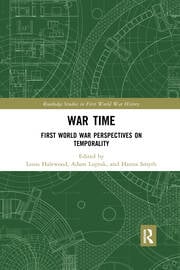
War Time [electronic resource] : First World War Perspectives on Temporality.
ISBN
9781351390095
1351390090
1138308358
9781138308350
9781351390101
1351390104
9781351390088
1351390082
9781315142968
1315142961
1351390090
1138308358
9781138308350
9781351390101
1351390104
9781351390088
1351390082
9781315142968
1315142961
Dil Kodu
İngilizce
Yazar
Fiziksel Niteleme
1 online resource (235 p.)
Dizi
Routledge Studies in First World War History Ser.
Genel Not
Description based upon print version of record.
İçindekiler Notu
Cover; Half Title; Title Page; Copyright Page; Table of Contents; Foreword; Notes on contributors; Acknowledgements; Introduction; Notes; Part I: Speed, pacing, and suspension; 1. No time to waste: How German military authorities attempted to speed up the recovery of soldiers in home-front hospitals, 1914-1918; Acceleration and synchronicity: reframing medical time; Hospitals as problematic areas: why long treatment periods created concern; In search of the culprit: the first acceleration decree of 1916; More of the same: the second acceleration decree of 1917; Conclusion; Notes; Bibliography
2. Fast therapy and fast recovery: The role of time for the Italian neuropsychiatric service in the war zonesThe organisation of the military psychiatric service and the control of time and space; The small neuropsychiatric villages; The time for therapy; Notes; Bibliography; 3. A stitch in time: Inefficiency and the appeal of patriotic work in Australia and Canada; Notes; Bibliography; 4. Slow going: Wartime affect and small press modernism; Thick time; Printing at the front; Printing at Hogarth House; Epilogue; Notes; Bibliography; Part II: Reorientation and memory
5. "It is at night-time that we notice most of the changes in our life caused by the war": War-time, Zeppelins, and children's experience of the Great War in LondonPart I; Part II; Notes; Bibliography; 6. Time, space, and death: Germany's living and lost aviators of the First World War; Military aviation and war time; Flight as chronos; From chronos to kairos; Flight as kairos; War's ending, war time continuing; Aviation as a site of memory, meaning-making, and mourning; Conclusion; Notes; Bibliography
7. The photo albums of the First World War: Composing and practising the images of the time of destructionFirst World War and photography: transdisciplinary research on the physiognomy of modern time; The album as an illustrated book of time sub specie bellica; The Italian photo albums of the 'Fondo Guerra': immortalising the experience and monumentalising the war; The material time of destruction: on some Italian iconic photograms; Conclusions; Notes; Bibliography; Part III: Relationship between past, present, and future
8. Brothers -- and sons -- in arms: First World War memory, the life cycle, and generational shifts during the Second World WarThe British Legion, 1939-1941; The American Legion, 1942-1944; Conclusion; Notes; Bibliography; 9. Between passatism and futurism: The rites of consecration to the Sacred Heart of Jesus in a transnational perspective (1914-1919); Introduction: The past is a foreign country. They do things slightlydifferently there; "The most important event of the whole war"; A Christian regime of historicity?; A passatist futurism; Experiencing time from below; Conclusion; Notes
2. Fast therapy and fast recovery: The role of time for the Italian neuropsychiatric service in the war zonesThe organisation of the military psychiatric service and the control of time and space; The small neuropsychiatric villages; The time for therapy; Notes; Bibliography; 3. A stitch in time: Inefficiency and the appeal of patriotic work in Australia and Canada; Notes; Bibliography; 4. Slow going: Wartime affect and small press modernism; Thick time; Printing at the front; Printing at Hogarth House; Epilogue; Notes; Bibliography; Part II: Reorientation and memory
5. "It is at night-time that we notice most of the changes in our life caused by the war": War-time, Zeppelins, and children's experience of the Great War in LondonPart I; Part II; Notes; Bibliography; 6. Time, space, and death: Germany's living and lost aviators of the First World War; Military aviation and war time; Flight as chronos; From chronos to kairos; Flight as kairos; War's ending, war time continuing; Aviation as a site of memory, meaning-making, and mourning; Conclusion; Notes; Bibliography
7. The photo albums of the First World War: Composing and practising the images of the time of destructionFirst World War and photography: transdisciplinary research on the physiognomy of modern time; The album as an illustrated book of time sub specie bellica; The Italian photo albums of the 'Fondo Guerra': immortalising the experience and monumentalising the war; The material time of destruction: on some Italian iconic photograms; Conclusions; Notes; Bibliography; Part III: Relationship between past, present, and future
8. Brothers -- and sons -- in arms: First World War memory, the life cycle, and generational shifts during the Second World WarThe British Legion, 1939-1941; The American Legion, 1942-1944; Conclusion; Notes; Bibliography; 9. Between passatism and futurism: The rites of consecration to the Sacred Heart of Jesus in a transnational perspective (1914-1919); Introduction: The past is a foreign country. They do things slightlydifferently there; "The most important event of the whole war"; A Christian regime of historicity?; A passatist futurism; Experiencing time from below; Conclusion; Notes
Özet, vb.
The International Society for First World War Studies' ninth conference, 'War Time', drew together emerging and leading scholars to discuss, reflect upon, and consider the ways that time has been conceptualised both during the war itself and in subsequent scholarship. War Time: First World War Perspectives on Temporality, stemming from this 2016 conference, offers its readers a collection of the conference's most inspiring and thought-provoking papers from the next generation of First World War scholars. In its varied yet thematically-related chapters, the book aims to examine new chronologies of the Great War and bring together its military and social history. Its cohesive theme creates opportunities to find common ground and connections between these sub-disciplines of history, and prompts students and academics alike to seriously consider time as alternately a unifying, divisive, and ultimately shaping force in the conflict and its historiography.?With content spanning land and air, the home and fighting fronts, multiple nations, and stretching to both pre-1914 and post-1918, these ten chapters by emerging researchers (plus an introductory chapter by the conference organisers, and a foreword by John Horne) offer an irreplaceable and invaluable snapshot of how the next generation of First World War scholars from eight countries were innovatively conceptualising the conflict and its legacy at the midpoint of its centenary.?.
Konu
HISTORY / Europe / Western. __ bisacsh
Diğer Yazarlar
Veritabanı
Eseri Alıntıla
Referansları kullanmadan önce gözden geçirmeniz ve varsa gerekli düzeltmeleri yapmanız önerilir.
Dijital Kaynak
MARC Görünümü
LEADER 06010cam a2200553Mu 4500
001 798308
003 TR_AnAIT
005 20260123013746
006 m d
007 cr cnu---unuuu
008 180714s2018 xx o 000 0 eng d
020 |a9781351390095
020 |a1351390090
020 |z1138308358
020 |z9781138308350
020 |a9781351390101
020 |a1351390104
020 |a9781351390088
020 |a1351390082
020 |a9781315142968
020 |a1315142961
024 7 |a10.4324/9781315142968|2doi
035 |a(OCoLC)1044940405|z(OCoLC)1044864330|z(OCoLC)1045464186|z(OCoLC)1046606300|z(OCoLC)1049602944
035 |a(OCoLC-P)1044940405
040 |aOCoLC-P|beng|cOCoLC-P
041 |aeng
049 |aTürk Tarih Kurumu Kütüphanesi
050 4|aD524.6
082 04|a940.31|223
100 1 |aHalewood, Louis.
245 10|aWar Time|h[electronic resource] :|bFirst World War Perspectives on Temporality.
260 |aMilton :|bRoutledge,|c2018.
300 |a1 online resource (235 p.)
336 |atext|2rdacontent
337 |acomputer|2rdamedia
338 |aonline resource|2rdacarrier
490 1 |aRoutledge Studies in First World War History Ser.
500 |aDescription based upon print version of record.
505 0 |aCover; Half Title; Title Page; Copyright Page; Table of Contents; Foreword; Notes on contributors; Acknowledgements; Introduction; Notes; Part I: Speed, pacing, and suspension; 1. No time to waste: How German military authorities attempted to speed up the recovery of soldiers in home-front hospitals, 1914-1918; Acceleration and synchronicity: reframing medical time; Hospitals as problematic areas: why long treatment periods created concern; In search of the culprit: the first acceleration decree of 1916; More of the same: the second acceleration decree of 1917; Conclusion; Notes; Bibliography
505 8 |a2. Fast therapy and fast recovery: The role of time for the Italian neuropsychiatric service in the war zonesThe organisation of the military psychiatric service and the control of time and space; The small neuropsychiatric villages; The time for therapy; Notes; Bibliography; 3. A stitch in time: Inefficiency and the appeal of patriotic work in Australia and Canada; Notes; Bibliography; 4. Slow going: Wartime affect and small press modernism; Thick time; Printing at the front; Printing at Hogarth House; Epilogue; Notes; Bibliography; Part II: Reorientation and memory
505 8 |a5. "It is at night-time that we notice most of the changes in our life caused by the war": War-time, Zeppelins, and children's experience of the Great War in LondonPart I; Part II; Notes; Bibliography; 6. Time, space, and death: Germany's living and lost aviators of the First World War; Military aviation and war time; Flight as chronos; From chronos to kairos; Flight as kairos; War's ending, war time continuing; Aviation as a site of memory, meaning-making, and mourning; Conclusion; Notes; Bibliography
505 8 |a7. The photo albums of the First World War: Composing and practising the images of the time of destructionFirst World War and photography: transdisciplinary research on the physiognomy of modern time; The album as an illustrated book of time sub specie bellica; The Italian photo albums of the 'Fondo Guerra': immortalising the experience and monumentalising the war; The material time of destruction: on some Italian iconic photograms; Conclusions; Notes; Bibliography; Part III: Relationship between past, present, and future
505 8 |a8. Brothers -- and sons -- in arms: First World War memory, the life cycle, and generational shifts during the Second World WarThe British Legion, 1939-1941; The American Legion, 1942-1944; Conclusion; Notes; Bibliography; 9. Between passatism and futurism: The rites of consecration to the Sacred Heart of Jesus in a transnational perspective (1914-1919); Introduction: The past is a foreign country. They do things slightlydifferently there; "The most important event of the whole war"; A Christian regime of historicity?; A passatist futurism; Experiencing time from below; Conclusion; Notes
520 3 |aThe International Society for First World War Studies' ninth conference, 'War Time', drew together emerging and leading scholars to discuss, reflect upon, and consider the ways that time has been conceptualised both during the war itself and in subsequent scholarship. War Time: First World War Perspectives on Temporality, stemming from this 2016 conference, offers its readers a collection of the conference's most inspiring and thought-provoking papers from the next generation of First World War scholars. In its varied yet thematically-related chapters, the book aims to examine new chronologies of the Great War and bring together its military and social history. Its cohesive theme creates opportunities to find common ground and connections between these sub-disciplines of history, and prompts students and academics alike to seriously consider time as alternately a unifying, divisive, and ultimately shaping force in the conflict and its historiography.?With content spanning land and air, the home and fighting fronts, multiple nations, and stretching to both pre-1914 and post-1918, these ten chapters by emerging researchers (plus an introductory chapter by the conference organisers, and a foreword by John Horne) offer an irreplaceable and invaluable snapshot of how the next generation of First World War scholars from eight countries were innovatively conceptualising the conflict and its legacy at the midpoint of its centenary.?.
588 |aOCLC-licensed vendor bibliographic record.
650 7|aHISTORY / Europe / Western.|2bisacsh
700 1 |aLuptak, Adam.
700 1 |aSmyth, Hanna.
856 40|uhttps://www.taylorfrancis.com/books/9781315142968|zClick here to view.
856 42|3OCLC metadata license agreement|uhttp://www.oclc.org/content/dam/oclc/forms/terms/vbrl-201703.pdf
901 |aTaylor & Francis
938 |aTaylor & Francis|bTAFR|n9781315142968
001 798308
003 TR_AnAIT
005 20260123013746
006 m d
007 cr cnu---unuuu
008 180714s2018 xx o 000 0 eng d
020 |a9781351390095
020 |a1351390090
020 |z1138308358
020 |z9781138308350
020 |a9781351390101
020 |a1351390104
020 |a9781351390088
020 |a1351390082
020 |a9781315142968
020 |a1315142961
024 7 |a10.4324/9781315142968|2doi
035 |a(OCoLC)1044940405|z(OCoLC)1044864330|z(OCoLC)1045464186|z(OCoLC)1046606300|z(OCoLC)1049602944
035 |a(OCoLC-P)1044940405
040 |aOCoLC-P|beng|cOCoLC-P
041 |aeng
049 |aTürk Tarih Kurumu Kütüphanesi
050 4|aD524.6
082 04|a940.31|223
100 1 |aHalewood, Louis.
245 10|aWar Time|h[electronic resource] :|bFirst World War Perspectives on Temporality.
260 |aMilton :|bRoutledge,|c2018.
300 |a1 online resource (235 p.)
336 |atext|2rdacontent
337 |acomputer|2rdamedia
338 |aonline resource|2rdacarrier
490 1 |aRoutledge Studies in First World War History Ser.
500 |aDescription based upon print version of record.
505 0 |aCover; Half Title; Title Page; Copyright Page; Table of Contents; Foreword; Notes on contributors; Acknowledgements; Introduction; Notes; Part I: Speed, pacing, and suspension; 1. No time to waste: How German military authorities attempted to speed up the recovery of soldiers in home-front hospitals, 1914-1918; Acceleration and synchronicity: reframing medical time; Hospitals as problematic areas: why long treatment periods created concern; In search of the culprit: the first acceleration decree of 1916; More of the same: the second acceleration decree of 1917; Conclusion; Notes; Bibliography
505 8 |a2. Fast therapy and fast recovery: The role of time for the Italian neuropsychiatric service in the war zonesThe organisation of the military psychiatric service and the control of time and space; The small neuropsychiatric villages; The time for therapy; Notes; Bibliography; 3. A stitch in time: Inefficiency and the appeal of patriotic work in Australia and Canada; Notes; Bibliography; 4. Slow going: Wartime affect and small press modernism; Thick time; Printing at the front; Printing at Hogarth House; Epilogue; Notes; Bibliography; Part II: Reorientation and memory
505 8 |a5. "It is at night-time that we notice most of the changes in our life caused by the war": War-time, Zeppelins, and children's experience of the Great War in LondonPart I; Part II; Notes; Bibliography; 6. Time, space, and death: Germany's living and lost aviators of the First World War; Military aviation and war time; Flight as chronos; From chronos to kairos; Flight as kairos; War's ending, war time continuing; Aviation as a site of memory, meaning-making, and mourning; Conclusion; Notes; Bibliography
505 8 |a7. The photo albums of the First World War: Composing and practising the images of the time of destructionFirst World War and photography: transdisciplinary research on the physiognomy of modern time; The album as an illustrated book of time sub specie bellica; The Italian photo albums of the 'Fondo Guerra': immortalising the experience and monumentalising the war; The material time of destruction: on some Italian iconic photograms; Conclusions; Notes; Bibliography; Part III: Relationship between past, present, and future
505 8 |a8. Brothers -- and sons -- in arms: First World War memory, the life cycle, and generational shifts during the Second World WarThe British Legion, 1939-1941; The American Legion, 1942-1944; Conclusion; Notes; Bibliography; 9. Between passatism and futurism: The rites of consecration to the Sacred Heart of Jesus in a transnational perspective (1914-1919); Introduction: The past is a foreign country. They do things slightlydifferently there; "The most important event of the whole war"; A Christian regime of historicity?; A passatist futurism; Experiencing time from below; Conclusion; Notes
520 3 |aThe International Society for First World War Studies' ninth conference, 'War Time', drew together emerging and leading scholars to discuss, reflect upon, and consider the ways that time has been conceptualised both during the war itself and in subsequent scholarship. War Time: First World War Perspectives on Temporality, stemming from this 2016 conference, offers its readers a collection of the conference's most inspiring and thought-provoking papers from the next generation of First World War scholars. In its varied yet thematically-related chapters, the book aims to examine new chronologies of the Great War and bring together its military and social history. Its cohesive theme creates opportunities to find common ground and connections between these sub-disciplines of history, and prompts students and academics alike to seriously consider time as alternately a unifying, divisive, and ultimately shaping force in the conflict and its historiography.?With content spanning land and air, the home and fighting fronts, multiple nations, and stretching to both pre-1914 and post-1918, these ten chapters by emerging researchers (plus an introductory chapter by the conference organisers, and a foreword by John Horne) offer an irreplaceable and invaluable snapshot of how the next generation of First World War scholars from eight countries were innovatively conceptualising the conflict and its legacy at the midpoint of its centenary.?.
588 |aOCLC-licensed vendor bibliographic record.
650 7|aHISTORY / Europe / Western.|2bisacsh
700 1 |aLuptak, Adam.
700 1 |aSmyth, Hanna.
856 40|uhttps://www.taylorfrancis.com/books/9781315142968|zClick here to view.
856 42|3OCLC metadata license agreement|uhttp://www.oclc.org/content/dam/oclc/forms/terms/vbrl-201703.pdf
901 |aTaylor & Francis
938 |aTaylor & Francis|bTAFR|n9781315142968
Materyaller
Depodan talep edilen materyal sadece kütüphane içerisinde kullanılmaktadır.
Materyal dışarıya ödünç verilmemektedir.
Materyal dışarıya ödünç verilmemektedir.
