

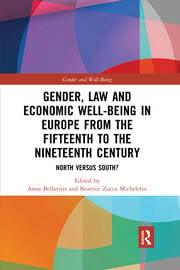
Gender, law and economic well-being in Europe from the fifteenth to the nineteenth century : North versus South? / edited by Anna Bellavitis and Beatrice Zucca Micheletto.
Erişim Adresi
ISBN
9780203702727 (e-book : PDF)
Dil Kodu
İngilizce
Basım Bildirimi
First edition.
Yayın Bilgisi
Boca Raton, FL : Routledge, an imprint of Taylor and Francis, 2018.
Fiziksel Niteleme
1 online resource (298 pages) : 21 illustrations.
Dizi
Gender and well-being
İçindekiler Notu
chapter Introduction: North versus South – gender, law and economic well-being in Europe in the fifteenth to nineteenth centuries / ANNA BELLAVITIS AND BEATRICE ZUCCA MICHELETTO -- part PART I Laws -- chapter 1 Community of goods, coverture and capability in Britain: Scotland versus England / Scotland versus England DEBORAH SIMONTON -- chapter 2 Between parental power and marital authority: How merchant women stood the test of customary laws in Brittany in the sixteenth to seventeenth centuries / NICOLE DUFOURNAUD -- chapter 3 Exceptional women: Female merchants and working women in Italy in the early modern period / SIMONA FECI -- chapter 4 Married women’s property rights in the nineteenth century in France and Spain: A North–South case study / MARION RÖWEKAMP -- chapter 5 From legal diversity to centralization: Marriage and wealth in nineteenth-century Greece / EVDOXIOS DOXIADIS -- part PART II Family strategies or marital economies? -- chapter 6 Marriage, law and property: Married noblewomen’s role in property management in fifteenth-century Norway / SUSANN ANETT PEDERSEN -- chapter 7 Class privileges and the public good: The monti dei maritaggi in early modern Naples / VITTORIA FIORELLI -- chapter 8 Women of high- and medium-ranking officers in the Île-de- France between the seventeenth and eighteenth centuries: What economic agency? / CLAIRE CHATELAIN -- chapter 9 Undivided brothers – renouncing sisters: Family strategies of low nobility in sixteenth- and seventeenth-century Tyrol / SIGLINDE CLEMENTI -- part PART III Inside the urban economy -- chapter 10 The ‘egalitarian trend’ in practice: Female participation in capital markets in late medieval Leuven / ANDREA BARDYN -- chapter 11 Women and credit in eighteenth-century Venice: A preliminary analysis / MATTEO POMPERMAIER -- chapter 12 Married women, property and paraphernalia in early modern Scotland / REBECCA MASON -- chapter 13 Women at work in a Southern European town: Women, guilds and commercial partnerships in Venice in the sixteenth century / EMILIE FIORUCCI -- chapter 14 Law, wives and the marital economy in sixteenth-century Antwerp: Bridging the gap between theory and practice / KAAT CAPPELLE -- chapter 15 Women, law and business formation in early modern Paris / JANINE M. LANZA -- chapter 16 Bankruptcies, a gateway to gender history: The example of women book traders in Paris in the nineteenth century / VIERA REBOLLEDO-DHUIN.
Özet, vb.
This book offers a comparative perspective on Northern and Southern European laws and customs concerning women’s property and economic rights. By focusing on both Northern and Southern European societies, these studies analyse the consequences of different juridical frameworks and norms on the development of the economic roles of men and women.By drawing on a wide range of social, economic and cultural European contexts, from the late medieval to early modern age to the nineteenth century, andincluding the middle and lower classes (especially artisans, merchants and traders) as well as the economic practices and norms of the upper middle class and aristocracy, this book will be of interest to economic and social historians, sociologists of health, gender andsexuality, and economists.This volume is divided into three parts. The first, Laws, presents general outlines related to some European regions; the second, Family strategies or marital economies?, questions the potential conflict between the economic interests of the married couple and those of the lineage within the nobility; finally, the third part of the book, Inside the urban economy, focuses on economic and work activities of middle and lower classes in the urban environment. The assorted and rich panorama offered by the history of the legislation on women’s economic rights shows that similarities and differences run through Europe in such a way that the North/South model looks very stereotyped. While this approach calls into question classical geographical and cultural maps and well-established chronologies, it encourages a reconsideration of European history according to a cross-boundaries perspective.
Konu
SOCIAL SCIENCE / Discrimination & Race Relations. __ bisacsh
SOCIAL SCIENCE / Minority Studies. __ bisacsh
Equality before the law __ United States __ Europe __ History.
Sex discrimination against women __ Law and legislation __ Europe __ History.
Women __ Legal status, laws, etc. __ Europe __ History.
Women __ Europe __ Social conditions __ History.
SOCIAL SCIENCE / Minority Studies. __ bisacsh
Equality before the law __ United States __ Europe __ History.
Sex discrimination against women __ Law and legislation __ Europe __ History.
Women __ Legal status, laws, etc. __ Europe __ History.
Women __ Europe __ Social conditions __ History.
Diğer Yazarlar
Kurum Adı
Veritabanı
Eseri Alıntıla
Referansları kullanmadan önce gözden geçirmeniz ve varsa gerekli düzeltmeleri yapmanız önerilir.
Dijital Kaynak
MARC Görünümü
LEADER 05889nam a2200409Ii 4500
001 798653
003 TR_AnAIT
005 20260123014220
008 180727s2018 fluab ob 001 0 eng d
020 |a9780203702727|q(e-book : PDF)
035 |a(OCoLC)1044733473
040 |aFlBoTFG|cFlBoTFG|erda
041 |aeng
043 |ae------
049 |aTürk Tarih Kurumu Kütüphanesi
050 4|aHQ1587|b.G463 2018
072 7|aSOC|x025000 |2bisacsh
072 7|aMBS |2bicscc
082 04|a305.409409/04|223
245 00|aGender, law and economic well-being in Europe from the fifteenth to the nineteenth century :|bNorth versus South? /|cedited by Anna Bellavitis and Beatrice Zucca Micheletto.
250 |aFirst edition.
264 1|aBoca Raton, FL :|bRoutledge, an imprint of Taylor and Francis,|c2018.
300 |a1 online resource (298 pages) :|b21 illustrations.
336 |atext|2rdacontent
337 |acomputer|2rdamedia
338 |aonline resource|2rdacarrier
490 1 |aGender and well-being
505 00|tchapter Introduction: North versus South – gender, law and economic well-being in Europe in the fifteenth to nineteenth centuries /|rANNA BELLAVITIS AND BEATRICE ZUCCA MICHELETTO -- |tpart PART I Laws -- |tchapter 1 Community of goods, coverture and capability in Britain: Scotland versus England /|rScotland versus England DEBORAH SIMONTON -- |tchapter 2 Between parental power and marital authority: How merchant women stood the test of customary laws in Brittany in the sixteenth to seventeenth centuries /|rNICOLE DUFOURNAUD -- |tchapter 3 Exceptional women: Female merchants and working women in Italy in the early modern period /|rSIMONA FECI -- |tchapter 4 Married women’s property rights in the nineteenth century in France and Spain: A North–South case study /|rMARION RÖWEKAMP -- |tchapter 5 From legal diversity to centralization: Marriage and wealth in nineteenth-century Greece /|rEVDOXIOS DOXIADIS -- |tpart PART II Family strategies or marital economies? -- |tchapter 6 Marriage, law and property: Married noblewomen’s role in property management in fifteenth-century Norway /|rSUSANN ANETT PEDERSEN -- |tchapter 7 Class privileges and the public good: The monti dei maritaggi in early modern Naples /|rVITTORIA FIORELLI -- |tchapter 8 Women of high- and medium-ranking officers in the Île-de- France between the seventeenth and eighteenth centuries: What economic agency? /|rCLAIRE CHATELAIN -- |tchapter 9 Undivided brothers – renouncing sisters: Family strategies of low nobility in sixteenth- and seventeenth-century Tyrol /|rSIGLINDE CLEMENTI -- |tpart PART III Inside the urban economy -- |tchapter 10 The ‘egalitarian trend’ in practice: Female participation in capital markets in late medieval Leuven /|rANDREA BARDYN -- |tchapter 11 Women and credit in eighteenth-century Venice: A preliminary analysis /|rMATTEO POMPERMAIER -- |tchapter 12 Married women, property and paraphernalia in early modern Scotland /|rREBECCA MASON -- |tchapter 13 Women at work in a Southern European town: Women, guilds and commercial partnerships in Venice in the sixteenth century /|rEMILIE FIORUCCI -- |tchapter 14 Law, wives and the marital economy in sixteenth-century Antwerp: Bridging the gap between theory and practice /|rKAAT CAPPELLE -- |tchapter 15 Women, law and business formation in early modern Paris /|rJANINE M. LANZA -- |tchapter 16 Bankruptcies, a gateway to gender history: The example of women book traders in Paris in the nineteenth century /|rVIERA REBOLLEDO-DHUIN.
520 3 |aThis book offers a comparative perspective on Northern and Southern European laws and customs concerning women’s property and economic rights. By focusing on both Northern and Southern European societies, these studies analyse the consequences of different juridical frameworks and norms on the development of the economic roles of men and women.By drawing on a wide range of social, economic and cultural European contexts, from the late medieval to early modern age to the nineteenth century, andincluding the middle and lower classes (especially artisans, merchants and traders) as well as the economic practices and norms of the upper middle class and aristocracy, this book will be of interest to economic and social historians, sociologists of health, gender andsexuality, and economists.This volume is divided into three parts. The first, Laws, presents general outlines related to some European regions; the second, Family strategies or marital economies?, questions the potential conflict between the economic interests of the married couple and those of the lineage within the nobility; finally, the third part of the book, Inside the urban economy, focuses on economic and work activities of middle and lower classes in the urban environment. The assorted and rich panorama offered by the history of the legislation on women’s economic rights shows that similarities and differences run through Europe in such a way that the North/South model looks very stereotyped. While this approach calls into question classical geographical and cultural maps and well-established chronologies, it encourages a reconsideration of European history according to a cross-boundaries perspective.
650 7|aSOCIAL SCIENCE / Discrimination & Race Relations.|2bisacsh
650 7|aSOCIAL SCIENCE / Minority Studies.|2bisacsh
650 0|aEquality before the law|zUnited States|zEurope|xHistory.
650 0|aSex discrimination against women|xLaw and legislation|zEurope|xHistory.
650 0|aWomen|xLegal status, laws, etc.|zEurope|xHistory.
650 0|aWomen|zEurope|xSocial conditions|xHistory.
700 1 |aBellavitis, Anna,|eeditor.
700 1 |aZucca Micheletto, Beatrice,|eeditor.
710 2 |aTaylor and Francis.
776 08|iPrint version: |z9781138571518|w(DLC) 2018007733
830 0|aGender and well-being.
856 40|uhttps://www.taylorfrancis.com/books/9780203702727|zClick here to view.
901 |aTaylor & Francis
001 798653
003 TR_AnAIT
005 20260123014220
008 180727s2018 fluab ob 001 0 eng d
020 |a9780203702727|q(e-book : PDF)
035 |a(OCoLC)1044733473
040 |aFlBoTFG|cFlBoTFG|erda
041 |aeng
043 |ae------
049 |aTürk Tarih Kurumu Kütüphanesi
050 4|aHQ1587|b.G463 2018
072 7|aSOC|x025000 |2bisacsh
072 7|aMBS |2bicscc
082 04|a305.409409/04|223
245 00|aGender, law and economic well-being in Europe from the fifteenth to the nineteenth century :|bNorth versus South? /|cedited by Anna Bellavitis and Beatrice Zucca Micheletto.
250 |aFirst edition.
264 1|aBoca Raton, FL :|bRoutledge, an imprint of Taylor and Francis,|c2018.
300 |a1 online resource (298 pages) :|b21 illustrations.
336 |atext|2rdacontent
337 |acomputer|2rdamedia
338 |aonline resource|2rdacarrier
490 1 |aGender and well-being
505 00|tchapter Introduction: North versus South – gender, law and economic well-being in Europe in the fifteenth to nineteenth centuries /|rANNA BELLAVITIS AND BEATRICE ZUCCA MICHELETTO -- |tpart PART I Laws -- |tchapter 1 Community of goods, coverture and capability in Britain: Scotland versus England /|rScotland versus England DEBORAH SIMONTON -- |tchapter 2 Between parental power and marital authority: How merchant women stood the test of customary laws in Brittany in the sixteenth to seventeenth centuries /|rNICOLE DUFOURNAUD -- |tchapter 3 Exceptional women: Female merchants and working women in Italy in the early modern period /|rSIMONA FECI -- |tchapter 4 Married women’s property rights in the nineteenth century in France and Spain: A North–South case study /|rMARION RÖWEKAMP -- |tchapter 5 From legal diversity to centralization: Marriage and wealth in nineteenth-century Greece /|rEVDOXIOS DOXIADIS -- |tpart PART II Family strategies or marital economies? -- |tchapter 6 Marriage, law and property: Married noblewomen’s role in property management in fifteenth-century Norway /|rSUSANN ANETT PEDERSEN -- |tchapter 7 Class privileges and the public good: The monti dei maritaggi in early modern Naples /|rVITTORIA FIORELLI -- |tchapter 8 Women of high- and medium-ranking officers in the Île-de- France between the seventeenth and eighteenth centuries: What economic agency? /|rCLAIRE CHATELAIN -- |tchapter 9 Undivided brothers – renouncing sisters: Family strategies of low nobility in sixteenth- and seventeenth-century Tyrol /|rSIGLINDE CLEMENTI -- |tpart PART III Inside the urban economy -- |tchapter 10 The ‘egalitarian trend’ in practice: Female participation in capital markets in late medieval Leuven /|rANDREA BARDYN -- |tchapter 11 Women and credit in eighteenth-century Venice: A preliminary analysis /|rMATTEO POMPERMAIER -- |tchapter 12 Married women, property and paraphernalia in early modern Scotland /|rREBECCA MASON -- |tchapter 13 Women at work in a Southern European town: Women, guilds and commercial partnerships in Venice in the sixteenth century /|rEMILIE FIORUCCI -- |tchapter 14 Law, wives and the marital economy in sixteenth-century Antwerp: Bridging the gap between theory and practice /|rKAAT CAPPELLE -- |tchapter 15 Women, law and business formation in early modern Paris /|rJANINE M. LANZA -- |tchapter 16 Bankruptcies, a gateway to gender history: The example of women book traders in Paris in the nineteenth century /|rVIERA REBOLLEDO-DHUIN.
520 3 |aThis book offers a comparative perspective on Northern and Southern European laws and customs concerning women’s property and economic rights. By focusing on both Northern and Southern European societies, these studies analyse the consequences of different juridical frameworks and norms on the development of the economic roles of men and women.By drawing on a wide range of social, economic and cultural European contexts, from the late medieval to early modern age to the nineteenth century, andincluding the middle and lower classes (especially artisans, merchants and traders) as well as the economic practices and norms of the upper middle class and aristocracy, this book will be of interest to economic and social historians, sociologists of health, gender andsexuality, and economists.This volume is divided into three parts. The first, Laws, presents general outlines related to some European regions; the second, Family strategies or marital economies?, questions the potential conflict between the economic interests of the married couple and those of the lineage within the nobility; finally, the third part of the book, Inside the urban economy, focuses on economic and work activities of middle and lower classes in the urban environment. The assorted and rich panorama offered by the history of the legislation on women’s economic rights shows that similarities and differences run through Europe in such a way that the North/South model looks very stereotyped. While this approach calls into question classical geographical and cultural maps and well-established chronologies, it encourages a reconsideration of European history according to a cross-boundaries perspective.
650 7|aSOCIAL SCIENCE / Discrimination & Race Relations.|2bisacsh
650 7|aSOCIAL SCIENCE / Minority Studies.|2bisacsh
650 0|aEquality before the law|zUnited States|zEurope|xHistory.
650 0|aSex discrimination against women|xLaw and legislation|zEurope|xHistory.
650 0|aWomen|xLegal status, laws, etc.|zEurope|xHistory.
650 0|aWomen|zEurope|xSocial conditions|xHistory.
700 1 |aBellavitis, Anna,|eeditor.
700 1 |aZucca Micheletto, Beatrice,|eeditor.
710 2 |aTaylor and Francis.
776 08|iPrint version: |z9781138571518|w(DLC) 2018007733
830 0|aGender and well-being.
856 40|uhttps://www.taylorfrancis.com/books/9780203702727|zClick here to view.
901 |aTaylor & Francis
Materyaller
Depodan talep edilen materyal sadece kütüphane içerisinde kullanılmaktadır.
Materyal dışarıya ödünç verilmemektedir.
Materyal dışarıya ödünç verilmemektedir.
