LEADER 04020cam a2200553 i 4500
001 798818
003 TR_AnAIT
005 20260123014447
006 m o d
007 cr cnu---unuuu
008 220811t20232023enka ob 001 0 eng
020 |a9781003024675|qelectronic book
020 |a100302467X|qelectronic book
020 |a9781000806908|qelectronic book
020 |a1000806901|qelectronic book
020 |a9781000806809|qelectronic book
020 |a1000806804|qelectronic book
020 |z9780367456696|qhardcover
020 |z9781032398839|qpaperback
024 7 |a10.4324/9781003024675|2doi
035 |a(OCoLC)1343870309
035 |a(OCoLC-P)1343870309
040 |aOCoLC-P|beng|erda|cOCoLC-P
041 |aeng
049 |aTürk Tarih Kurumu Kütüphanesi
050 04|aHC79.T4|bM363 2023
072 7|aBUS|x027000|2bisacsh
072 7|aBUS|x073000|2bisacsh
072 7|aKF|2bicssc
082 00|a338/.064|223/eng/20220906
100 1 |aMathis, F. John,|eauthor.
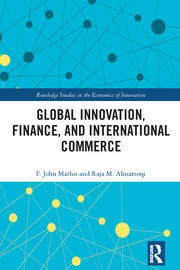
245 10|aGlobal innovation, finance, and international commerce /|cF. John Mathis and Raja M. Almarzoqi.
264 1|aAbingdon, Oxon ;|aNew York, NY :|bRoutledge,|c2023.
264 4|c©2023
300 |a1 online resource (viii, 257 pages) :|billustrations.
336 |atext|btxt|2rdacontent
337 |acomputer|bc|2rdamedia
338 |aonline resource|bcr|2rdacarrier
490 1 |aRoutledge studies in the economics of innovation
520 |a"This book analyses the historical context and progression of "significant innovations" beginning with the industrial revolution, starting around 1750 to the present. It explores the interrelationship, causes, and evolutionary process of contemporary "disruptive" inventions and the role played by global finance and international commerce to support these. First, the authors examine the environment and circumstances surrounding the inventors and explore their backgrounds to determine, why at a specific time, they identified a need that became the seed for invention and, what was their method of successfully commercializing their innovation. Secondly, they focus on the financing of the inventor, the innovation, and the commercialization of the invention(s). They analyze the changes in finance during the shift from a labor-based production process to a more capital-intensive production process, and what new financial products or financial markets were created to facilitate this transition. Third, they explore the impact of global commerce on the inventor country's innovation environment and international competition impacting the innovation's production, distribution, and sales, as well as, investigating any financial impact from the demand side and whether that impact was domestic or global in character. Furthermore, they consider if and how global finance and international commerce including the migration of people, together play a role in helping the disruptive invention satisfy a need in society, whether from a production or consumption perspective. Finally, they search for common elements that repeatedly inspired inventors and their disruptive innovations over time. This book will appeal to global government officials, business leadership, early career professionals, and students across a number of disciplines including finance, economics, business, engineering, and technology"--|cProvided by publisher.
588 |aOCLC-licensed vendor bibliographic record.
650 0|aTechnological innovations|xEconomic aspects.
650 0|aInventions|xEconomic aspects.
650 0|aFinance.
650 0|aInternational economic relations.
650 7|aBUSINESS & ECONOMICS / Finance|2bisacsh
650 7|aBUSINESS & ECONOMICS / Commerce|2bisacsh
700 1 |aAlmarzoqi, Raja,|eauthor.
830 0|aRoutledge studies in the economics of innovation.
856 40|3Taylor & Francis|uhttps://www.taylorfrancis.com/books/9781003024675
856 42|3OCLC metadata license agreement|uhttp://www.oclc.org/content/dam/oclc/forms/terms/vbrl-201703.pdf
901 |aTaylor & Francis