

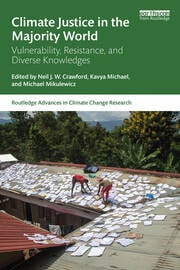
Climate justice in the majority world : vulnerability, resistance and diverse knowledges / Edited by Neil J.W. Crawford, Kavya Michael, Michael Mikulewicz.
ISBN
9781003214021 electronic book
1003214029 electronic book
1000921298 electronic book
9781000921311 electronic book
100092131X electronic book
9781000921298 (electronic bk.)
9781032101804 hardcover
9781032101712 paperback
1003214029 electronic book
1000921298 electronic book
9781000921311 electronic book
100092131X electronic book
9781000921298 (electronic bk.)
9781032101804 hardcover
9781032101712 paperback
Dil Kodu
İngilizce
Yayın Bilgisi
Abingdon, Oxon ; New York, NY : Routledge, 2024.
Fiziksel Niteleme
1 online resource.
Dizi
Routledge advances in climate change
Özet, vb.
"This edited collection explores a diverse range of climate (in)justice case studies from the Majority World - where most of humans and non-humans live. It is also the site of the most severe impacts of climate change and home to some of the key solutions for the climate crisis. The collection brings together twelve chapters featuring the work of over thirty authors from around the globe. The impacts of climate change are disproportionately affecting individuals, communities, and countries in the Majority World who historically have contributed little to rising global temperatures. The twelve chapters focus on a range of cross-cutting themes, demonstrating both individual and collective experiences of climate change and struggles for achieving climate justice from the Majority World. This includes activism, resistance, and social movement organising in India and Brazil, lived experiences and understandings of frontline communities in Bangladesh and South Africa, consequences of and responses to disasters in Mozambique and Puerto Rico, and contested accounts, narratives, and futures in the Maldives and Pakistan, among other topics. By adopting a decolonial lens, this book provides rich empirical content, insightful comparisons, and novel conceptual interventions. It foregrounds climate justice from an intersectional perspective and contributes to the ongoing efforts by scholars and activists to address epistemic injustice in climate change research, policy and practice. It will appeal to undergraduate and graduate-level students, academics, activists, policymakers, and members of the public concerned with the impacts and inequalities of climate change in the Majority World. Neil J. W. Crawford is a Research Fellow in Climate Action and member of the Priestley International Centre for Climate, University of Leeds, UK. Their research focuses on forced migration and displacement, refugee rights, climate justice and the inequalities of climate change, gender and sexuality, and cities"-- Provided by publisher.
Konu
Environmental justice __ Cross-cultural studies.
Climatic changes __ Social aspects __ Cross-cultural studies.
Environmental policy __ Cross-cultural studies.
SOCIAL SCIENCE / Third World Development __ bisacsh
POLITICAL SCIENCE / Public Policy / Environmental Policy __ bisacsh
Climatic changes __ Social aspects __ Cross-cultural studies.
Environmental policy __ Cross-cultural studies.
SOCIAL SCIENCE / Third World Development __ bisacsh
POLITICAL SCIENCE / Public Policy / Environmental Policy __ bisacsh
Diğer Yazarlar
Veritabanı
