LEADER 03177cam a22005418i 4500
001 799198
003 TR_AnAIT
005 20260123015051
006 m o d
007 cr |||||||||||
008 251017s2026 enka o 000 0 eng d
020 |a9781040621226|qePub ebook
020 |a1040621228
020 |a9781040554876
020 |a1040554873
020 |a9781003660507|q(electronic bk.)
020 |a1003660509|q(electronic bk.)
020 |z9781041115427
024 8 |aCIPO000305119
024 7 |a10.4324/9781003660507|2doi
035 |a(OCoLC)1552151234
035 |a(OCoLC-P)1552151234
040 |aOCoLC-P|beng|erda|epn|cOCoLC-P
041 |aeng
049 |aTürk Tarih Kurumu Kütüphanesi
050 4|aDS271.5
072 7|aHBJF1|2bicssc
072 7|aHIS050000|2bisacsh
072 7|aHBAH|2bicssc
072 7|aGTB|2bicssc
072 7|aHIS016000|2bisacsh
072 7|aHIS026020|2bisacsh
072 7|aHIS055000|2bisacsh
072 7|aHIS026000|2bisacsh
082 04|a955/.03|223/eng/20251209
100 1 |aSaeedi, Nilab,|eauthor.
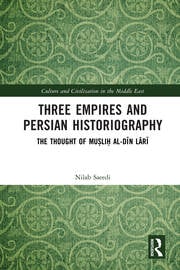
245 10|aThree empires and Persian historiography :|bthe thought of Mus??lih?? al-din Lari /|cNilab Saeedi.
264 1|aLondon :|bRoutledge,|c2026.
300 |a1 online resource (210 pages) :|billustrations (black and white).
336 |atext|2rdacontent
336 |astill image|2rdacontent
337 |acomputer|2rdamedia
338 |aonline resource|2rdacarrier
490 0 |aCulture and civilization in the Middle East
520 |aThree Empires and Persian Historiography: The Thought of Muli al-dn Lr uncovers the underexplored historical vision of a sixteenth-century scholar whose work spanned the Safavid, Timurid, and Ottoman worlds.Centering on Lr's universal chronicle [Mir'atu'l-Advr wa Mirtu'l-Abr], The Mirror of Epochs and the Staircase of Historical Reports, this book explores how a figure in philosophy, theology, and the sciences used history to navigate shifting imperial landscapes. Written in Persian and completed upon Sultan Selm II's accession to the throne, Lr's work offers a nuanced and often critical perspective on the Safavid dynasty, reverent accounts of the Timurid legacy, and a carefully constructed narrative of Ottoman rule. Through detailed textual analysis, the book demonstrates how Lr positioned himself as both a cultural mediator and a political commentator, using historiography to reflect broader debates about legitimacy, identity, and intellectual authority in the early modern Islamic world.A vital resource for scholars of Islamic historiography, Persianate studies, and Ottoman intellectual history, this book illuminates the enduring power of historical writing as a tool for negotiation, memory, and empire-making.
588 |aOCLC-licensed vendor bibliographic record.
600 10|aMus??lih?? al-Di??n al-La??ri??, Muh??ammad ibn S??ala??h??,|d-1571 or 1572.|tMir??a??t al-adva??r va mirqa??t al-akhba??r.
651 0|aIran|xHistoriography|xHistory|y16th century.
856 40|3Taylor & Francis|uhttps://www.taylorfrancis.com/books/9781003660507
856 42|3OCLC metadata license agreement|uhttp://www.oclc.org/content/dam/oclc/forms/terms/vbrl-201703.pdf
901 |aTaylor & Francis