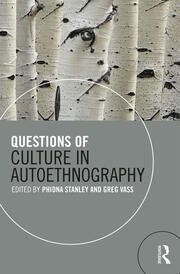
Questions of culture in autoethnography / edited by Phiona Stanley and Greg Vass.
Erişim Adresi
ISBN
9781315178738
Dil Kodu
İngilizce
Yayın Bilgisi
Boca Raton, FL : Routledge, an imprint of Taylor and Francis, 2018.
Fiziksel Niteleme
1 online resource (206 pages) : 10 illustrations
İçindekiler Notu
chapter 1 On the diffi culties of writing about culture in autoethnography / Phiona Stanley -- chapter 2 ‘Help me’: The English language and a voice from a Korean Australian living in Singapore / Hyejeong Ahn -- chapter 3 Personal instructions on how to remain a stranger to enforce a sociological perspective / Silvia Bénard Calva -- chapter 4 Writing fl ows: The self as fragmentary whole / David Bright -- chapter 5 Searching for ‘my’ Mexico: An autoethnographic account of unlearning and relearning about the limits of knowing the Other / Alice Cranney -- chapter 6 Negotiating the va¯: The ‘self’ in relation to others and navigating the multiple spaces as a New Zealand-raised Tongan male -- chapter 7 Scene, seen, unseen / Fetaui Iosefo -- chapter 8 How do ‘we’ know what ‘they’ need? Learning together through duoethnography and English language teaching to immigrant and refugee women / Ulrike Najar -- chapter 9 Performing problematic privilege in Japan / Gabrielle Piggin -- chapter 10 Nuanced ‘culture shock’: Local and global ‘mate’ culture / Robert E. Rinehart -- chapter 11 In which I am sung to, cry, and other suchlike: Refl ections on research in and with Tibetan refugees in India / Harmony Siganporia -- chapter 12 Walking to heal or walking to heel? Contesting cultural narratives about fat women who hike and camp alone / Phiona Stanley -- chapter 13 Reading Shiva Naipaul: A refl ection on Brownness and leading an experiential learning project in Malawi / C. Darius Stonebanks -- chapter 14 Untangling me: Complexifying cultural identity / Gresilda A. Tilley-Lubbs -- chapter 15 Whose story is it anyway? Refl ecting on a collaborative research project with/in an educational community / Greg Vass -- chapter 16 Six tales of a visit to Chile: An autoethnographic refl ection on ‘questions of culture’ / Esther Fitzpatrick.
Özet, vb.
Autoethnography allows researchers to make sense of the ‘ethno’ –the cultural – by studying their own experiences– the ‘auto’. It links the self to the cultural, allowing for an inductive grounding of theoretical insight into researchers' lived experiences. But what happens when the culture that we research is not conventionally or entirely our ‘own’? What happens when our culture does not neatly conceptualise the ‘auto’ as an individual, Western self? And does autoethnographic writing risk reducing cultural ‘Others’ if we cannot help but see them through ‘imperial eyes’? Questions of Culture in Autoethnography showcases how cross-cultural autoethnographies might be done effectively, ethically, and reflectively. Chapters include: identity work among Tibetans in India and among the descendants of Spanish conquistadores in Appalachia; insider/outsider identities in myriad contexts from Mexico to Japan; embodied (gendered, raced, sized) intercultural experiences from Samoa to Aotearoa/New Zealand and from Canada to Malawi; and language stories from Korea to Singapore and from Somalia to Australia. It also explorescultural Otherness within ‘a’ culture, including researchers’ accounts of working with Indigenous Australians, of contesting mainstream cultural narratives from a body positive perspective, and as aUS American man in New Zealand’s ‘bloke culture’, only seemingly sharing the same English-language-speaking, 'Western' culture.For all scholars of qualitative methods and autoethnography, the book has a dual purpose – to show and to tell. It presents evocative autoethnographies of and about ‘culture’, as it is variously understood, and discusses the issues inherent in autoethnographic writing.
Konu
Cross-cultural studies __ Methodology __ Case studies.
Ethnology __ Authorship __ Case studies.
Ethnology __ Biographical methods __ Case studies.
Ethnology __ Authorship __ Case studies.
Ethnology __ Biographical methods __ Case studies.
Diğer Yazarlar
Kurum Adı
Veritabanı

Eseri Alıntıla
Referansları kullanmadan önce gözden geçirmeniz ve varsa gerekli düzeltmeleri yapmanız önerilir.
Dijital Kaynak
MARC Görünümü
LEADER 04852nam a2200325Ii 4500
001 799283
003 TR_AnAIT
005 20260123015207
008 180611s2018 fluab ob 001 0 eng d
020 |a9781315178738
035 |a(OCoLC)1013592391
040 |aFlBoTFG|cFlBoTFG|erda
041 |aeng
049 |aTürk Tarih Kurumu Kütüphanesi
050 4|aGN346.6
072 7|aSOC|x024000 |2bisacsh
072 7|aGPS |2bicscc
082 04|a305.8001|223
245 00|aQuestions of culture in autoethnography /|cedited by Phiona Stanley and Greg Vass.
264 1|aBoca Raton, FL :|bRoutledge, an imprint of Taylor and Francis,|c2018.
300 |a1 online resource (206 pages) :|b10 illustrations
336 |atext|2rdacontent
337 |acomputer|2rdamedia
338 |aonline resource|2rdacarrier
505 00|tchapter 1 On the diffi culties of writing about culture in autoethnography /|rPhiona Stanley -- |tchapter 2 ‘Help me’: The English language and a voice from a Korean Australian living in Singapore /|rHyejeong Ahn -- |tchapter 3 Personal instructions on how to remain a stranger to enforce a sociological perspective /|rSilvia Bénard Calva -- |tchapter 4 Writing fl ows: The self as fragmentary whole /|rDavid Bright -- |tchapter 5 Searching for ‘my’ Mexico: An autoethnographic account of unlearning and relearning about the limits of knowing the Other /|rAlice Cranney -- |tchapter 6 Negotiating the va¯: The ‘self’ in relation to others and navigating the multiple spaces as a New Zealand-raised Tongan male -- |tchapter 7 Scene, seen, unseen /|rFetaui Iosefo -- |tchapter 8 How do ‘we’ know what ‘they’ need? Learning together through duoethnography and English language teaching to immigrant and refugee women /|rUlrike Najar -- |tchapter 9 Performing problematic privilege in Japan /|rGabrielle Piggin -- |tchapter 10 Nuanced ‘culture shock’: Local and global ‘mate’ culture /|rRobert E. Rinehart -- |tchapter 11 In which I am sung to, cry, and other suchlike: Refl ections on research in and with Tibetan refugees in India /|rHarmony Siganporia -- |tchapter 12 Walking to heal or walking to heel? Contesting cultural narratives about fat women who hike and camp alone /|rPhiona Stanley -- |tchapter 13 Reading Shiva Naipaul: A refl ection on Brownness and leading an experiential learning project in Malawi /|rC. Darius Stonebanks -- |tchapter 14 Untangling me: Complexifying cultural identity /|rGresilda A. Tilley-Lubbs -- |tchapter 15 Whose story is it anyway? Refl ecting on a collaborative research project with/in an educational community /|rGreg Vass -- |tchapter 16 Six tales of a visit to Chile: An autoethnographic refl ection on ‘questions of culture’ /|rEsther Fitzpatrick.
520 3 |aAutoethnography allows researchers to make sense of the ‘ethno’ –the cultural – by studying their own experiences– the ‘auto’. It links the self to the cultural, allowing for an inductive grounding of theoretical insight into researchers' lived experiences. But what happens when the culture that we research is not conventionally or entirely our ‘own’? What happens when our culture does not neatly conceptualise the ‘auto’ as an individual, Western self? And does autoethnographic writing risk reducing cultural ‘Others’ if we cannot help but see them through ‘imperial eyes’? Questions of Culture in Autoethnography showcases how cross-cultural autoethnographies might be done effectively, ethically, and reflectively. Chapters include: identity work among Tibetans in India and among the descendants of Spanish conquistadores in Appalachia; insider/outsider identities in myriad contexts from Mexico to Japan; embodied (gendered, raced, sized) intercultural experiences from Samoa to Aotearoa/New Zealand and from Canada to Malawi; and language stories from Korea to Singapore and from Somalia to Australia. It also explorescultural Otherness within ‘a’ culture, including researchers’ accounts of working with Indigenous Australians, of contesting mainstream cultural narratives from a body positive perspective, and as aUS American man in New Zealand’s ‘bloke culture’, only seemingly sharing the same English-language-speaking, 'Western' culture.For all scholars of qualitative methods and autoethnography, the book has a dual purpose – to show and to tell. It presents evocative autoethnographies of and about ‘culture’, as it is variously understood, and discusses the issues inherent in autoethnographic writing.
650 0|aCross-cultural studies|xMethodology|vCase studies.
650 0|aEthnology|xAuthorship|vCase studies.
650 0|aEthnology|xBiographical methods|vCase studies.
700 1 |aStanley, Phiona,|eeditor.
700 1 |aVass, Greg,|eeditor.
710 2 |aTaylor and Francis.
776 08|iPrint version: |z9781138908642
856 40|uhttps://www.taylorfrancis.com/books/9781315178738|zClick here to view.
901 |aTaylor & Francis
001 799283
003 TR_AnAIT
005 20260123015207
008 180611s2018 fluab ob 001 0 eng d
020 |a9781315178738
035 |a(OCoLC)1013592391
040 |aFlBoTFG|cFlBoTFG|erda
041 |aeng
049 |aTürk Tarih Kurumu Kütüphanesi
050 4|aGN346.6
072 7|aSOC|x024000 |2bisacsh
072 7|aGPS |2bicscc
082 04|a305.8001|223
245 00|aQuestions of culture in autoethnography /|cedited by Phiona Stanley and Greg Vass.
264 1|aBoca Raton, FL :|bRoutledge, an imprint of Taylor and Francis,|c2018.
300 |a1 online resource (206 pages) :|b10 illustrations
336 |atext|2rdacontent
337 |acomputer|2rdamedia
338 |aonline resource|2rdacarrier
505 00|tchapter 1 On the diffi culties of writing about culture in autoethnography /|rPhiona Stanley -- |tchapter 2 ‘Help me’: The English language and a voice from a Korean Australian living in Singapore /|rHyejeong Ahn -- |tchapter 3 Personal instructions on how to remain a stranger to enforce a sociological perspective /|rSilvia Bénard Calva -- |tchapter 4 Writing fl ows: The self as fragmentary whole /|rDavid Bright -- |tchapter 5 Searching for ‘my’ Mexico: An autoethnographic account of unlearning and relearning about the limits of knowing the Other /|rAlice Cranney -- |tchapter 6 Negotiating the va¯: The ‘self’ in relation to others and navigating the multiple spaces as a New Zealand-raised Tongan male -- |tchapter 7 Scene, seen, unseen /|rFetaui Iosefo -- |tchapter 8 How do ‘we’ know what ‘they’ need? Learning together through duoethnography and English language teaching to immigrant and refugee women /|rUlrike Najar -- |tchapter 9 Performing problematic privilege in Japan /|rGabrielle Piggin -- |tchapter 10 Nuanced ‘culture shock’: Local and global ‘mate’ culture /|rRobert E. Rinehart -- |tchapter 11 In which I am sung to, cry, and other suchlike: Refl ections on research in and with Tibetan refugees in India /|rHarmony Siganporia -- |tchapter 12 Walking to heal or walking to heel? Contesting cultural narratives about fat women who hike and camp alone /|rPhiona Stanley -- |tchapter 13 Reading Shiva Naipaul: A refl ection on Brownness and leading an experiential learning project in Malawi /|rC. Darius Stonebanks -- |tchapter 14 Untangling me: Complexifying cultural identity /|rGresilda A. Tilley-Lubbs -- |tchapter 15 Whose story is it anyway? Refl ecting on a collaborative research project with/in an educational community /|rGreg Vass -- |tchapter 16 Six tales of a visit to Chile: An autoethnographic refl ection on ‘questions of culture’ /|rEsther Fitzpatrick.
520 3 |aAutoethnography allows researchers to make sense of the ‘ethno’ –the cultural – by studying their own experiences– the ‘auto’. It links the self to the cultural, allowing for an inductive grounding of theoretical insight into researchers' lived experiences. But what happens when the culture that we research is not conventionally or entirely our ‘own’? What happens when our culture does not neatly conceptualise the ‘auto’ as an individual, Western self? And does autoethnographic writing risk reducing cultural ‘Others’ if we cannot help but see them through ‘imperial eyes’? Questions of Culture in Autoethnography showcases how cross-cultural autoethnographies might be done effectively, ethically, and reflectively. Chapters include: identity work among Tibetans in India and among the descendants of Spanish conquistadores in Appalachia; insider/outsider identities in myriad contexts from Mexico to Japan; embodied (gendered, raced, sized) intercultural experiences from Samoa to Aotearoa/New Zealand and from Canada to Malawi; and language stories from Korea to Singapore and from Somalia to Australia. It also explorescultural Otherness within ‘a’ culture, including researchers’ accounts of working with Indigenous Australians, of contesting mainstream cultural narratives from a body positive perspective, and as aUS American man in New Zealand’s ‘bloke culture’, only seemingly sharing the same English-language-speaking, 'Western' culture.For all scholars of qualitative methods and autoethnography, the book has a dual purpose – to show and to tell. It presents evocative autoethnographies of and about ‘culture’, as it is variously understood, and discusses the issues inherent in autoethnographic writing.
650 0|aCross-cultural studies|xMethodology|vCase studies.
650 0|aEthnology|xAuthorship|vCase studies.
650 0|aEthnology|xBiographical methods|vCase studies.
700 1 |aStanley, Phiona,|eeditor.
700 1 |aVass, Greg,|eeditor.
710 2 |aTaylor and Francis.
776 08|iPrint version: |z9781138908642
856 40|uhttps://www.taylorfrancis.com/books/9781315178738|zClick here to view.
901 |aTaylor & Francis
Materyaller
Depodan talep edilen materyal sadece kütüphane içerisinde kullanılmaktadır.
Materyal dışarıya ödünç verilmemektedir.
