

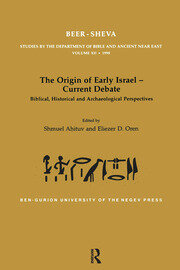
The origin of early Israel--current debate : Biblical, historical and archaeological perspectives : Irene Levi-Sala Seminar, 1997 / editors Shmuel Aòhituv and Eliezer D. Oren.
Erişim Adresi
ISBN
9781315417691 (e-book : PDF)
9781315417660 (e-book: Mobi)
9781315417677 (e-book: ePub)
9781598743913 (hardback)
9781315417660 (e-book: Mobi)
9781315417677 (e-book: ePub)
9781598743913 (hardback)
Dil Kodu
İngilizce
Yayın Bilgisi
London : Routledge, 2016.
Fiziksel Niteleme
1 online resource (176 pages)
Dizi
UCL Institute of Archaeology Publications
Genel Not
First published 1998 by the Bialik Institute.
Bibliyografi, vb. Notu
Includes bibliographical references.
İçindekiler Notu
chapter The Rise of Early Israel Archaeology and Long-Term History / Israel Finkelstein -- chapter had a dimorphic structure, but the northern one was more sedentary and the southern one more pastoral. The emergence of large political entities in the highlands in the Middle Bronze was again connected with impressive population growth, expan-sion into the inhospitable regions, which were conducive only to horticul-tural activity, and development of specialized agriculture, which required balancing institutions to control the flow of commodities. Demand for these commodities by the sophisticated lowland centers, and possibly by Egypt, must have played a major role in this process. The Canaanite-Egyptian con-nection is revealed by studies of pottery uncovered at Tell ed-Daba in the Delta. It is worth mentioning that the only highland political entities mentioned If we accept the identification of Bit Ninurta of EA 290 with Beth Horon, -- in the Amarna letters of the 14th century (a period of severe decline in the highlands) are Shechem and Jerusalem. This is the first period which offers clues about the border between the two units of the highlands. The territory of Shechem extended at least to the Dothan Valley in the north and to the coastal plain in the west. The political involvement of Shechem -- chapter Keith W. Whitelam The Search for Early Israel: Historical Perspective -- chapter thiness of the Bible. He goes on to say that 'By the 1880s, scholars of the Near Orient in the United States saw their studies in the front lines of a defense of the Old Testament. They also believed that a scientifically de-fended history of the Israelites would fit in with the histories of other an-cient peoples and merge with the story of the West. They wanted a defen-sible spiritual basis for human history and sought to link it to a story that would explain present society.' It is in the period at the tum of the century -- that a distinctive American interpretation begins to emerge in contrast to the dominant German model Sasson 1981: 11). Sasson describes it as an attempt to recapture the aspirations of the founding fathers while resur- recting Jeffersonian ideals enunciated in the Declaration of Independence. Thus Henry George presented the Mosaic law as a precursor of the Declara- -- chapter K.A. Kitchen Egyptians and Hebrews, from Ra'amses to Jericho -- chapter occur alongside military establishments: 'cities of chariotry and cities of horse(men),. In 2 Chronicles 17:12, we are told that Jehoshaphat built forts or citadels as well as cities of mislrenot. Finally,3 in 2 -- implications of the references under Solomon and Jehoshaphat: these kings were said to have established supply-depots alongside their military strongpoints for chariotry, et cetera, and strategic citadels. So, in tum, as has been long and widely accepted, Pithom and Ra'amses may readily be understood as 'store-cities': settlements which served as -- chapter.108This must suffice, as a staccato presentation of some of the -- chapter batch of Pi-Ramesse tourist-souvenirs just to edify a modem scholar in today's Late Chromium Age! Ask a silly question, one gets a useless answer. Again, Weinstein falls into the usual trap; no archaeological material to indicate 'a major outflow' of Asiatics from Egypt to Canaan in mud aeons ago. Surely, some common It boils down to the old truth, -- 19th-20th Dynasties, therefore no entry of Israelites into Canaan. Just what would he expect to find? We do not even have the teeming Egyptian suburbs of mighty Pi-Ramesse, never mind the hovels of foreign slaves. cannot expect written records from Egyptian sources on an Exodus. No pharaoh ever erected stelae or had carved great war-scenes, celebrating his applied the same illogical reasoning, 'no trace on the ground of a Hebrew Exodus o Exodus in history', to the endless Syro-Palestinian campaigns by Egypt in the New Kingdom, and of Assyria and the Neo-8abylonians in the 1st millennium for which we also (in terms of their military camp-sites, et cetera) have not one scintilla of evidence from 'archaeology', then we must equally pretend that these campaigns were imaginary, toO.l40 And nobody is (so far) quite so inane as to apply such 'reasoning' in these cases. -- chapter Caminos, R.A. 1954 LAte-Egyptian Miscellanies, London CernY,J· 1955 'Reference to Blood Brotherhood among Semites in Egyptian Text of the Ramesside Period', INES 14: 161-163 of 'Ancient Israel', Sheffield BASOR 297 (1995): 61-80 of King Sety I (Reliefs and Inscriptions at Dictionary of Middle Egyptian, Oxford Streitschrift des Papyrus Anastasi I, Textzusammenstellung, Wiesbaden -- 1958 'Stela of Ramesses II from Beisan', Eretz-Israel 5: 75*-82* Couyat, J. and Mentet, P. 1912 Les inscriptions hieroglyphiques et hieratiques du Ouadi Hammamat, Cairo Cross, F.M. -- chapter The Origins of Ancient Israel The Documentary Evidence / Shmuel Ahituv -- chapter The Origins of Israel: Can Safely Ignore The Bible? -- chapter A Response from the'Plains of Moab -- chapter 1996 Prag, K. and Barnes, H., 'Three Fortresses on the Wadi Kafrain, Jordan', Levant 28: 41-61 1997 'Tell Iktanu' in E. Meyers (edition), The Oxford Encyclopedia International Conference: The Archaeology of Israel in the Period of nomad/ settled relations on the -- Archaeology in the Near East, New York: 143-144 Forthcoming a) 'Figurines, Figures and Contexts in Jerusalem and Regions to the East in the 7th and 6th Centuries Be', paper given at the Institute of Jewish Studies, University College, London:.
Özet, vb.
"The origin of Israel, their settlement in the land of Canaan and transformation into an organized kingdom is one of the most stimulating and controversial chapters in the history of ancient Israel. In this volume, three of the researchers who have presented key models regarding this era--Finkelstein, Whitelam, and Kitchen--offer their latest thinking and are critiqued by a panel of other scholars, using biblical, historical, archaeological, anthropological and comparative Near Eastern data. An important introduction to the debate over this crucial question."--Provided by publisher.
Konu
Bible. __ Old Testament __ History of Biblical events __ Congresses.
Jews __ History __ To 586 B.C. __ Historiography __ Congresses.
Palestine __ History __ To 70 A.D. __ Historiography __ Congresses.
Jews __ History __ To 586 B.C. __ Historiography __ Congresses.
Palestine __ History __ To 70 A.D. __ Historiography __ Congresses.
Diğer Yazarlar
Veritabanı
Eseri Alıntıla
Referansları kullanmadan önce gözden geçirmeniz ve varsa gerekli düzeltmeleri yapmanız önerilir.
Dijital Kaynak
MARC Görünümü
LEADER 07796cam a2200397Ii 4500
001 799330
003 TR_AnAIT
005 20260123015239
008 180706r20161998enkad ob 100 0 eng d
020 |a9781315417691|q(e-book : PDF)
020 |a9781315417660|q(e-book: Mobi)
020 |a9781315417677|q(e-book: ePub)
020 |z9781598743913|q(hardback)
024 7 |a10.4324/9781315417691 |2doi
035 |a(OCoLC)1005554715
040 |aFlBoTFG|cFlBoTFG|erda
041 |aeng
043 |aa-is---
049 |aTürk Tarih Kurumu Kütüphanesi
050 4|aDS121|b.I74 1997
082 04|a933|bI66
111 2 |aIrene Levi-Sala Seminar|d(1997 :|cBeersheba, Israel),|jauthor.
245 14|aThe origin of early Israel--current debate :|bBiblical, historical and archaeological perspectives : Irene Levi-Sala Seminar, 1997 /|ceditors Shmuel Aòhituv and Eliezer D. Oren.
264 1|aLondon :|bRoutledge,|c2016.
300 |a1 online resource (176 pages)
336 |atext|2rdacontent
337 |acomputer|2rdamedia
338 |aonline resource|2rdacarrier
490 0 |aUCL Institute of Archaeology Publications
500 |aFirst published 1998 by the Bialik Institute.
504 |aIncludes bibliographical references.
505 00|tchapter The Rise of Early Israel Archaeology and Long-Term History /|rIsrael Finkelstein -- |tchapter had a dimorphic structure, but the northern one was more sedentary and the southern one more pastoral. The emergence of large political entities in the highlands in the Middle Bronze was again connected with impressive population growth, expan-sion into the inhospitable regions, which were conducive only to horticul-tural activity, and development of specialized agriculture, which required balancing institutions to control the flow of commodities. Demand for these commodities by the sophisticated lowland centers, and possibly by Egypt, must have played a major role in this process. The Canaanite-Egyptian con-nection is revealed by studies of pottery uncovered at Tell ed-Daba in the Delta. It is worth mentioning that the only highland political entities mentioned If we accept the identification of Bit Ninurta of EA 290 with Beth Horon, -- |tin the Amarna letters of the 14th century (a period of severe decline in the highlands) are Shechem and Jerusalem. This is the first period which offers clues about the border between the two units of the highlands. The territory of Shechem extended at least to the Dothan Valley in the north and to the coastal plain in the west. The political involvement of Shechem -- |tchapter Keith W. Whitelam The Search for Early Israel: Historical Perspective -- |tchapter thiness of the Bible. He goes on to say that 'By the 1880s, scholars of the Near Orient in the United States saw their studies in the front lines of a defense of the Old Testament. They also believed that a scientifically de-fended history of the Israelites would fit in with the histories of other an-cient peoples and merge with the story of the West. They wanted a defen-sible spiritual basis for human history and sought to link it to a story that would explain present society.' It is in the period at the tum of the century -- |tthat a distinctive American interpretation begins to emerge in contrast to the dominant German model Sasson 1981: 11). Sasson describes it as an attempt to recapture the aspirations of the founding fathers while resur- recting Jeffersonian ideals enunciated in the Declaration of Independence. Thus Henry George presented the Mosaic law as a precursor of the Declara- -- |tchapter K.A. Kitchen Egyptians and Hebrews, from Ra'amses to Jericho -- |tchapter occur alongside military establishments: 'cities of chariotry and cities of horse(men),. In 2 Chronicles 17:12, we are told that Jehoshaphat built forts or citadels as well as cities of mislrenot. Finally,3 in 2 -- |timplications of the references under Solomon and Jehoshaphat: these kings were said to have established supply-depots alongside their military strongpoints for chariotry, et cetera, and strategic citadels. So, in tum, as has been long and widely accepted, Pithom and Ra'amses may readily be understood as 'store-cities': settlements which served as -- |tchapter.108This must suffice, as a staccato presentation of some of the -- |tchapter batch of Pi-Ramesse tourist-souvenirs just to edify a modem scholar in today's Late Chromium Age! Ask a silly question, one gets a useless answer. Again, Weinstein falls into the usual trap; no archaeological material to indicate 'a major outflow' of Asiatics from Egypt to Canaan in mud aeons ago. Surely, some common It boils down to the old truth, -- |t19th-20th Dynasties, therefore no entry of Israelites into Canaan. Just what would he expect to find? We do not even have the teeming Egyptian suburbs of mighty Pi-Ramesse, never mind the hovels of foreign slaves. cannot expect written records from Egyptian sources on an Exodus. No pharaoh ever erected stelae or had carved great war-scenes, celebrating his applied the same illogical reasoning, 'no trace on the ground of a Hebrew Exodus o Exodus in history', to the endless Syro-Palestinian campaigns by Egypt in the New Kingdom, and of Assyria and the Neo-8abylonians in the 1st millennium for which we also (in terms of their military camp-sites, et cetera) have not one scintilla of evidence from 'archaeology', then we must equally pretend that these campaigns were imaginary, toO.l40 And nobody is (so far) quite so inane as to apply such 'reasoning' in these cases. -- |tchapter Caminos, R.A. 1954 LAte-Egyptian Miscellanies, London CernY,J· 1955 'Reference to Blood Brotherhood among Semites in Egyptian Text of the Ramesside Period', INES 14: 161-163 of 'Ancient Israel', Sheffield BASOR 297 (1995): 61-80 of King Sety I (Reliefs and Inscriptions at Dictionary of Middle Egyptian, Oxford Streitschrift des Papyrus Anastasi I, Textzusammenstellung, Wiesbaden -- |t1958 'Stela of Ramesses II from Beisan', Eretz-Israel 5: 75*-82* Couyat, J. and Mentet, P. 1912 Les inscriptions hieroglyphiques et hieratiques du Ouadi Hammamat, Cairo Cross, F.M. -- |tchapter The Origins of Ancient Israel The Documentary Evidence /|rShmuel Ahituv -- |tchapter The Origins of Israel: Can Safely Ignore The Bible? -- |tchapter A Response from the'Plains of Moab -- |tchapter 1996 Prag, K. and Barnes, H., 'Three Fortresses on the Wadi Kafrain, Jordan', Levant 28: 41-61 1997 'Tell Iktanu' in E. Meyers (edition), The Oxford Encyclopedia International Conference: The Archaeology of Israel in the Period of nomad/ settled relations on the -- |tArchaeology in the Near East, New York: 143-144 Forthcoming a) 'Figurines, Figures and Contexts in Jerusalem and Regions to the East in the 7th and 6th Centuries Be', paper given at the Institute of Jewish Studies, University College, London:.
520 |a"The origin of Israel, their settlement in the land of Canaan and transformation into an organized kingdom is one of the most stimulating and controversial chapters in the history of ancient Israel. In this volume, three of the researchers who have presented key models regarding this era--Finkelstein, Whitelam, and Kitchen--offer their latest thinking and are critiqued by a panel of other scholars, using biblical, historical, archaeological, anthropological and comparative Near Eastern data. An important introduction to the debate over this crucial question."--Provided by publisher.
630 00|aBible.|pOld Testament|xHistory of Biblical events|vCongresses.
650 0|aJews|xHistory|yTo 586 B.C.|xHistoriography|vCongresses.
651 0|aPalestine|xHistory|yTo 70 A.D.|xHistoriography|vCongresses.
700 1 |aAhituv, Shmuel,|eeditor.
700 1 |aOren, Eliezar,|eeditor.
776 08|iPrint version: |z9781598743913
856 40|uhttps://www.taylorfrancis.com/books/9781315417691|zClick here to view.
901 |aTaylor & Francis
001 799330
003 TR_AnAIT
005 20260123015239
008 180706r20161998enkad ob 100 0 eng d
020 |a9781315417691|q(e-book : PDF)
020 |a9781315417660|q(e-book: Mobi)
020 |a9781315417677|q(e-book: ePub)
020 |z9781598743913|q(hardback)
024 7 |a10.4324/9781315417691 |2doi
035 |a(OCoLC)1005554715
040 |aFlBoTFG|cFlBoTFG|erda
041 |aeng
043 |aa-is---
049 |aTürk Tarih Kurumu Kütüphanesi
050 4|aDS121|b.I74 1997
082 04|a933|bI66
111 2 |aIrene Levi-Sala Seminar|d(1997 :|cBeersheba, Israel),|jauthor.
245 14|aThe origin of early Israel--current debate :|bBiblical, historical and archaeological perspectives : Irene Levi-Sala Seminar, 1997 /|ceditors Shmuel Aòhituv and Eliezer D. Oren.
264 1|aLondon :|bRoutledge,|c2016.
300 |a1 online resource (176 pages)
336 |atext|2rdacontent
337 |acomputer|2rdamedia
338 |aonline resource|2rdacarrier
490 0 |aUCL Institute of Archaeology Publications
500 |aFirst published 1998 by the Bialik Institute.
504 |aIncludes bibliographical references.
505 00|tchapter The Rise of Early Israel Archaeology and Long-Term History /|rIsrael Finkelstein -- |tchapter had a dimorphic structure, but the northern one was more sedentary and the southern one more pastoral. The emergence of large political entities in the highlands in the Middle Bronze was again connected with impressive population growth, expan-sion into the inhospitable regions, which were conducive only to horticul-tural activity, and development of specialized agriculture, which required balancing institutions to control the flow of commodities. Demand for these commodities by the sophisticated lowland centers, and possibly by Egypt, must have played a major role in this process. The Canaanite-Egyptian con-nection is revealed by studies of pottery uncovered at Tell ed-Daba in the Delta. It is worth mentioning that the only highland political entities mentioned If we accept the identification of Bit Ninurta of EA 290 with Beth Horon, -- |tin the Amarna letters of the 14th century (a period of severe decline in the highlands) are Shechem and Jerusalem. This is the first period which offers clues about the border between the two units of the highlands. The territory of Shechem extended at least to the Dothan Valley in the north and to the coastal plain in the west. The political involvement of Shechem -- |tchapter Keith W. Whitelam The Search for Early Israel: Historical Perspective -- |tchapter thiness of the Bible. He goes on to say that 'By the 1880s, scholars of the Near Orient in the United States saw their studies in the front lines of a defense of the Old Testament. They also believed that a scientifically de-fended history of the Israelites would fit in with the histories of other an-cient peoples and merge with the story of the West. They wanted a defen-sible spiritual basis for human history and sought to link it to a story that would explain present society.' It is in the period at the tum of the century -- |tthat a distinctive American interpretation begins to emerge in contrast to the dominant German model Sasson 1981: 11). Sasson describes it as an attempt to recapture the aspirations of the founding fathers while resur- recting Jeffersonian ideals enunciated in the Declaration of Independence. Thus Henry George presented the Mosaic law as a precursor of the Declara- -- |tchapter K.A. Kitchen Egyptians and Hebrews, from Ra'amses to Jericho -- |tchapter occur alongside military establishments: 'cities of chariotry and cities of horse(men),. In 2 Chronicles 17:12, we are told that Jehoshaphat built forts or citadels as well as cities of mislrenot. Finally,3 in 2 -- |timplications of the references under Solomon and Jehoshaphat: these kings were said to have established supply-depots alongside their military strongpoints for chariotry, et cetera, and strategic citadels. So, in tum, as has been long and widely accepted, Pithom and Ra'amses may readily be understood as 'store-cities': settlements which served as -- |tchapter.108This must suffice, as a staccato presentation of some of the -- |tchapter batch of Pi-Ramesse tourist-souvenirs just to edify a modem scholar in today's Late Chromium Age! Ask a silly question, one gets a useless answer. Again, Weinstein falls into the usual trap; no archaeological material to indicate 'a major outflow' of Asiatics from Egypt to Canaan in mud aeons ago. Surely, some common It boils down to the old truth, -- |t19th-20th Dynasties, therefore no entry of Israelites into Canaan. Just what would he expect to find? We do not even have the teeming Egyptian suburbs of mighty Pi-Ramesse, never mind the hovels of foreign slaves. cannot expect written records from Egyptian sources on an Exodus. No pharaoh ever erected stelae or had carved great war-scenes, celebrating his applied the same illogical reasoning, 'no trace on the ground of a Hebrew Exodus o Exodus in history', to the endless Syro-Palestinian campaigns by Egypt in the New Kingdom, and of Assyria and the Neo-8abylonians in the 1st millennium for which we also (in terms of their military camp-sites, et cetera) have not one scintilla of evidence from 'archaeology', then we must equally pretend that these campaigns were imaginary, toO.l40 And nobody is (so far) quite so inane as to apply such 'reasoning' in these cases. -- |tchapter Caminos, R.A. 1954 LAte-Egyptian Miscellanies, London CernY,J· 1955 'Reference to Blood Brotherhood among Semites in Egyptian Text of the Ramesside Period', INES 14: 161-163 of 'Ancient Israel', Sheffield BASOR 297 (1995): 61-80 of King Sety I (Reliefs and Inscriptions at Dictionary of Middle Egyptian, Oxford Streitschrift des Papyrus Anastasi I, Textzusammenstellung, Wiesbaden -- |t1958 'Stela of Ramesses II from Beisan', Eretz-Israel 5: 75*-82* Couyat, J. and Mentet, P. 1912 Les inscriptions hieroglyphiques et hieratiques du Ouadi Hammamat, Cairo Cross, F.M. -- |tchapter The Origins of Ancient Israel The Documentary Evidence /|rShmuel Ahituv -- |tchapter The Origins of Israel: Can Safely Ignore The Bible? -- |tchapter A Response from the'Plains of Moab -- |tchapter 1996 Prag, K. and Barnes, H., 'Three Fortresses on the Wadi Kafrain, Jordan', Levant 28: 41-61 1997 'Tell Iktanu' in E. Meyers (edition), The Oxford Encyclopedia International Conference: The Archaeology of Israel in the Period of nomad/ settled relations on the -- |tArchaeology in the Near East, New York: 143-144 Forthcoming a) 'Figurines, Figures and Contexts in Jerusalem and Regions to the East in the 7th and 6th Centuries Be', paper given at the Institute of Jewish Studies, University College, London:.
520 |a"The origin of Israel, their settlement in the land of Canaan and transformation into an organized kingdom is one of the most stimulating and controversial chapters in the history of ancient Israel. In this volume, three of the researchers who have presented key models regarding this era--Finkelstein, Whitelam, and Kitchen--offer their latest thinking and are critiqued by a panel of other scholars, using biblical, historical, archaeological, anthropological and comparative Near Eastern data. An important introduction to the debate over this crucial question."--Provided by publisher.
630 00|aBible.|pOld Testament|xHistory of Biblical events|vCongresses.
650 0|aJews|xHistory|yTo 586 B.C.|xHistoriography|vCongresses.
651 0|aPalestine|xHistory|yTo 70 A.D.|xHistoriography|vCongresses.
700 1 |aAhituv, Shmuel,|eeditor.
700 1 |aOren, Eliezar,|eeditor.
776 08|iPrint version: |z9781598743913
856 40|uhttps://www.taylorfrancis.com/books/9781315417691|zClick here to view.
901 |aTaylor & Francis
Materyaller
Depodan talep edilen materyal sadece kütüphane içerisinde kullanılmaktadır.
Materyal dışarıya ödünç verilmemektedir.
Materyal dışarıya ödünç verilmemektedir.
