

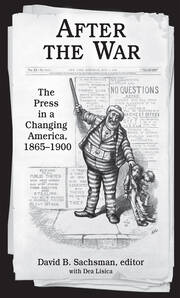
After the war : the press in a changing America, 1865-1900 / David B. Sachsman, editor ; with Dea Lisica.
Erişim Adresi
ISBN
9781351295055 (e-book: Mobi)
9781351295086 (e-book : PDF)
9781412865135 (hardback)
9781351295086 (e-book : PDF)
9781412865135 (hardback)
Dil Kodu
İngilizce
Yayın Bilgisi
London : Routledge, 2017.
Fiziksel Niteleme
1 online resource (xxxii, 385 pages)
Genel Not
First published 2017 by Transaction Publishers.
İçindekiler Notu
part, I Press, Politics, and Restoration / David B. Sachsman Lisica Dea -- chapter 1 Rebel Yells and Idle Vaporings: The Lost Cause Rises and Dissipates in the Chicago Tribune, the Atlanta Constitution, and the New York Times, 1860–1914 / Thomas C. Terry Donald L. Shaw -- chapter 2 The New Departure: The Northern Democratic Press and Reconstruction, 1868–1876 / Erik B. Alexander -- chapter 3 The Forgotten Issue: The Little Bighorn and the Election of 1876 / James E. Mueller -- chapter 4 Thomas Nast, Harper’s Weekly, and the Election of 1876 / William E. Huntzicker -- chapter 5 The President’s Private Life: A New Explanation for “The Right to Privacy” / Patricia Ferrier -- chapter 6 “Always to be the ‘Tocsin’”: Josephus Daniels, the News & Observer, and the Rise of Jim Crow / Thomas C. Terry Donald L. Shaw -- part, II Journalism in the Gilded Age: Entertaining the Masses, Serving the Public, and Raking the Muck / David B. Sachsman Lisica Dea -- chapter 7 Haunted Times? Ghosts in Crime Stories Printed by the New York Times, 1851–1901 / Paulette D. Kilmer -- chapter 8 The Rocky Mountains, Yosemite, and Other Natural Wonders: Western Landscape in Travel Correspondence of the Post–Civil War Press / Katrina J. Quinn -- chapter 9 Consuelo, the Duke, and the Press: Celebrity and Sensationalism in the Gilded Age / Wallace B. Eberhard -- chapter 10 Are You Going to the Hanging? Georgia Editors and the Movement to End Public Hangings / Wallace B. Eberhard -- chapter 11 Abolishing Wage Slavery in the Gilded Age: John Swinton and the American Labor Movement’s Memory of the Civil War / Maryan Soliman -- chapter 12 Babies as Breadwinners: Child Labor Prior to Federal Reform in the Industrial North and the Industrializing South, 1890–1899 / Amber Welch -- part, III Images of Immigrants, Race, and Gender / David B. Sachsman Lisica Dea -- chapter 13 Sickness from Abroad: How Media Framing of New Immigrants and Disease Fueled the Immigration Debate, 1891–1893 / Harriet Moore -- chapter 14 Changes in the News: Characterizing Immigration, 1850–1890 / Timothy L. Moran -- chapter 15 Riot, Race, and Placing Blame: Press Coverage of the 1885 Rock Springs Chinese Massacre / Rich Shumate -- chapter 16 “Black Fiends” and “Atrocious Murders”: Redefining “Sensationalism” through Coverage of Interracial Crime in the Nineteenth-Century Press / Lee Jolliffe -- chapter 17 Ida B. Wells and Coverage of Lynchings and Antilynching Efforts in Selected Mainstream Newspapers, 1892–1894 / Aleen J. Ratzlaff -- chapter 18 Custer and the “Savages”: Newspaper Coverage of the Indian War, Summer 1876 / Thomas C. Terry Donald L. Shaw -- chapter 19 A Moral Panic on the Plains? Press Culpability and the 1890 Massacre at Wounded Knee / Brian Gabrial -- chapter 20 Why Women Dared to Make Journalism Their Calling / Paulette D. Kilmer -- chapter 21 “They’d Vote for What is Pure and Good”: Representations of Women in the Gilded Age Press / Jennifer E. Moore -- chapter 22 The New Woman as Athlete: Coverage of the Sporting Woman in the Gilded Age Press / Amber Roessner.
Özet, vb.
"After the War presents a panoramic view of social, political, and economic change in post-Civil War America by examining its journalism, from coverage of politics and Reconstruction to sensational reporting and images of the American people. The changes in America during this time were so dramatic that they transformed the social structure of the country and the nature of journalism. By the 1870s and 1880s, new kinds of daily newspapers had developed. New Journalism eventually gave rise to Yellow Journalism, resulting in big-city newspapers that were increasingly sensationalistic, entertaining, and designed to attract everyone. The images of the nation's people as seen through journalistic eyes, from coverage of immigrants to stories about African American "Black fiends" and Native American "savages," tell a vibrant story that will engage scholars and students of history, journalism, and media studies.?"--Provided by publisher.
Konu
Journalism __ United States __ History __ 19th century.
Press __ United States __ History __ 19th century.
Press __ United States __ History __ 19th century.
Diğer Yazarlar
Veritabanı
Eseri Alıntıla
Referansları kullanmadan önce gözden geçirmeniz ve varsa gerekli düzeltmeleri yapmanız önerilir.
Dijital Kaynak
MARC Görünümü
LEADER 05407cam a2200337Ii 4500
001 799607
003 TR_AnAIT
005 20260123015608
008 180706r20172017enka ob 001 0 eng d
020 |a9781351295055|q(e-book: Mobi)
020 |a9781351295086|q(e-book : PDF)
020 |z9781412865135|q(hardback)
024 7 |a10.4324/9781351295086 |2doi
035 |a(OCoLC)997446764
040 |aFlBoTFG|cFlBoTFG|erda
041 |aeng
043 |an-us---
049 |aTürk Tarih Kurumu Kütüphanesi
050 4|aPN4864|b.A38 2017
082 04|a071.309034|bA258
245 00|aAfter the war :|bthe press in a changing America, 1865-1900 /|cDavid B. Sachsman, editor ; with Dea Lisica.
264 1|aLondon :|bRoutledge,|c2017.
300 |a1 online resource (xxxii, 385 pages)
336 |atext|2rdacontent
337 |acomputer|2rdamedia
338 |aonline resource|2rdacarrier
500 |aFirst published 2017 by Transaction Publishers.
505 00|tpart, I Press, Politics, and Restoration /|r David B. Sachsman Lisica Dea -- |tchapter 1 Rebel Yells and Idle Vaporings: The Lost Cause Rises and Dissipates in the Chicago Tribune, the Atlanta Constitution, and the New York Times, 1860–1914 /|r Thomas C. Terry Donald L. Shaw -- |tchapter 2 The New Departure: The Northern Democratic Press and Reconstruction, 1868–1876 /|r Erik B. Alexander -- |tchapter 3 The Forgotten Issue: The Little Bighorn and the Election of 1876 /|r James E. Mueller -- |tchapter 4 Thomas Nast, Harper’s Weekly, and the Election of 1876 /|r William E. Huntzicker -- |tchapter 5 The President’s Private Life: A New Explanation for “The Right to Privacy” /|r Patricia Ferrier -- |tchapter 6 “Always to be the ‘Tocsin’”: Josephus Daniels, the News & Observer, and the Rise of Jim Crow /|r Thomas C. Terry Donald L. Shaw -- |tpart, II Journalism in the Gilded Age: Entertaining the Masses, Serving the Public, and Raking the Muck /|r David B. Sachsman Lisica Dea -- |tchapter 7 Haunted Times? Ghosts in Crime Stories Printed by the New York Times, 1851–1901 /|r Paulette D. Kilmer -- |tchapter 8 The Rocky Mountains, Yosemite, and Other Natural Wonders: Western Landscape in Travel Correspondence of the Post–Civil War Press /|r Katrina J. Quinn -- |tchapter 9 Consuelo, the Duke, and the Press: Celebrity and Sensationalism in the Gilded Age /|r Wallace B. Eberhard -- |tchapter 10 Are You Going to the Hanging? Georgia Editors and the Movement to End Public Hangings /|r Wallace B. Eberhard -- |tchapter 11 Abolishing Wage Slavery in the Gilded Age: John Swinton and the American Labor Movement’s Memory of the Civil War /|r Maryan Soliman -- |tchapter 12 Babies as Breadwinners: Child Labor Prior to Federal Reform in the Industrial North and the Industrializing South, 1890–1899 /|r Amber Welch -- |tpart, III Images of Immigrants, Race, and Gender /|r David B. Sachsman Lisica Dea -- |tchapter 13 Sickness from Abroad: How Media Framing of New Immigrants and Disease Fueled the Immigration Debate, 1891–1893 /|r Harriet Moore -- |tchapter 14 Changes in the News: Characterizing Immigration, 1850–1890 /|r Timothy L. Moran -- |tchapter 15 Riot, Race, and Placing Blame: Press Coverage of the 1885 Rock Springs Chinese Massacre /|r Rich Shumate -- |tchapter 16 “Black Fiends” and “Atrocious Murders”: Redefining “Sensationalism” through Coverage of Interracial Crime in the Nineteenth-Century Press /|r Lee Jolliffe -- |tchapter 17 Ida B. Wells and Coverage of Lynchings and Antilynching Efforts in Selected Mainstream Newspapers, 1892–1894 /|r Aleen J. Ratzlaff -- |tchapter 18 Custer and the “Savages”: Newspaper Coverage of the Indian War, Summer 1876 /|r Thomas C. Terry Donald L. Shaw -- |tchapter 19 A Moral Panic on the Plains? Press Culpability and the 1890 Massacre at Wounded Knee /|r Brian Gabrial -- |tchapter 20 Why Women Dared to Make Journalism Their Calling /|r Paulette D. Kilmer -- |tchapter 21 “They’d Vote for What is Pure and Good”: Representations of Women in the Gilded Age Press /|r Jennifer E. Moore -- |tchapter 22 The New Woman as Athlete: Coverage of the Sporting Woman in the Gilded Age Press /|r Amber Roessner.
520 |a"After the War presents a panoramic view of social, political, and economic change in post-Civil War America by examining its journalism, from coverage of politics and Reconstruction to sensational reporting and images of the American people. The changes in America during this time were so dramatic that they transformed the social structure of the country and the nature of journalism. By the 1870s and 1880s, new kinds of daily newspapers had developed. New Journalism eventually gave rise to Yellow Journalism, resulting in big-city newspapers that were increasingly sensationalistic, entertaining, and designed to attract everyone. The images of the nation's people as seen through journalistic eyes, from coverage of immigrants to stories about African American "Black fiends" and Native American "savages," tell a vibrant story that will engage scholars and students of history, journalism, and media studies.?"--Provided by publisher.
650 0|aJournalism|zUnited States|xHistory|y19th century.
650 0|aPress|zUnited States|xHistory|y19th century.
700 1 |aLisica, Dea,|econtributor.
700 1 |aSachsman, David B.,|eeditor.
776 08|iPrint version: |z9781412865135|w(DLC) 2016055998
856 40|uhttps://www.taylorfrancis.com/books/9781351295086|zClick here to view.
901 |aTaylor & Francis
001 799607
003 TR_AnAIT
005 20260123015608
008 180706r20172017enka ob 001 0 eng d
020 |a9781351295055|q(e-book: Mobi)
020 |a9781351295086|q(e-book : PDF)
020 |z9781412865135|q(hardback)
024 7 |a10.4324/9781351295086 |2doi
035 |a(OCoLC)997446764
040 |aFlBoTFG|cFlBoTFG|erda
041 |aeng
043 |an-us---
049 |aTürk Tarih Kurumu Kütüphanesi
050 4|aPN4864|b.A38 2017
082 04|a071.309034|bA258
245 00|aAfter the war :|bthe press in a changing America, 1865-1900 /|cDavid B. Sachsman, editor ; with Dea Lisica.
264 1|aLondon :|bRoutledge,|c2017.
300 |a1 online resource (xxxii, 385 pages)
336 |atext|2rdacontent
337 |acomputer|2rdamedia
338 |aonline resource|2rdacarrier
500 |aFirst published 2017 by Transaction Publishers.
505 00|tpart, I Press, Politics, and Restoration /|r David B. Sachsman Lisica Dea -- |tchapter 1 Rebel Yells and Idle Vaporings: The Lost Cause Rises and Dissipates in the Chicago Tribune, the Atlanta Constitution, and the New York Times, 1860–1914 /|r Thomas C. Terry Donald L. Shaw -- |tchapter 2 The New Departure: The Northern Democratic Press and Reconstruction, 1868–1876 /|r Erik B. Alexander -- |tchapter 3 The Forgotten Issue: The Little Bighorn and the Election of 1876 /|r James E. Mueller -- |tchapter 4 Thomas Nast, Harper’s Weekly, and the Election of 1876 /|r William E. Huntzicker -- |tchapter 5 The President’s Private Life: A New Explanation for “The Right to Privacy” /|r Patricia Ferrier -- |tchapter 6 “Always to be the ‘Tocsin’”: Josephus Daniels, the News & Observer, and the Rise of Jim Crow /|r Thomas C. Terry Donald L. Shaw -- |tpart, II Journalism in the Gilded Age: Entertaining the Masses, Serving the Public, and Raking the Muck /|r David B. Sachsman Lisica Dea -- |tchapter 7 Haunted Times? Ghosts in Crime Stories Printed by the New York Times, 1851–1901 /|r Paulette D. Kilmer -- |tchapter 8 The Rocky Mountains, Yosemite, and Other Natural Wonders: Western Landscape in Travel Correspondence of the Post–Civil War Press /|r Katrina J. Quinn -- |tchapter 9 Consuelo, the Duke, and the Press: Celebrity and Sensationalism in the Gilded Age /|r Wallace B. Eberhard -- |tchapter 10 Are You Going to the Hanging? Georgia Editors and the Movement to End Public Hangings /|r Wallace B. Eberhard -- |tchapter 11 Abolishing Wage Slavery in the Gilded Age: John Swinton and the American Labor Movement’s Memory of the Civil War /|r Maryan Soliman -- |tchapter 12 Babies as Breadwinners: Child Labor Prior to Federal Reform in the Industrial North and the Industrializing South, 1890–1899 /|r Amber Welch -- |tpart, III Images of Immigrants, Race, and Gender /|r David B. Sachsman Lisica Dea -- |tchapter 13 Sickness from Abroad: How Media Framing of New Immigrants and Disease Fueled the Immigration Debate, 1891–1893 /|r Harriet Moore -- |tchapter 14 Changes in the News: Characterizing Immigration, 1850–1890 /|r Timothy L. Moran -- |tchapter 15 Riot, Race, and Placing Blame: Press Coverage of the 1885 Rock Springs Chinese Massacre /|r Rich Shumate -- |tchapter 16 “Black Fiends” and “Atrocious Murders”: Redefining “Sensationalism” through Coverage of Interracial Crime in the Nineteenth-Century Press /|r Lee Jolliffe -- |tchapter 17 Ida B. Wells and Coverage of Lynchings and Antilynching Efforts in Selected Mainstream Newspapers, 1892–1894 /|r Aleen J. Ratzlaff -- |tchapter 18 Custer and the “Savages”: Newspaper Coverage of the Indian War, Summer 1876 /|r Thomas C. Terry Donald L. Shaw -- |tchapter 19 A Moral Panic on the Plains? Press Culpability and the 1890 Massacre at Wounded Knee /|r Brian Gabrial -- |tchapter 20 Why Women Dared to Make Journalism Their Calling /|r Paulette D. Kilmer -- |tchapter 21 “They’d Vote for What is Pure and Good”: Representations of Women in the Gilded Age Press /|r Jennifer E. Moore -- |tchapter 22 The New Woman as Athlete: Coverage of the Sporting Woman in the Gilded Age Press /|r Amber Roessner.
520 |a"After the War presents a panoramic view of social, political, and economic change in post-Civil War America by examining its journalism, from coverage of politics and Reconstruction to sensational reporting and images of the American people. The changes in America during this time were so dramatic that they transformed the social structure of the country and the nature of journalism. By the 1870s and 1880s, new kinds of daily newspapers had developed. New Journalism eventually gave rise to Yellow Journalism, resulting in big-city newspapers that were increasingly sensationalistic, entertaining, and designed to attract everyone. The images of the nation's people as seen through journalistic eyes, from coverage of immigrants to stories about African American "Black fiends" and Native American "savages," tell a vibrant story that will engage scholars and students of history, journalism, and media studies.?"--Provided by publisher.
650 0|aJournalism|zUnited States|xHistory|y19th century.
650 0|aPress|zUnited States|xHistory|y19th century.
700 1 |aLisica, Dea,|econtributor.
700 1 |aSachsman, David B.,|eeditor.
776 08|iPrint version: |z9781412865135|w(DLC) 2016055998
856 40|uhttps://www.taylorfrancis.com/books/9781351295086|zClick here to view.
901 |aTaylor & Francis
Materyaller
Depodan talep edilen materyal sadece kütüphane içerisinde kullanılmaktadır.
Materyal dışarıya ödünç verilmemektedir.
Materyal dışarıya ödünç verilmemektedir.
