LEADER 04187cam a22005298i 4500
001 799721
003 TR_AnAIT
005 20260123015747
006 m o d
007 cr |||||||||||
008 210914s2022 enk ob 001 0 eng
020 |a9780429202254|q(ebook)
020 |a0429202253
020 |a9780429510878|q(electronic bk. : PDF)
020 |a042951087X|q(electronic bk. : PDF)
020 |a9780429517730|q(electronic bk. : Mobipocket)
020 |a0429517734|q(electronic bk. : Mobipocket)
020 |a9780429514302|q(electronic bk. : EPUB)
020 |a0429514301|q(electronic bk. : EPUB)
020 |z9781032139784|q(hardback)
020 |z9781032139791|q(paperback)
035 |a(OCoLC)1268545891
035 |a(OCoLC-P)1268545891
040 |aOCoLC-P|beng|erda|cOCoLC-P
041 |aeng
049 |aTürk Tarih Kurumu Kütüphanesi
050 00|aHE551
072 7|aBUS|x023000|2bisacsh
072 7|aBUS|x067000|2bisacsh
072 7|aBUS|x069000|2bisacsh
072 7|aKCZ|2bicssc
082 00|a307.76|223
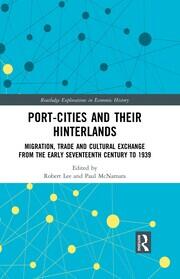
245 00|aPort-cities and their hinterlands :|bmigration, trade and cultural exchange from the early seventeenth-century to 1939 /|cedited by Robert Lee and Paul McNamara.
264 1|aAbingdon, Oxon ;|aNew York, NY :|bRoutledge,|c2022.
300 |a1 online resource.
336 |atext|btxt|2rdacontent
337 |acomputer|bc|2rdamedia
338 |aonline resource|bcr|2rdacarrier
490 0 |aRoutledge explorations in economic history
520 |a"This interdisciplinary book brings together eleven original contributions by scholars in the United Kingdom, continental Europe, America and Japan which represent innovative and important research on the relationship between cities and their hinterlands. They discuss the factors which determined the changing nature of port-hinterland relations in particular, and highlight the ways in which port-cities have interacted and intersected with their different hinterlands as a result of both in- and out-migration, cultural exchange and the wider flow of goods, services and information. Historically, maritime commerce was a powerful driving force behind urbanisation and by 1850 seaports accounted for a significant proportion of the world's great cities. Ports acted as nodal points for the flow of population and the dissemination of goods and services, but their role as growth poles also affected the economic transformation of both their hinterlands and forelands. In fact, most ports, irrespective of their size, had a series of overlapping hinterlands whose shifting importance reflected changes in trading relations (political frameworks), migration patterns, family networks, and cultural exchange. Urban historians have been criticised for being concerned primarily with self-contained processes which operate within the boundaries of individual towns and cities and as a result, the key relationships between cities and their hinterlands have often been neglected. The chapters in this work focus primarily on the determinants of port-hinterland linkages and analyse these as distinct, but interrelated, fields of interaction. Marking a significant contribution to the literature in this field, Port-Cities and their Hinterlands provides essential reading for students and scholars of the history of economics. Robert Lee was the Chaddock Professor of Economic and Social History at the University of Liverpool, UK, where he is now an Emeritus and Honorary Professor. Paul McNamara is Assistant Professor in History and Political Science at the Technical University of Koszalin, Poland"--|cProvided by publisher.
588 |aOCLC-licensed vendor bibliographic record.
650 0|aPort cities|xHistory.
650 7|aBUSINESS & ECONOMICS / Economic History|2bisacsh
650 7|aBUSINESS & ECONOMICS / Urban & Regional|2bisacsh
650 7|aBUSINESS & ECONOMICS / Economics / General|2bisacsh
700 1 |aLee, W. Robert,|eeditor.
700 1 |aMcNamara, Paul|c(Lecturer),|eeditor.
856 40|3Taylor & Francis|uhttps://www.taylorfrancis.com/books/9780429202254
856 42|3OCLC metadata license agreement|uhttp://www.oclc.org/content/dam/oclc/forms/terms/vbrl-201703.pdf
901 |aTaylor & Francis