LEADER 03521cam a2200469Mu 4500
001 799753
003 TR_AnAIT
005 20260123015817
006 m d
007 cr cnu---unuuu
008 191116s2020 enk o 000 0 eng d
020 |a9781000732610
020 |a1000732614
020 |a9780429351938|q(electronic bk.)
020 |a0429351933|q(electronic bk.)
020 |a9781000732894|q(electronic bk. : EPUB)
020 |a1000732894|q(electronic bk. : EPUB)
020 |a9781000732757|q(electronic bk. : Mobipocket)
020 |a1000732754|q(electronic bk. : Mobipocket)
020 |z0367369249
020 |z9780367369248
020 |z0367369257
020 |z9780367369255
035 |a(OCoLC)1127941625|z(OCoLC)1127861386
035 |a(OCoLC-P)1127941625
040 |aOCoLC-P|beng|cOCoLC-P
041 |aeng
049 |aTürk Tarih Kurumu Kütüphanesi
050 4|aBF23
072 7|aPSY|x026000|2bisacsh
072 7|aJMAF|2bicssc
082 04|a150.1952|223
100 1 |aDuffy, Kathleen|c(Psychotherapist)
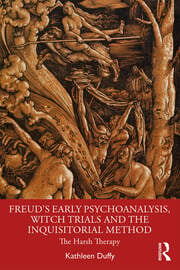
245 10|aFreud's Early Psychoanalysis, Witch Trials and the Inquisitorial Method|h[electronic resource] :|bThe Harsh Therapy.
260 |aLondon :|bRoutledge,|c2020.
300 |a1 online resource (189 p.)
500 |aDescription based upon print version of record.
520 |aIn Freud's Early Psychoanalysis, Witch Trials and the Inquisitorial Method: The Harsh Therapy, author Kathleen Duffy asks why Freud compared his hysterical' patients to the accused women in the witch trials, and his psychoanalytical' treatment to the inquisitorial method of their judges. He wrote in 1897 to Wilhelm Fliess: I ... understand the harsh therapy of the witches' judges'. This book proves that Freud's view of his method as inquisitorial was both serious and accurate. In this multidisciplinary and in-depth examination, Duffy demonstrates that Freud carefully studied the witch trial literature to develop the supposed parallels between his patients and the witches and between his own psychoanalytic method and the judges' inquisitorial extraction of confessions',by torture if necessary. She examines in meticulous detail both the witch trial literature that Freud studied and his own case studies, papers, letters and other writings. She shows that the various stages of his developing early psychoanalytic method, from the 'Katharina' case of 1893, through the so-called seduction theory of 1896 and its retraction, to the 'Dora' case of 1900, were indeed in many respects inquisitorial and invalidated his patients' experience. This book demonstrates with devastating effect the destructive consequences of Freud's nineteenth-century inquisitorial practice. This raises the question aboutthe extent to which his mature practice and psychoanalysis and psychotherapy today, despite great achievements, remain at times inquisitorial and consequently untrustworthy. This book will therefore be invaluable not only to academics, practitioners and students of psychoanalysis, psychotherapy, literature, history and cultural studies, but also to those seeking professional psychoanalytic or psychotherapeutic help.
588 |aOCLC-licensed vendor bibliographic record.
600 10|aFreud, Sigmund,|d1856-1939.
650 7|aPSYCHOLOGY / Movements / Psychoanalysis|2bisacsh
650 0|aPsychoanalysis.
856 40|3Taylor & Francis|uhttps://www.taylorfrancis.com/books/9780429351938
856 42|3OCLC metadata license agreement|uhttp://www.oclc.org/content/dam/oclc/forms/terms/vbrl-201703.pdf
901 |aTaylor & Francis