

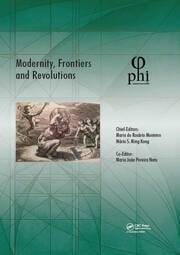
Modernity, Frontiers and Revolutions : Proceedings of the 4th International Multidisciplinary Congress (PHI 2018), October 3-6, 2018, S. Miguel, Azores, Portugal / edited by Maria do Rosário Monteiro, Mário S. Ming Kong and Maria João Pereira Neto.
Erişim Adresi
ISBN
9780429399831 (e-book : PDF)
Dil Kodu
İngilizce
İngilizce
İngilizce
Basım Bildirimi
First edition.
Yayın Bilgisi
Boca Raton, FL : CRC Press, [2018].
©2019.
©2019.
Fiziksel Niteleme
1 online resource (510 pages)
Dizi
PHI
Bibliyografi, vb. Notu
Includes bibliographical references and index.
İçindekiler Notu
Part I: Modernity: Frontiers and revolutions -- Know how and cultural context: From ideas to facts and from facts to ideas --M. Silva -- A silent revolution --J. Seixas -- A paradigm for the 21st century considering fuzzy logic --G. Braviano -- Modernity, revolutions and frontiers in Philip Pullmans His Dark Materials or a contribution to the fourth culture --M. do Rosrio Monteiro -- -- Part II: Architecture/urbanism/design -- The invention of the architect: The reiteration of the scale model as a representational system under the definition of a new paradigm for the profession --J.M. Couto Duarte -- Architecture and modern science: The mathematics of the circlearithmetic and geometry as figure and symbol in the Renaissance and Baroque --C.G. Gonalves -- Revolutionised through glass: Russian modernism in the age of the Crystal Palace --I. Seits -- 19th century industrial architecture related to the olive grove revolution in the province of Jan, Spain --S.P. Alarcn -- The Joy at work as a revolution: Evolution of the industrial space, from the place of production to one of re-creation --R. Maddaluno -- Vienna 1900: Stage of modernities --J. Nunes -- The machine of living in Brazil: An Oscar Niemeyer experience --E. Kuchpil & A. Pimentel dos Santos -- The Ural Architectural School: Integration into the international higher education space: Utopia or reality? --I.V. Tarasova -- Architecture of representation X architecture of living --G.M. de Carvalho -- Cultural anthropophagy and regionalism in the architectures of Brazil and Portugal in the 20th century --U.M. de Andrade -- Expressiveness and figuration in the construction of social architecture --D. Chizzoniti & M. Moscatelli -- Lean alternative: The plastic use of concrete in the architecture of Paolo Soleri in the United States of America --P. Viscomi -- Like a machine in motion: The modernity of the Cagliari Opera House and the Osaka Expo Pavilion by Maurizio Sacripanti --S. Centineo -- The influence of the proposals of the sixties: An open context of the contemporary city in a new hypermodern era --A.M. Feliciano -- Modernity and preservation in Casa Forte: The dialogue between the frontier of the new and the protection of the ancient --T. Fonseca, A. Fonseca & F. Moreira da Silva -- Out of the BOXinto the BIM: The limits and paradoxes of creative thinking and the new frontiers for architecture teaching --F. Oliveira -- Castle cities and their contribution to modern Japan --F. Carmo -- A perspective on the Portuguese identity: The idea of modernity in A Exposiao do Mundo Portugues and Expo98 --A. Neiva & J. Cabral Dias -- Beyond self-hating urbanism; Identifying a common pathology --J. Silva Jordao -- The urban project as a holistic approach to the recovery of degraded areas of public housing --C. Montalbano -- An interscalar approach to the recovery of degraded neighbourhoods of public housing --C. Chiarantoni -- Dwelling on the border; A strategy for refugees in the town of Calais --M. Louro & B. Ribeiro -- Finitio: Afore and beyond limit in the binomial We and Others --J.L. Morgado -- From palimpsest to an intentional identity re-inscription: The value and ways of preserving an identity essence in the urban and architectural rehabilitation of our contemporaneity --A. Santos Leite -- A quiet revolution: Electric mobility and the new city soundscape --P.C. Monteiro -- The project as an instrument of social participationinclusive and reverential ecology project --F. Moreira da Silva -- Interactive printed book: A design experience --M. Neves & I. Caixeiro -- Production of didactic material for visually impaired children in science teaching --B. de Cssia Xavier Cassins Aguiar, G. de Frana Aguiar, A.F. Andrade & Q.S. Coden -- Production of didactic material for the visually impaired in mathematics teaching --B. de Cssia Xavier Cassins Aguiar, G. de Frana Aguiar, A.F. Andrade & Q.S. Coden -- Developing a trumpet configuration applying a methodology from design-by-drawing and craft evolution --E. Aparo, F. Moreira da Silva & L. Soares -- Standardisation of the female body and the plus-size market --C. de Holanda Sousa Matos Sousa, M.J. Pereira Neto & H.P. Lopes -- -- Part III: Arts -- The self-reflection of the artists hands --D. Swartz -- The modern paradigm of art and its frontiers --G. Horvth -- Imaginary construction in visual art: The case of Piranesi and Matta-Clark --S. Paiva de Sousa & M. Baptista-Bastos -- Modernity and frontiers: Art travel in the colonial context --M.J. Castro -- False sailing maps --A.L.M.M. Rodrigues -- Le Portugais by Georges Braque: A frontier and evocative boundary-place --A. Vasconcelos -- Free-hand drawing versus new technologies in project creative process --A. Moreira da Silva -- Digital technologies, a modern medium: Pushing frontiers through a creative artistic approach --A. Canau -- Graphite and pixel: Related knowledge of modernity --A.R. Ortega & S. Weihermann -- -- Part IV: Humanities -- Revolutions in film in the postmodern narrative: A matter of illusion and memory --I. Borbely -- Ideals, reality and frontiers of human existence in fiction films: Their expression, representation, living, telling and space --C.M. Figueiredo -- Praising silence in the modern literary artwork --F. Ribeiro -- April in fantasy: Polyphonic memories of the revolution --M. Rendeiro -- Modernity, gender and cultural representations in the work of Mozambican writer Suleiman Cassamo: Redefining the revolution and its legacy --A.M. Martinho Gale -- Breaking boundaries, challenging modernity, building revolutions: Rap in Portugal and its new generation of female voices --F. Lupati -- The early sixties in the 20th century and their artistic expressions: The third and last Portuguese Modernism --M. Baptista-Bastos & S. Paiva de Sousa -- A hero with many faces; The frontiers of authorial identity in translated texts --L. Sampaio da Silva -- Crossing borders and dreaming the revolution in Nuno Braganas A Noite e o Riso --L.S. Loureiro -- Alexandria, the building of an imaginary city; Frontiers and silent, inner revolutions --M. Avelar -- New winds, distinct times of the Church: The activity of Bishop Sardinha and the Provincial Nbrega in Brazil (16th century) --M. Boscariol -- Ways of negotiating, social frontiers and modernity --M.L.G. da Cruz -- Revolts and revolutions under slavery --M. do Rosrio Pimentel -- Tradition and modernity in the memory of an empire: The writing of A. Lopes Mendes --A.P. Avelar -- Demystifying oriental alterities: Pedro Teixeira and the early modern scientificity regarding the past --M. de Ftima Rosa & I. Almeida -- Exploring Africa in the Nordic Press. David Livingstone, Henry Stanley and the popular fascination with exploration and adventure in Africa in the late 19th century --K.S. Groop -- The contribution of Lusophone publishing in the autonomy of the periphery: Exile, diaspora, anti-colonialism and national literature in Africa --D. Melo -- Alfredo Bensade: A revolutionary in the tra ining of engineers --A. Cardoso de Matos & M. da Luz Sampaio -- -- Part V: Social sciences -- Universal Exhibition Paris 1900: Celebration of modernity, women and fashion --M.J. Pereira Neto -- A revolutionary humanitarian: The moral socialism of Richard Congreve --M. Wilson -- Mediator of modernity: Anders Svedberg as a link between the elite and the peasantry and between tradition and modernity --J. Dahlbacka -- Das Wunder von Leipzig; The Paulinum in Leipzig and palimpsestic memories of oppression and revolution --K.S. Groop -- Transculturation and translanguaging as representation of second modernity: Polish migrants in the East Midlands, UK --R. Seredynska-Abou Eid -- Destination development along the Austrian-Hungarian border --R. Bagdi -- The role of flight specification in travel decision making --A. Mondok, M. Krdi, A. Szab & R. Bakos -- What revolution could be in the times of biocapitalism? --S. Wrbel
Özet, vb.
The texts presented in Proportion Harmonies and Identities (PHI) - MODERNITY, FRONTIERS AND REVOLUTIONS were compiled with the intent to establish a multidisciplinary platform for the presentation, interaction and dissemination of research. It also aims to foster awareness of and discussion on the topics of Harmony and Proportion with a focus on different visions relevant to Architecture, Arts and Humanities, Design, Engineering, Social and Natural Sciences, and their importance and benefits for the sense of both individual and community identity. The idea of modernity has been a significant driver of development since the Western Early Modern Age. Its theoretical and practical foundations have become the working tools of scientists, philosophers, and artists, who seek strategies and policies to accelerate the development process in different contexts.
Konu
Harmony (Aesthetics) __ Congresses.
Proportion __ Congresses.
SOCIAL SCIENCE / Anthropology / Physical. __ bisacsh
TECHNOLOGY & ENGINEERING / Civil / General. __ bisacsh
architecture. __ bisacsh
arts and humanities. __ bisacsh
design. __ bisacsh
engineering. __ bisacsh
social and natural sciences. __ bisacsh
technology. __ bisacsh
Electronic books.
Proportion __ Congresses.
SOCIAL SCIENCE / Anthropology / Physical. __ bisacsh
TECHNOLOGY & ENGINEERING / Civil / General. __ bisacsh
architecture. __ bisacsh
arts and humanities. __ bisacsh
design. __ bisacsh
engineering. __ bisacsh
social and natural sciences. __ bisacsh
technology. __ bisacsh
Electronic books.
Kurum Adı
Veritabanı
Eseri Alıntıla
Referansları kullanmadan önce gözden geçirmeniz ve varsa gerekli düzeltmeleri yapmanız önerilir.
Dijital Kaynak
MARC Görünümü
LEADER 11056nam a2200589Ii 4500
001 799760
003 TR_AnAIT
005 20260123015824
006 m o d
007 cr
008 181112t20182019flu b ob 001 0 eng d
020 |a9780429399831|q(e-book : PDF)
035 |a(OCoLC)1055160588
040 |aFlBoTFG|cFlBoTFG|erda
041 1 |aeng
041 |aeng
049 |aTürk Tarih Kurumu Kütüphanesi
050 4|aBH301|b.H3
072 7|aSOC|x000000 |2bisacsh
072 7|aSOC|x002020 |2bisacsh
072 7|aTEC|x009020 |2bisacsh
072 7|aTN |2bicscc
082 04|a701.17
245 00|aModernity, Frontiers and Revolutions :|bProceedings of the 4th International Multidisciplinary Congress (PHI 2018), October 3-6, 2018, S. Miguel, Azores, Portugal /|cedited by Maria do Rosário Monteiro, Mário S. Ming Kong and Maria João Pereira Neto.
250 |aFirst edition.
264 1|aBoca Raton, FL :|bCRC Press,|c[2018].
264 4|c©2019.
300 |a1 online resource (510 pages)
336 |atext|2rdacontent
337 |acomputer|2rdamedia
338 |aonline resource|2rdacarrier
490 1 |aPHI
504 |aIncludes bibliographical references and index.
505 00|tPart I: Modernity: Frontiers and revolutions -- |tKnow how and cultural context: From ideas to facts and from facts to ideas --M. Silva -- |tA silent revolution --J. Seixas -- |tA paradigm for the 21st century considering fuzzy logic --G. Braviano -- |tModernity, revolutions and frontiers in Philip Pullmans His Dark Materials or a contribution to the fourth culture --M. do Rosrio Monteiro -- |t -- |tPart II: Architecture/urbanism/design -- |tThe invention of the architect: The reiteration of the scale model as a representational system under the definition of a new paradigm for the profession --J.M. Couto Duarte -- |tArchitecture and modern science: The mathematics of the circlearithmetic and geometry as figure and symbol in the Renaissance and Baroque --C.G. Gonalves -- |tRevolutionised through glass: Russian modernism in the age of the Crystal Palace --I. Seits -- |t19th century industrial architecture related to the olive grove revolution in the province of Jan, Spain --S.P. Alarcn -- |tThe Joy at work as a revolution: Evolution of the industrial space, from the place of production to one of re-creation --R. Maddaluno -- |tVienna 1900: Stage of modernities --J. Nunes -- |tThe machine of living in Brazil: An Oscar Niemeyer experience --E. Kuchpil & A. Pimentel dos Santos -- |tThe Ural Architectural School: Integration into the international higher education space: Utopia or reality? --I.V. Tarasova -- |tArchitecture of representation X architecture of living --G.M. de Carvalho -- |tCultural anthropophagy and regionalism in the architectures of Brazil and Portugal in the 20th century --U.M. de Andrade -- |tExpressiveness and figuration in the construction of social architecture --D. Chizzoniti & M. Moscatelli -- |tLean alternative: The plastic use of concrete in the architecture of Paolo Soleri in the United States of America --P. Viscomi -- |tLike a machine in motion: The modernity of the Cagliari Opera House and the Osaka Expo Pavilion by Maurizio Sacripanti --S. Centineo -- |tThe influence of the proposals of the sixties: An open context of the contemporary city in a new hypermodern era --A.M. Feliciano -- |tModernity and preservation in Casa Forte: The dialogue between the frontier of the new and the protection of the ancient --T. Fonseca, A. Fonseca & F. Moreira da Silva -- |tOut of the BOXinto the BIM: The limits and paradoxes of creative thinking and the new frontiers for architecture teaching --F. Oliveira -- |tCastle cities and their contribution to modern Japan --F. Carmo -- |tA perspective on the Portuguese identity: The idea of modernity in A Exposiao do Mundo Portugues and Expo98 --A. Neiva & J. Cabral Dias -- |tBeyond self-hating urbanism; Identifying a common pathology --J. Silva Jordao -- |tThe urban project as a holistic approach to the recovery of degraded areas of public housing --C. Montalbano -- |tAn interscalar approach to the recovery of degraded neighbourhoods of public housing --C. Chiarantoni -- |tDwelling on the border; A strategy for refugees in the town of Calais --M. Louro & B. Ribeiro -- |tFinitio: Afore and beyond limit in the binomial We and Others --J.L. Morgado -- |tFrom palimpsest to an intentional identity re-inscription: The value and ways of preserving an identity essence in the urban and architectural rehabilitation of our contemporaneity --A. Santos Leite -- |tA quiet revolution: Electric mobility and the new city soundscape --P.C. Monteiro -- |tThe project as an instrument of social participationinclusive and reverential ecology project --F. Moreira da Silva -- |tInteractive printed book: A design experience --M. Neves & I. Caixeiro -- |tProduction of didactic material for visually impaired children in science teaching --B. de Cssia Xavier Cassins Aguiar, G. de Frana Aguiar, A.F. Andrade & Q.S. Coden -- |tProduction of didactic material for the visually impaired in mathematics teaching --B. de Cssia Xavier Cassins Aguiar, G. de Frana Aguiar, A.F. Andrade & Q.S. Coden -- |tDeveloping a trumpet configuration applying a methodology from design-by-drawing and craft evolution --E. Aparo, F. Moreira da Silva & L. Soares -- |tStandardisation of the female body and the plus-size market --C. de Holanda Sousa Matos Sousa, M.J. Pereira Neto & H.P. Lopes -- |t -- |tPart III: Arts -- |tThe self-reflection of the artists hands --D. Swartz -- |tThe modern paradigm of art and its frontiers --G. Horvth -- |tImaginary construction in visual art: The case of Piranesi and Matta-Clark --S. Paiva de Sousa & M. Baptista-Bastos -- |tModernity and frontiers: Art travel in the colonial context --M.J. Castro -- |tFalse sailing maps --A.L.M.M. Rodrigues -- |tLe Portugais by Georges Braque: A frontier and evocative boundary-place --A. Vasconcelos -- |tFree-hand drawing versus new technologies in project creative process --A. Moreira da Silva -- |tDigital technologies, a modern medium: Pushing frontiers through a creative artistic approach --A. Canau -- |tGraphite and pixel: Related knowledge of modernity --A.R. Ortega & S. Weihermann -- |t -- |tPart IV: Humanities -- |tRevolutions in film in the postmodern narrative: A matter of illusion and memory --I. Borbely -- |tIdeals, reality and frontiers of human existence in fiction films: Their expression, representation, living, telling and space --C.M. Figueiredo -- |tPraising silence in the modern literary artwork --F. Ribeiro -- |tApril in fantasy: Polyphonic memories of the revolution --M. Rendeiro -- |tModernity, gender and cultural representations in the work of Mozambican writer Suleiman Cassamo: Redefining the revolution and its legacy --A.M. Martinho Gale -- |tBreaking boundaries, challenging modernity, building revolutions: Rap in Portugal and its new generation of female voices --F. Lupati -- |tThe early sixties in the 20th century and their artistic expressions: The third and last Portuguese Modernism --M. Baptista-Bastos & S. Paiva de Sousa -- |tA hero with many faces; The frontiers of authorial identity in translated texts --L. Sampaio da Silva -- |tCrossing borders and dreaming the revolution in Nuno Braganas A Noite e o Riso --L.S. Loureiro -- |tAlexandria, the building of an imaginary city; Frontiers and silent, inner revolutions --M. Avelar -- |tNew winds, distinct times of the Church: The activity of Bishop Sardinha and the Provincial Nbrega in Brazil (16th century) --M. Boscariol -- |tWays of negotiating, social frontiers and modernity --M.L.G. da Cruz -- |tRevolts and revolutions under slavery --M. do Rosrio Pimentel -- |tTradition and modernity in the memory of an empire: The writing of A. Lopes Mendes --A.P. Avelar -- |tDemystifying oriental alterities: Pedro Teixeira and the early modern scientificity regarding the past --M. de Ftima Rosa & I. Almeida -- |tExploring Africa in the Nordic Press. David Livingstone, Henry Stanley and the popular fascination with exploration and adventure in Africa in the late 19th century --K.S. Groop -- |tThe contribution of Lusophone publishing in the autonomy of the periphery: Exile, diaspora, anti-colonialism and national literature in Africa --D. Melo -- |tAlfredo Bensade: A revolutionary in the tra ining of engineers --A. Cardoso de Matos & M. da Luz Sampaio -- |t -- |tPart V: Social sciences -- |tUniversal Exhibition Paris 1900: Celebration of modernity, women and fashion --M.J. Pereira Neto -- |tA revolutionary humanitarian: The moral socialism of Richard Congreve --M. Wilson -- |tMediator of modernity: Anders Svedberg as a link between the elite and the peasantry and between tradition and modernity --J. Dahlbacka -- |tDas Wunder von Leipzig; The Paulinum in Leipzig and palimpsestic memories of oppression and revolution --K.S. Groop -- |tTransculturation and translanguaging as representation of second modernity: Polish migrants in the East Midlands, UK --R. Seredynska-Abou Eid -- |tDestination development along the Austrian-Hungarian border --R. Bagdi -- |tThe role of flight specification in travel decision making --A. Mondok, M. Krdi, A. Szab & R. Bakos -- |tWhat revolution could be in the times of biocapitalism? --S. Wrbel
520 3 |aThe texts presented in Proportion Harmonies and Identities (PHI) - MODERNITY, FRONTIERS AND REVOLUTIONS were compiled with the intent to establish a multidisciplinary platform for the presentation, interaction and dissemination of research. It also aims to foster awareness of and discussion on the topics of Harmony and Proportion with a focus on different visions relevant to Architecture, Arts and Humanities, Design, Engineering, Social and Natural Sciences, and their importance and benefits for the sense of both individual and community identity. The idea of modernity has been a significant driver of development since the Western Early Modern Age. Its theoretical and practical foundations have become the working tools of scientists, philosophers, and artists, who seek strategies and policies to accelerate the development process in different contexts.
530 |aAlso available in print format.
650 0|aHarmony (Aesthetics)|vCongresses.
650 0|aProportion|vCongresses.
650 7|aSOCIAL SCIENCE / Anthropology / Physical.|2bisacsh
650 7|aTECHNOLOGY & ENGINEERING / Civil / General.|2bisacsh
650 7|aarchitecture.|2bisacsh
650 7|aarts and humanities.|2bisacsh
650 7|adesign.|2bisacsh
650 7|aengineering.|2bisacsh
650 7|asocial and natural sciences.|2bisacsh
650 7|atechnology.|2bisacsh
655 0|aElectronic books.
700 1 |aRosário Monteiro, Maria do,|eeditor.
700 1 |aMing Kong, Mário S.,|eeditor.
700 1 |aPereira Neto, Maria João,|eeditor.
710 2 |aTaylor and Francis.
776 08|iPrint version: |z9780367023973
830 0|aPHI.
856 40|uhttps://www.taylorfrancis.com/books/9780429399831|zClick here to view.
901 |aTaylor & Francis
001 799760
003 TR_AnAIT
005 20260123015824
006 m o d
007 cr
008 181112t20182019flu b ob 001 0 eng d
020 |a9780429399831|q(e-book : PDF)
035 |a(OCoLC)1055160588
040 |aFlBoTFG|cFlBoTFG|erda
041 1 |aeng
041 |aeng
049 |aTürk Tarih Kurumu Kütüphanesi
050 4|aBH301|b.H3
072 7|aSOC|x000000 |2bisacsh
072 7|aSOC|x002020 |2bisacsh
072 7|aTEC|x009020 |2bisacsh
072 7|aTN |2bicscc
082 04|a701.17
245 00|aModernity, Frontiers and Revolutions :|bProceedings of the 4th International Multidisciplinary Congress (PHI 2018), October 3-6, 2018, S. Miguel, Azores, Portugal /|cedited by Maria do Rosário Monteiro, Mário S. Ming Kong and Maria João Pereira Neto.
250 |aFirst edition.
264 1|aBoca Raton, FL :|bCRC Press,|c[2018].
264 4|c©2019.
300 |a1 online resource (510 pages)
336 |atext|2rdacontent
337 |acomputer|2rdamedia
338 |aonline resource|2rdacarrier
490 1 |aPHI
504 |aIncludes bibliographical references and index.
505 00|tPart I: Modernity: Frontiers and revolutions -- |tKnow how and cultural context: From ideas to facts and from facts to ideas --M. Silva -- |tA silent revolution --J. Seixas -- |tA paradigm for the 21st century considering fuzzy logic --G. Braviano -- |tModernity, revolutions and frontiers in Philip Pullmans His Dark Materials or a contribution to the fourth culture --M. do Rosrio Monteiro -- |t -- |tPart II: Architecture/urbanism/design -- |tThe invention of the architect: The reiteration of the scale model as a representational system under the definition of a new paradigm for the profession --J.M. Couto Duarte -- |tArchitecture and modern science: The mathematics of the circlearithmetic and geometry as figure and symbol in the Renaissance and Baroque --C.G. Gonalves -- |tRevolutionised through glass: Russian modernism in the age of the Crystal Palace --I. Seits -- |t19th century industrial architecture related to the olive grove revolution in the province of Jan, Spain --S.P. Alarcn -- |tThe Joy at work as a revolution: Evolution of the industrial space, from the place of production to one of re-creation --R. Maddaluno -- |tVienna 1900: Stage of modernities --J. Nunes -- |tThe machine of living in Brazil: An Oscar Niemeyer experience --E. Kuchpil & A. Pimentel dos Santos -- |tThe Ural Architectural School: Integration into the international higher education space: Utopia or reality? --I.V. Tarasova -- |tArchitecture of representation X architecture of living --G.M. de Carvalho -- |tCultural anthropophagy and regionalism in the architectures of Brazil and Portugal in the 20th century --U.M. de Andrade -- |tExpressiveness and figuration in the construction of social architecture --D. Chizzoniti & M. Moscatelli -- |tLean alternative: The plastic use of concrete in the architecture of Paolo Soleri in the United States of America --P. Viscomi -- |tLike a machine in motion: The modernity of the Cagliari Opera House and the Osaka Expo Pavilion by Maurizio Sacripanti --S. Centineo -- |tThe influence of the proposals of the sixties: An open context of the contemporary city in a new hypermodern era --A.M. Feliciano -- |tModernity and preservation in Casa Forte: The dialogue between the frontier of the new and the protection of the ancient --T. Fonseca, A. Fonseca & F. Moreira da Silva -- |tOut of the BOXinto the BIM: The limits and paradoxes of creative thinking and the new frontiers for architecture teaching --F. Oliveira -- |tCastle cities and their contribution to modern Japan --F. Carmo -- |tA perspective on the Portuguese identity: The idea of modernity in A Exposiao do Mundo Portugues and Expo98 --A. Neiva & J. Cabral Dias -- |tBeyond self-hating urbanism; Identifying a common pathology --J. Silva Jordao -- |tThe urban project as a holistic approach to the recovery of degraded areas of public housing --C. Montalbano -- |tAn interscalar approach to the recovery of degraded neighbourhoods of public housing --C. Chiarantoni -- |tDwelling on the border; A strategy for refugees in the town of Calais --M. Louro & B. Ribeiro -- |tFinitio: Afore and beyond limit in the binomial We and Others --J.L. Morgado -- |tFrom palimpsest to an intentional identity re-inscription: The value and ways of preserving an identity essence in the urban and architectural rehabilitation of our contemporaneity --A. Santos Leite -- |tA quiet revolution: Electric mobility and the new city soundscape --P.C. Monteiro -- |tThe project as an instrument of social participationinclusive and reverential ecology project --F. Moreira da Silva -- |tInteractive printed book: A design experience --M. Neves & I. Caixeiro -- |tProduction of didactic material for visually impaired children in science teaching --B. de Cssia Xavier Cassins Aguiar, G. de Frana Aguiar, A.F. Andrade & Q.S. Coden -- |tProduction of didactic material for the visually impaired in mathematics teaching --B. de Cssia Xavier Cassins Aguiar, G. de Frana Aguiar, A.F. Andrade & Q.S. Coden -- |tDeveloping a trumpet configuration applying a methodology from design-by-drawing and craft evolution --E. Aparo, F. Moreira da Silva & L. Soares -- |tStandardisation of the female body and the plus-size market --C. de Holanda Sousa Matos Sousa, M.J. Pereira Neto & H.P. Lopes -- |t -- |tPart III: Arts -- |tThe self-reflection of the artists hands --D. Swartz -- |tThe modern paradigm of art and its frontiers --G. Horvth -- |tImaginary construction in visual art: The case of Piranesi and Matta-Clark --S. Paiva de Sousa & M. Baptista-Bastos -- |tModernity and frontiers: Art travel in the colonial context --M.J. Castro -- |tFalse sailing maps --A.L.M.M. Rodrigues -- |tLe Portugais by Georges Braque: A frontier and evocative boundary-place --A. Vasconcelos -- |tFree-hand drawing versus new technologies in project creative process --A. Moreira da Silva -- |tDigital technologies, a modern medium: Pushing frontiers through a creative artistic approach --A. Canau -- |tGraphite and pixel: Related knowledge of modernity --A.R. Ortega & S. Weihermann -- |t -- |tPart IV: Humanities -- |tRevolutions in film in the postmodern narrative: A matter of illusion and memory --I. Borbely -- |tIdeals, reality and frontiers of human existence in fiction films: Their expression, representation, living, telling and space --C.M. Figueiredo -- |tPraising silence in the modern literary artwork --F. Ribeiro -- |tApril in fantasy: Polyphonic memories of the revolution --M. Rendeiro -- |tModernity, gender and cultural representations in the work of Mozambican writer Suleiman Cassamo: Redefining the revolution and its legacy --A.M. Martinho Gale -- |tBreaking boundaries, challenging modernity, building revolutions: Rap in Portugal and its new generation of female voices --F. Lupati -- |tThe early sixties in the 20th century and their artistic expressions: The third and last Portuguese Modernism --M. Baptista-Bastos & S. Paiva de Sousa -- |tA hero with many faces; The frontiers of authorial identity in translated texts --L. Sampaio da Silva -- |tCrossing borders and dreaming the revolution in Nuno Braganas A Noite e o Riso --L.S. Loureiro -- |tAlexandria, the building of an imaginary city; Frontiers and silent, inner revolutions --M. Avelar -- |tNew winds, distinct times of the Church: The activity of Bishop Sardinha and the Provincial Nbrega in Brazil (16th century) --M. Boscariol -- |tWays of negotiating, social frontiers and modernity --M.L.G. da Cruz -- |tRevolts and revolutions under slavery --M. do Rosrio Pimentel -- |tTradition and modernity in the memory of an empire: The writing of A. Lopes Mendes --A.P. Avelar -- |tDemystifying oriental alterities: Pedro Teixeira and the early modern scientificity regarding the past --M. de Ftima Rosa & I. Almeida -- |tExploring Africa in the Nordic Press. David Livingstone, Henry Stanley and the popular fascination with exploration and adventure in Africa in the late 19th century --K.S. Groop -- |tThe contribution of Lusophone publishing in the autonomy of the periphery: Exile, diaspora, anti-colonialism and national literature in Africa --D. Melo -- |tAlfredo Bensade: A revolutionary in the tra ining of engineers --A. Cardoso de Matos & M. da Luz Sampaio -- |t -- |tPart V: Social sciences -- |tUniversal Exhibition Paris 1900: Celebration of modernity, women and fashion --M.J. Pereira Neto -- |tA revolutionary humanitarian: The moral socialism of Richard Congreve --M. Wilson -- |tMediator of modernity: Anders Svedberg as a link between the elite and the peasantry and between tradition and modernity --J. Dahlbacka -- |tDas Wunder von Leipzig; The Paulinum in Leipzig and palimpsestic memories of oppression and revolution --K.S. Groop -- |tTransculturation and translanguaging as representation of second modernity: Polish migrants in the East Midlands, UK --R. Seredynska-Abou Eid -- |tDestination development along the Austrian-Hungarian border --R. Bagdi -- |tThe role of flight specification in travel decision making --A. Mondok, M. Krdi, A. Szab & R. Bakos -- |tWhat revolution could be in the times of biocapitalism? --S. Wrbel
520 3 |aThe texts presented in Proportion Harmonies and Identities (PHI) - MODERNITY, FRONTIERS AND REVOLUTIONS were compiled with the intent to establish a multidisciplinary platform for the presentation, interaction and dissemination of research. It also aims to foster awareness of and discussion on the topics of Harmony and Proportion with a focus on different visions relevant to Architecture, Arts and Humanities, Design, Engineering, Social and Natural Sciences, and their importance and benefits for the sense of both individual and community identity. The idea of modernity has been a significant driver of development since the Western Early Modern Age. Its theoretical and practical foundations have become the working tools of scientists, philosophers, and artists, who seek strategies and policies to accelerate the development process in different contexts.
530 |aAlso available in print format.
650 0|aHarmony (Aesthetics)|vCongresses.
650 0|aProportion|vCongresses.
650 7|aSOCIAL SCIENCE / Anthropology / Physical.|2bisacsh
650 7|aTECHNOLOGY & ENGINEERING / Civil / General.|2bisacsh
650 7|aarchitecture.|2bisacsh
650 7|aarts and humanities.|2bisacsh
650 7|adesign.|2bisacsh
650 7|aengineering.|2bisacsh
650 7|asocial and natural sciences.|2bisacsh
650 7|atechnology.|2bisacsh
655 0|aElectronic books.
700 1 |aRosário Monteiro, Maria do,|eeditor.
700 1 |aMing Kong, Mário S.,|eeditor.
700 1 |aPereira Neto, Maria João,|eeditor.
710 2 |aTaylor and Francis.
776 08|iPrint version: |z9780367023973
830 0|aPHI.
856 40|uhttps://www.taylorfrancis.com/books/9780429399831|zClick here to view.
901 |aTaylor & Francis
Materyaller
Depodan talep edilen materyal sadece kütüphane içerisinde kullanılmaktadır.
Materyal dışarıya ödünç verilmemektedir.
Materyal dışarıya ödünç verilmemektedir.
