LEADER 03747cam a22005418i 4500
001 799845
003 TR_AnAIT
005 20260123015943
006 m o d
007 cr |||||||||||
008 200130s2020 nyu ob 001 0 eng
020 |a9781003048411|q(ebook)
020 |a1003048412|q(ebook)
020 |a9781000071160|q(electronic bk. : Mobipocket)
020 |a1000071162|q(electronic bk. : Mobipocket)
020 |a9781000070682|q(electronic bk. : PDF)
020 |a1000070689|q(electronic bk. : PDF)
020 |a9781000071672|q(electronic bk. : EPUB)
020 |a1000071677|q(electronic bk. : EPUB)
020 |z9780367902766|q(hardback)
035 |a(OCoLC)1140353574
035 |a(OCoLC-P)1140353574
040 |aOCoLC-P|beng|erda|cOCoLC-P
041 |aeng
049 |aTürk Tarih Kurumu Kütüphanesi
050 00|aHQ1791
072 7|aLAW|x000000|2bisacsh
072 7|aLAW|x013000|2bisacsh
072 7|aLAW|x043000|2bisacsh
072 7|aLB|2bicssc
082 00|a305.420964|223
100 1 |aGagliardi, Silvia,|eauthor.
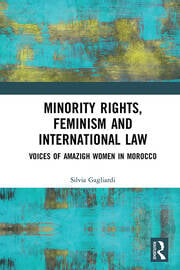
245 10|aMinority rights, feminism and international law :|bvoices of Amazigh women in Morocco /|cSilvia Gagliardi.
264 1|aAbingdon, Oxon ;|aNew York, NY :|bRoutledge,|c2020.
300 |a1 online resource
336 |atext|btxt|2rdacontent
337 |acomputer|bn|2rdamedia
338 |aonline resource|bnc|2rdacarrier
500 |aBased on author's thesis (doctoral - National University of Ireland, Galway, 2018) issued under title: When the 'minority' speaks : voices of Amazigh women in Morocco.
505 0 |aTheoretical framework -- The politics of rights : Morocco's human rights structure -- Shaping narratives in Moroccan society -- Mapping over the Amazigh body
520 |a"Investigating minority and indigenous women's rights in Muslim-majority states, this book critically examines the human rights regime within international law. Based on extensive and diverse ethnographic research on Amazigh women in Morocco, the book unpacks and challenges generally accepted notions of rights and equality. Significantly, and controversially, the book challenges the supposedly 'emancipatory' power vested in the human rights project; arguing that rights-based discourses are sites of contestation for different groups that use them to assert their agency in society. More specifically, it shows how the very conditions that make minority and indigenous women instrumental to the preservation of their culture may condemn them to a position of subalternity. In response, and engaging the notion and meaning of Islamic feminism, the book proposes that feminism should be interpreted and contextualised locally in order to be effective and inclusive, and so in order for the human rights project to fully realise its potential to empower the marginalised and make space for their voices to be heard. Providing a detailed, empirically-based, analysis of rights in action, this book will be of relevance to scholars, students and practitioners in human rights policy and practice, in international law, minorities' and indigenous peoples' rights, gender studies, and Middle Eastern and North African Studies"--|cProvided by publisher.
588 |aOCLC-licensed vendor bibliographic record.
650 0|aWomen, Berber|zMorocco|xSocial conditions.
650 0|aWomen, Berber|xLegal status, laws, etc.|zMorocco.
650 0|aFeminism|xReligious aspects|xIslam.
650 7|aLAW / General|2bisacsh
650 7|aLAW / Civil Rights|2bisacsh
650 7|aLAW / Gender & the Law|2bisacsh
856 40|3Taylor & Francis|uhttps://www.taylorfrancis.com/books/9781003048411
856 42|3OCLC metadata license agreement|uhttp://www.oclc.org/content/dam/oclc/forms/terms/vbrl-201703.pdf
901 |aTaylor & Francis