

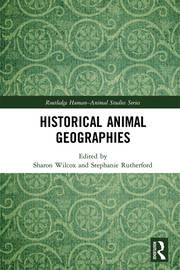
Historical Animal Geographies / edited by Sharon Wilcox and Stephanie Rutherford.
Erişim Adresi
ISBN
9781315204208 (e-book : PDF)
Dil Kodu
İngilizce
Basım Bildirimi
First edition.
Yayın Bilgisi
London : Taylor and Francis, 2018.
Fiziksel Niteleme
1 online resource (xiii, 214 pages)
Dizi
Routledge Human-Animal Studies Series
İçindekiler Notu
part, I The home – shared spaces of cohabitation -- chapter 1 Introduction -- A meeting place / Stephanie Rutherford Sharon Wilcox -- chapter 2 When did pets become animals? / Philip Howell -- chapter 3 The entwined socioecological histories of the Sawtelle, California war veterans and the animal “menagerie” at the Pacific Branch Soldier’s Home (1888–1918) / Teresa Lloro-Bidart -- chapter 4 Shaking the ground -- Histories of earthworms from Darwin to niche construction / Camilla Royle -- part, II The city – historical animals in and out of sight -- chapter 5 Zoöpolis / Jennifer Wolch -- chapter 6 Kansas City -- The morphology of an American zoöpolis through film / Julie Urbanik -- chapter 7 The strange case of the missing slaughterhouse geographies / Chris Philo Ian MacLachlan -- chapter 8 The pigs are back again -- Urban pig keeping in wartime Britain, 1939–45 / Thomas Webb -- part, III The nation – historical animal bodies and human identities -- chapter 9 Rebel elephants -- Resistance through human–elephant partnerships / Jennifer Mateer -- chapter 10 Western horizons, animal becomings -- Race, species, and the troubled boundaries of the human in the era of American expansionism / Dominik Ohrem -- chapter 11 For the love of life -- Coal mining and pit bull fighting in early 19th-century Britain / Heidi J. Nast -- part, IV The global – imperial networks and the movements of animals -- chapter 12 Migration, assimilation, and invasion in the nineteenth century 1 / Harriet Ritvo -- chapter 13 Runaways and strays -- Rethinking (non)human agency in Caribbean slave societies / David Lambert -- part, Epilogue -- chapter 14 Finding our way in the Anthropocene / Stephanie Rutherford.
Özet, vb.
"Arguing that historical analysis is an important, yet heretofore largely underexplored, dimension of scholarship in animal geographies, this book seeks to define historical animal geography as the exploration of how spatially situated human-animal relations have changed through time. This volume centers on the changing relationships among people, animals, and the landscapes they inhabit, taking a spatio-temporal approach to animal studies. Foregrounding the assertion that geography matters as much as history in terms of how humans relate to animals, this collection offers unique insight into the lives of animals past, how interrelationships were co-constructed amongst and between animals and humans, and how non-human actors came to make their own worlds. This collection of chapters explores the rich value of work at the contact points between three sub disciplines, demonstrating how geographical analyses enriches work in historical animal studies; that historical work is important to animal geography; and that recognition of animals as actors can further enrich historical geographic research."--Provided by publisher.
Konu
Animals __ Economic aspects.
Animals __ Social aspects.
Human-animal relationships __ Moral and ethical aspects.
Wildlife utilization __ Moral and ethical aspects.
Animals __ Social aspects.
Human-animal relationships __ Moral and ethical aspects.
Wildlife utilization __ Moral and ethical aspects.
Diğer Yazarlar
Veritabanı
Eseri Alıntıla
Referansları kullanmadan önce gözden geçirmeniz ve varsa gerekli düzeltmeleri yapmanız önerilir.
Dijital Kaynak
MARC Görünümü
LEADER 04144cam a2200337Ii 4500
001 800171
003 TR_AnAIT
005 20260123020456
008 180706s2018 enka ob 001 0 eng d
020 |a9781315204208|q(e-book : PDF)
024 7 |a10.4324/9781315204208 |2doi
035 |a(OCoLC)1031316435
040 |aFlBoTFG|cFlBoTFG|erda
041 |aeng
049 |aTürk Tarih Kurumu Kütüphanesi
050 4|aQL85|b.H57 2018
082 04|a590|bH673
245 00|aHistorical Animal Geographies /|cedited by Sharon Wilcox and Stephanie Rutherford.
250 |aFirst edition.
264 1|aLondon :|bTaylor and Francis,|c2018.
300 |a1 online resource (xiii, 214 pages)
336 |atext|2rdacontent
337 |acomputer|2rdamedia
338 |aonline resource|2rdacarrier
490 0 |aRoutledge Human-Animal Studies Series
505 00|tpart, I The home – shared spaces of cohabitation -- |tchapter 1 Introduction -- |tA meeting place /|r Stephanie Rutherford Sharon Wilcox -- |tchapter 2 When did pets become animals? /|r Philip Howell -- |tchapter 3 The entwined socioecological histories of the Sawtelle, California war veterans and the animal “menagerie” at the Pacific Branch Soldier’s Home (1888–1918) /|r Teresa Lloro-Bidart -- |tchapter 4 Shaking the ground -- |tHistories of earthworms from Darwin to niche construction /|r Camilla Royle -- |tpart, II The city – historical animals in and out of sight -- |tchapter 5 Zoöpolis /|r Jennifer Wolch -- |tchapter 6 Kansas City -- |tThe morphology of an American zoöpolis through film /|r Julie Urbanik -- |tchapter 7 The strange case of the missing slaughterhouse geographies /|r Chris Philo Ian MacLachlan -- |tchapter 8 The pigs are back again -- |tUrban pig keeping in wartime Britain, 1939–45 /|r Thomas Webb -- |tpart, III The nation – historical animal bodies and human identities -- |tchapter 9 Rebel elephants -- |tResistance through human–elephant partnerships /|r Jennifer Mateer -- |tchapter 10 Western horizons, animal becomings -- |tRace, species, and the troubled boundaries of the human in the era of American expansionism /|r Dominik Ohrem -- |tchapter 11 For the love of life -- |tCoal mining and pit bull fighting in early 19th-century Britain /|r Heidi J. Nast -- |tpart, IV The global – imperial networks and the movements of animals -- |tchapter 12 Migration, assimilation, and invasion in the nineteenth century 1 /|r Harriet Ritvo -- |tchapter 13 Runaways and strays -- |tRethinking (non)human agency in Caribbean slave societies /|r David Lambert -- |tpart, Epilogue -- |tchapter 14 Finding our way in the Anthropocene /|r Stephanie Rutherford.
520 |a"Arguing that historical analysis is an important, yet heretofore largely underexplored, dimension of scholarship in animal geographies, this book seeks to define historical animal geography as the exploration of how spatially situated human-animal relations have changed through time. This volume centers on the changing relationships among people, animals, and the landscapes they inhabit, taking a spatio-temporal approach to animal studies. Foregrounding the assertion that geography matters as much as history in terms of how humans relate to animals, this collection offers unique insight into the lives of animals past, how interrelationships were co-constructed amongst and between animals and humans, and how non-human actors came to make their own worlds. This collection of chapters explores the rich value of work at the contact points between three sub disciplines, demonstrating how geographical analyses enriches work in historical animal studies; that historical work is important to animal geography; and that recognition of animals as actors can further enrich historical geographic research."--Provided by publisher.
650 0|aAnimals|xEconomic aspects.
650 0|aAnimals|xSocial aspects.
650 0|aHuman-animal relationships|xMoral and ethical aspects.
650 0|aWildlife utilization|xMoral and ethical aspects.
700 1 |aRutherford, Stephanie,|eeditor.
700 1 |aWilcox, Sharon,|eeditor.
776 08|iPrint version:|z9781138701175
856 40|uhttps://www.taylorfrancis.com/books/9781315204208|zClick here to view.
901 |aTaylor & Francis
001 800171
003 TR_AnAIT
005 20260123020456
008 180706s2018 enka ob 001 0 eng d
020 |a9781315204208|q(e-book : PDF)
024 7 |a10.4324/9781315204208 |2doi
035 |a(OCoLC)1031316435
040 |aFlBoTFG|cFlBoTFG|erda
041 |aeng
049 |aTürk Tarih Kurumu Kütüphanesi
050 4|aQL85|b.H57 2018
082 04|a590|bH673
245 00|aHistorical Animal Geographies /|cedited by Sharon Wilcox and Stephanie Rutherford.
250 |aFirst edition.
264 1|aLondon :|bTaylor and Francis,|c2018.
300 |a1 online resource (xiii, 214 pages)
336 |atext|2rdacontent
337 |acomputer|2rdamedia
338 |aonline resource|2rdacarrier
490 0 |aRoutledge Human-Animal Studies Series
505 00|tpart, I The home – shared spaces of cohabitation -- |tchapter 1 Introduction -- |tA meeting place /|r Stephanie Rutherford Sharon Wilcox -- |tchapter 2 When did pets become animals? /|r Philip Howell -- |tchapter 3 The entwined socioecological histories of the Sawtelle, California war veterans and the animal “menagerie” at the Pacific Branch Soldier’s Home (1888–1918) /|r Teresa Lloro-Bidart -- |tchapter 4 Shaking the ground -- |tHistories of earthworms from Darwin to niche construction /|r Camilla Royle -- |tpart, II The city – historical animals in and out of sight -- |tchapter 5 Zoöpolis /|r Jennifer Wolch -- |tchapter 6 Kansas City -- |tThe morphology of an American zoöpolis through film /|r Julie Urbanik -- |tchapter 7 The strange case of the missing slaughterhouse geographies /|r Chris Philo Ian MacLachlan -- |tchapter 8 The pigs are back again -- |tUrban pig keeping in wartime Britain, 1939–45 /|r Thomas Webb -- |tpart, III The nation – historical animal bodies and human identities -- |tchapter 9 Rebel elephants -- |tResistance through human–elephant partnerships /|r Jennifer Mateer -- |tchapter 10 Western horizons, animal becomings -- |tRace, species, and the troubled boundaries of the human in the era of American expansionism /|r Dominik Ohrem -- |tchapter 11 For the love of life -- |tCoal mining and pit bull fighting in early 19th-century Britain /|r Heidi J. Nast -- |tpart, IV The global – imperial networks and the movements of animals -- |tchapter 12 Migration, assimilation, and invasion in the nineteenth century 1 /|r Harriet Ritvo -- |tchapter 13 Runaways and strays -- |tRethinking (non)human agency in Caribbean slave societies /|r David Lambert -- |tpart, Epilogue -- |tchapter 14 Finding our way in the Anthropocene /|r Stephanie Rutherford.
520 |a"Arguing that historical analysis is an important, yet heretofore largely underexplored, dimension of scholarship in animal geographies, this book seeks to define historical animal geography as the exploration of how spatially situated human-animal relations have changed through time. This volume centers on the changing relationships among people, animals, and the landscapes they inhabit, taking a spatio-temporal approach to animal studies. Foregrounding the assertion that geography matters as much as history in terms of how humans relate to animals, this collection offers unique insight into the lives of animals past, how interrelationships were co-constructed amongst and between animals and humans, and how non-human actors came to make their own worlds. This collection of chapters explores the rich value of work at the contact points between three sub disciplines, demonstrating how geographical analyses enriches work in historical animal studies; that historical work is important to animal geography; and that recognition of animals as actors can further enrich historical geographic research."--Provided by publisher.
650 0|aAnimals|xEconomic aspects.
650 0|aAnimals|xSocial aspects.
650 0|aHuman-animal relationships|xMoral and ethical aspects.
650 0|aWildlife utilization|xMoral and ethical aspects.
700 1 |aRutherford, Stephanie,|eeditor.
700 1 |aWilcox, Sharon,|eeditor.
776 08|iPrint version:|z9781138701175
856 40|uhttps://www.taylorfrancis.com/books/9781315204208|zClick here to view.
901 |aTaylor & Francis
Materyaller
Depodan talep edilen materyal sadece kütüphane içerisinde kullanılmaktadır.
Materyal dışarıya ödünç verilmemektedir.
Materyal dışarıya ödünç verilmemektedir.
