

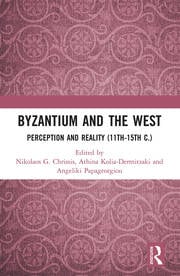
Byzantium and the West : perception and reality (11th-15th c.) / edited by Nikolaos G. Chrissis, Athina Kolia-Dermitzaki, and Angeliki Papageorgiou.
ISBN
131516339X
9781351671040 (web pdf)
1351671049
9781351671033 ( epub)
1351671030
9781351671026 (mobi/kindle)
1351671022
9781315163390 (electronic bk.)
9781138059740 (hardback : alk. paper)
9781351671040 (web pdf)
1351671049
9781351671033 ( epub)
1351671030
9781351671026 (mobi/kindle)
1351671022
9781315163390 (electronic bk.)
9781138059740 (hardback : alk. paper)
Dil Kodu
İngilizce
Yayın Bilgisi
Abingdon, Oxon ; New York, NY : Routledge, 2019.
Fiziksel Niteleme
1 online resource
İçindekiler Notu
Cover; Half Title; Title Page; Copyright Page; Table of Contents; List of Contributors; List of Abbreviations; Introduction; Structure of the volume; Acknowledgements; Notes; Part I Setting the Scene; Chapter 1 Keroularios in 1054: Nonconfrontational to the papal legates and loyal to the emperor; Acknowledgement; Notes; Reference List; Chapter 2 Colonisation and population movements in the Mediterranean in the Middle Ages; The Italian colonisation in the Eastern Mediterranean; Population movements; The modalities of emigration; Reference list
Chapter 3 Genoa and Byzantium: Aspects of a long relationshipA premise: the impact of the crusades; The danger from Italian cities as perceived in 12th-century Byzantium; Genoese, Pisans, Venetians and Byzantium in the 12th century: encounters and conflicts; The strife for the dominion of the sea after 1261; Genoese and Greek experiences in the 14th century; Facing each other: enduring suspicions and attempts at conciliation; Notes; Reference list; Part II Byzantium and the West during the Early Crusades; Chapter 4 Byzantium and the Crusades in the Komnenian era: Perception and reality
PerceptionIdeological acceptance or political necessity?; Conclusions; Notes; Reference list; Chapter 5 Some thoughts on the relations between Greeks and Latins at the time of the First and Fourth Crusades; Turkish pressure as the real cause of the expedition; The papacy, Christian solidarity and Alexios Komnenos' call; An expedition to the East with no real precedent; The agreements with the leaders of the expedition; Antioch, the key to the East; The Empire, an indispensable source of logistical and financial support
The diversion of the Fourth Crusade: a logical consequence of the policy of the KomnenoiConclusion; Notes; Reference list; Chapter 6 Crusader perceptions of Byzantium, c.1095 to c.1150; Reference list; Chapter 7 The perception of Westerners in the court of John II Komnenos; Reference list; Chapter 8 A 12th-century perspective on Byzantium's Western neighbours: The witness of Manganeios Prodromos; Notes; Reference list; Chapter 9 De-centring 12th-century Constantinople: Archbishop Eustathios and the Norman conquest of Thessalonica revisited; Tensions between Constantinople and Thessalonica
Thessalonica: alternative centre?Conclusions and implications; Notes; Reference list; Chapter 10 The fall of Jerusalem in 1187 to Saladin and its impact on Byzantine opinion; Reference list; Part III Cross-cultural Contacts in the Margins of East and West; Chapter 11 Admiral Eugenius of Sicily (12th century) Court poetry and political propaganda in a cross-cultural environment; Notes; Reference list; Chapter 12 A detail of the Third Lateran Council (1179): The leper king of Jerusalem and the papal policy in the East; Notes; Reference list
Chapter 3 Genoa and Byzantium: Aspects of a long relationshipA premise: the impact of the crusades; The danger from Italian cities as perceived in 12th-century Byzantium; Genoese, Pisans, Venetians and Byzantium in the 12th century: encounters and conflicts; The strife for the dominion of the sea after 1261; Genoese and Greek experiences in the 14th century; Facing each other: enduring suspicions and attempts at conciliation; Notes; Reference list; Part II Byzantium and the West during the Early Crusades; Chapter 4 Byzantium and the Crusades in the Komnenian era: Perception and reality
PerceptionIdeological acceptance or political necessity?; Conclusions; Notes; Reference list; Chapter 5 Some thoughts on the relations between Greeks and Latins at the time of the First and Fourth Crusades; Turkish pressure as the real cause of the expedition; The papacy, Christian solidarity and Alexios Komnenos' call; An expedition to the East with no real precedent; The agreements with the leaders of the expedition; Antioch, the key to the East; The Empire, an indispensable source of logistical and financial support
The diversion of the Fourth Crusade: a logical consequence of the policy of the KomnenoiConclusion; Notes; Reference list; Chapter 6 Crusader perceptions of Byzantium, c.1095 to c.1150; Reference list; Chapter 7 The perception of Westerners in the court of John II Komnenos; Reference list; Chapter 8 A 12th-century perspective on Byzantium's Western neighbours: The witness of Manganeios Prodromos; Notes; Reference list; Chapter 9 De-centring 12th-century Constantinople: Archbishop Eustathios and the Norman conquest of Thessalonica revisited; Tensions between Constantinople and Thessalonica
Thessalonica: alternative centre?Conclusions and implications; Notes; Reference list; Chapter 10 The fall of Jerusalem in 1187 to Saladin and its impact on Byzantine opinion; Reference list; Part III Cross-cultural Contacts in the Margins of East and West; Chapter 11 Admiral Eugenius of Sicily (12th century) Court poetry and political propaganda in a cross-cultural environment; Notes; Reference list; Chapter 12 A detail of the Third Lateran Council (1179): The leper king of Jerusalem and the papal policy in the East; Notes; Reference list
Özet, vb.
"The interaction between Byzantium and the Latin West was intimately connected to practically all the major events and developments which shaped the medieval world in the High and Late Middle Ages - for example, the rise of the 'papal monarchy', the launch of the crusades, the expansion of international and long-distance commerce, or the flowering of the Renaissance. This volume explores not only the actual avenues of interaction between the two sides (trade, political and diplomatic contacts, ecclesiastical dialogue, intellectual exchange, armed conflict), but also the image each side had of the other and the way perceptions evolved over this long period in the context of their manifold contact. Twenty-one stimulating papers offer new insights and original research on numerous aspects of this relationship, pooling the expertise of an international group of scholars working on both sides of the Byzantine-Western 'divide', on topics as diverse as identity formation, ideology, court ritual, literary history, military technology and the economy, among others. The particular contribution of the research presented here is the exploration of how cross-cultural relations were shaped by the interplay of the thought-world of the various historical agents and the material circumstances which circumscribed their actions. The volume is primarily aimed at scholars and students interested in the history of Byzantium, the Mediterranean world, and, more widely, intercultural contacts in the Middle Ages"-- Provided by publisher.
Konu
Intercultural communication __ Mediterranean Region __ History __ To 1500.
SOCIAL SCIENCE / General __ bisacsh
HISTORY / Medieval __ bisacsh
HISTORY / General __ bisacsh
Byzantine Empire __ Relations __ Europe, Western.
Europe, Western __ Relations __ Byzantine Empire.
Byzantine Empire __ History __ 1081-1453.
Mediterranean Region __ History __ 476-1517.
SOCIAL SCIENCE / General __ bisacsh
HISTORY / Medieval __ bisacsh
HISTORY / General __ bisacsh
Byzantine Empire __ Relations __ Europe, Western.
Europe, Western __ Relations __ Byzantine Empire.
Byzantine Empire __ History __ 1081-1453.
Mediterranean Region __ History __ 476-1517.
Veritabanı
Eseri Alıntıla
Referansları kullanmadan önce gözden geçirmeniz ve varsa gerekli düzeltmeleri yapmanız önerilir.
Dijital Kaynak
MARC Görünümü
LEADER 06602cam a22006378i 4500
001 800324
003 TR_AnAIT
005 20260123020729
006 m o d
007 cr |||||||||||
008 181105s2019 enk ob 001 0 eng
020 |a131516339X
020 |a9781351671040|q(web pdf)
020 |a1351671049
020 |a9781351671033|q( epub)
020 |a1351671030
020 |a9781351671026|q(mobi/kindle)
020 |a1351671022
020 |a9781315163390|q(electronic bk.)
020 |z9781138059740 (hardback : alk. paper)
024 7 |a10.4324/9781315163390|2doi
035 |a(OCoLC)1061865432
035 |a(OCoLC-P)1061865432
040 |aOCoLC-P|beng|erda|cOCoLC-P
041 |aeng
049 |aTürk Tarih Kurumu Kütüphanesi
050 10|aDF547.E85
072 7|aSOC|x000000|2bisacsh
072 7|aHIS|x037010|2bisacsh
072 7|aHIS|x000000|2bisacsh
072 7|aHBLA1|2bicssc
082 00|a303.48/2495040902|223
245 00|aByzantium and the West :|bperception and reality (11th-15th c.) /|cedited by Nikolaos G. Chrissis, Athina Kolia-Dermitzaki, and Angeliki Papageorgiou.
264 1|aAbingdon, Oxon ;|aNew York, NY :|bRoutledge,|c2019.
300 |a1 online resource
336 |atext|2rdacontent
337 |acomputer|2rdamedia
338 |aonline resource|2rdacarrier
505 0 |aCover; Half Title; Title Page; Copyright Page; Table of Contents; List of Contributors; List of Abbreviations; Introduction; Structure of the volume; Acknowledgements; Notes; Part I Setting the Scene; Chapter 1 Keroularios in 1054: Nonconfrontational to the papal legates and loyal to the emperor; Acknowledgement; Notes; Reference List; Chapter 2 Colonisation and population movements in the Mediterranean in the Middle Ages; The Italian colonisation in the Eastern Mediterranean; Population movements; The modalities of emigration; Reference list
505 8 |aChapter 3 Genoa and Byzantium: Aspects of a long relationshipA premise: the impact of the crusades; The danger from Italian cities as perceived in 12th-century Byzantium; Genoese, Pisans, Venetians and Byzantium in the 12th century: encounters and conflicts; The strife for the dominion of the sea after 1261; Genoese and Greek experiences in the 14th century; Facing each other: enduring suspicions and attempts at conciliation; Notes; Reference list; Part II Byzantium and the West during the Early Crusades; Chapter 4 Byzantium and the Crusades in the Komnenian era: Perception and reality
505 8 |aPerceptionIdeological acceptance or political necessity?; Conclusions; Notes; Reference list; Chapter 5 Some thoughts on the relations between Greeks and Latins at the time of the First and Fourth Crusades; Turkish pressure as the real cause of the expedition; The papacy, Christian solidarity and Alexios Komnenos' call; An expedition to the East with no real precedent; The agreements with the leaders of the expedition; Antioch, the key to the East; The Empire, an indispensable source of logistical and financial support
505 8 |aThe diversion of the Fourth Crusade: a logical consequence of the policy of the KomnenoiConclusion; Notes; Reference list; Chapter 6 Crusader perceptions of Byzantium, c.1095 to c.1150; Reference list; Chapter 7 The perception of Westerners in the court of John II Komnenos; Reference list; Chapter 8 A 12th-century perspective on Byzantium's Western neighbours: The witness of Manganeios Prodromos; Notes; Reference list; Chapter 9 De-centring 12th-century Constantinople: Archbishop Eustathios and the Norman conquest of Thessalonica revisited; Tensions between Constantinople and Thessalonica
505 8 |aThessalonica: alternative centre?Conclusions and implications; Notes; Reference list; Chapter 10 The fall of Jerusalem in 1187 to Saladin and its impact on Byzantine opinion; Reference list; Part III Cross-cultural Contacts in the Margins of East and West; Chapter 11 Admiral Eugenius of Sicily (12th century) Court poetry and political propaganda in a cross-cultural environment; Notes; Reference list; Chapter 12 A detail of the Third Lateran Council (1179): The leper king of Jerusalem and the papal policy in the East; Notes; Reference list
520 |a"The interaction between Byzantium and the Latin West was intimately connected to practically all the major events and developments which shaped the medieval world in the High and Late Middle Ages - for example, the rise of the 'papal monarchy', the launch of the crusades, the expansion of international and long-distance commerce, or the flowering of the Renaissance. This volume explores not only the actual avenues of interaction between the two sides (trade, political and diplomatic contacts, ecclesiastical dialogue, intellectual exchange, armed conflict), but also the image each side had of the other and the way perceptions evolved over this long period in the context of their manifold contact. Twenty-one stimulating papers offer new insights and original research on numerous aspects of this relationship, pooling the expertise of an international group of scholars working on both sides of the Byzantine-Western 'divide', on topics as diverse as identity formation, ideology, court ritual, literary history, military technology and the economy, among others. The particular contribution of the research presented here is the exploration of how cross-cultural relations were shaped by the interplay of the thought-world of the various historical agents and the material circumstances which circumscribed their actions. The volume is primarily aimed at scholars and students interested in the history of Byzantium, the Mediterranean world, and, more widely, intercultural contacts in the Middle Ages"--|cProvided by publisher.
588 |aOCLC-licensed vendor bibliographic record.
650 0|aIntercultural communication|zMediterranean Region|xHistory|yTo 1500.
650 7|aSOCIAL SCIENCE / General|2bisacsh
650 7|aHISTORY / Medieval|2bisacsh
650 7|aHISTORY / General|2bisacsh
651 0|aByzantine Empire|xRelations|zEurope, Western.
651 0|aEurope, Western|xRelations|zByzantine Empire.
651 0|aByzantine Empire|xHistory|y1081-1453.
651 0|aMediterranean Region|xHistory|y476-1517.
700 1 |aChrissis, Nikolaos G.,|eeditor.
700 1 |aKolia-Dermitzakē, Athēna,|eeditor.
700 1 |aPapageōrgiou, Angelikē,|eeditor.
856 40|3Taylor & Francis|uhttps://www.taylorfrancis.com/books/9781315163390
856 42|3OCLC metadata license agreement|uhttp://www.oclc.org/content/dam/oclc/forms/terms/vbrl-201703.pdf
901 |aTaylor & Francis
001 800324
003 TR_AnAIT
005 20260123020729
006 m o d
007 cr |||||||||||
008 181105s2019 enk ob 001 0 eng
020 |a131516339X
020 |a9781351671040|q(web pdf)
020 |a1351671049
020 |a9781351671033|q( epub)
020 |a1351671030
020 |a9781351671026|q(mobi/kindle)
020 |a1351671022
020 |a9781315163390|q(electronic bk.)
020 |z9781138059740 (hardback : alk. paper)
024 7 |a10.4324/9781315163390|2doi
035 |a(OCoLC)1061865432
035 |a(OCoLC-P)1061865432
040 |aOCoLC-P|beng|erda|cOCoLC-P
041 |aeng
049 |aTürk Tarih Kurumu Kütüphanesi
050 10|aDF547.E85
072 7|aSOC|x000000|2bisacsh
072 7|aHIS|x037010|2bisacsh
072 7|aHIS|x000000|2bisacsh
072 7|aHBLA1|2bicssc
082 00|a303.48/2495040902|223
245 00|aByzantium and the West :|bperception and reality (11th-15th c.) /|cedited by Nikolaos G. Chrissis, Athina Kolia-Dermitzaki, and Angeliki Papageorgiou.
264 1|aAbingdon, Oxon ;|aNew York, NY :|bRoutledge,|c2019.
300 |a1 online resource
336 |atext|2rdacontent
337 |acomputer|2rdamedia
338 |aonline resource|2rdacarrier
505 0 |aCover; Half Title; Title Page; Copyright Page; Table of Contents; List of Contributors; List of Abbreviations; Introduction; Structure of the volume; Acknowledgements; Notes; Part I Setting the Scene; Chapter 1 Keroularios in 1054: Nonconfrontational to the papal legates and loyal to the emperor; Acknowledgement; Notes; Reference List; Chapter 2 Colonisation and population movements in the Mediterranean in the Middle Ages; The Italian colonisation in the Eastern Mediterranean; Population movements; The modalities of emigration; Reference list
505 8 |aChapter 3 Genoa and Byzantium: Aspects of a long relationshipA premise: the impact of the crusades; The danger from Italian cities as perceived in 12th-century Byzantium; Genoese, Pisans, Venetians and Byzantium in the 12th century: encounters and conflicts; The strife for the dominion of the sea after 1261; Genoese and Greek experiences in the 14th century; Facing each other: enduring suspicions and attempts at conciliation; Notes; Reference list; Part II Byzantium and the West during the Early Crusades; Chapter 4 Byzantium and the Crusades in the Komnenian era: Perception and reality
505 8 |aPerceptionIdeological acceptance or political necessity?; Conclusions; Notes; Reference list; Chapter 5 Some thoughts on the relations between Greeks and Latins at the time of the First and Fourth Crusades; Turkish pressure as the real cause of the expedition; The papacy, Christian solidarity and Alexios Komnenos' call; An expedition to the East with no real precedent; The agreements with the leaders of the expedition; Antioch, the key to the East; The Empire, an indispensable source of logistical and financial support
505 8 |aThe diversion of the Fourth Crusade: a logical consequence of the policy of the KomnenoiConclusion; Notes; Reference list; Chapter 6 Crusader perceptions of Byzantium, c.1095 to c.1150; Reference list; Chapter 7 The perception of Westerners in the court of John II Komnenos; Reference list; Chapter 8 A 12th-century perspective on Byzantium's Western neighbours: The witness of Manganeios Prodromos; Notes; Reference list; Chapter 9 De-centring 12th-century Constantinople: Archbishop Eustathios and the Norman conquest of Thessalonica revisited; Tensions between Constantinople and Thessalonica
505 8 |aThessalonica: alternative centre?Conclusions and implications; Notes; Reference list; Chapter 10 The fall of Jerusalem in 1187 to Saladin and its impact on Byzantine opinion; Reference list; Part III Cross-cultural Contacts in the Margins of East and West; Chapter 11 Admiral Eugenius of Sicily (12th century) Court poetry and political propaganda in a cross-cultural environment; Notes; Reference list; Chapter 12 A detail of the Third Lateran Council (1179): The leper king of Jerusalem and the papal policy in the East; Notes; Reference list
520 |a"The interaction between Byzantium and the Latin West was intimately connected to practically all the major events and developments which shaped the medieval world in the High and Late Middle Ages - for example, the rise of the 'papal monarchy', the launch of the crusades, the expansion of international and long-distance commerce, or the flowering of the Renaissance. This volume explores not only the actual avenues of interaction between the two sides (trade, political and diplomatic contacts, ecclesiastical dialogue, intellectual exchange, armed conflict), but also the image each side had of the other and the way perceptions evolved over this long period in the context of their manifold contact. Twenty-one stimulating papers offer new insights and original research on numerous aspects of this relationship, pooling the expertise of an international group of scholars working on both sides of the Byzantine-Western 'divide', on topics as diverse as identity formation, ideology, court ritual, literary history, military technology and the economy, among others. The particular contribution of the research presented here is the exploration of how cross-cultural relations were shaped by the interplay of the thought-world of the various historical agents and the material circumstances which circumscribed their actions. The volume is primarily aimed at scholars and students interested in the history of Byzantium, the Mediterranean world, and, more widely, intercultural contacts in the Middle Ages"--|cProvided by publisher.
588 |aOCLC-licensed vendor bibliographic record.
650 0|aIntercultural communication|zMediterranean Region|xHistory|yTo 1500.
650 7|aSOCIAL SCIENCE / General|2bisacsh
650 7|aHISTORY / Medieval|2bisacsh
650 7|aHISTORY / General|2bisacsh
651 0|aByzantine Empire|xRelations|zEurope, Western.
651 0|aEurope, Western|xRelations|zByzantine Empire.
651 0|aByzantine Empire|xHistory|y1081-1453.
651 0|aMediterranean Region|xHistory|y476-1517.
700 1 |aChrissis, Nikolaos G.,|eeditor.
700 1 |aKolia-Dermitzakē, Athēna,|eeditor.
700 1 |aPapageōrgiou, Angelikē,|eeditor.
856 40|3Taylor & Francis|uhttps://www.taylorfrancis.com/books/9781315163390
856 42|3OCLC metadata license agreement|uhttp://www.oclc.org/content/dam/oclc/forms/terms/vbrl-201703.pdf
901 |aTaylor & Francis
Materyaller
Depodan talep edilen materyal sadece kütüphane içerisinde kullanılmaktadır.
Materyal dışarıya ödünç verilmemektedir.
Materyal dışarıya ödünç verilmemektedir.
