

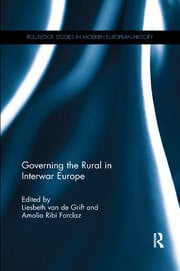
Governing the rural in interwar Europe / edited by Liesbeth van de Grift and Amalia Ribi Forclaz.
Erişim Adresi
ISBN
9781315525587 (e-book: Mobi)
9781315525617 (e-book : PDF)
9781138696013 (hardback)
9781315525617 (e-book : PDF)
9781138696013 (hardback)
Dil Kodu
İngilizce
Yayın Bilgisi
London : Routledge, 2018.
Fiziksel Niteleme
1 online resource (xviii, 291 pages)
Dizi
Routledge Studies in Modern European History
İçindekiler Notu
chapter 1 The Green Heart of Governance -- Rural Europe during the Interwar Years in a Global Perspective / \n Kiran Klaus\n Patel\n -- chapter 2 Internal Colonization in Weimar Germany -- Transnational and Local Approaches to Rural Governance in the 1920s / \n Elizabeth B.\n Jones\n -- chapter 3 Colonization Projects and Agrarian Reforms in East-Central and Southeastern Europe, 1913–1950* / \n Dietmar\n Müller\n -- chapter 4 Cultivating Land and People -- Internal Colonization in Interwar Europe / \n Liesbeth\n van de Grift\n -- chapter 5 The Future of Village Life -- Welfare, Planning and the Role of Government in Rural Britain between the Wars / \n Clare\n Griffiths\n -- chapter 6 The “Social Museum” of Village Life -- Sociology and Heritage in 1930s Romania / \n Raluca\n Mușat\n -- chapter 7 Knowledge and Power in the Making of the Soviet Village / \n Katja\n Bruisch\n -- chapter 8 Between Mobilization and De-Politicization -- Political Technologies of Rural Self-Government in Weimar Germany / \n Anette\n Schlimm\n -- chapter 9 Governing Rural Exodus in Nazi Germany, 1933 to 1939 / \n Ernst\n Langthaler\n -- chapter 10 Guardians of the Countryside -- The Associated Countrywomen of the World (ACWW) and International Rural Governance in the Interwar Years / \n Amalia Ribi\n Forclaz\n -- chapter 11 Cartels, Grossraumwirtschaft and Statistical Knowledge -- International Organizations and Their Efforts to Govern Europe’s Forest Resources in the 1930s and 1940s / \n Martin\n Bemmann\n -- chapter 12 The Red Peasant International 1 / \n Wim\n van Meurs\n .
Özet, vb.
"This book examines how rural Europe as a hybrid social and natural environment emerged as a key site of local, national and international governance in the interwar years. The post-war need to secure and intensify food production, to protect contested border areas, to improve rural infrastructure and the economic viability of rural regions and to politically integrate rural populations, gave rise to a variety of schemes aimed at modernizing agriculture and remaking rural society. The volume examines discourses, institutions and practices of rural governance from a transnational perspective, revealing striking commonalities across national and political boundaries. From the village town hall to the headquarters of international organizations, local authorities, government officials and politicians, scientific experts and farmers engaged in debates about the social, political and economic future of rural communities. They sought to respond to both real and imagined concerns over poverty and decline, backwardness and insufficient control, by conceptualizing planning and engineering models that would help foster an ideal rural community and develop an efficient agricultural sector. By examining some of these local, national and international schemes and policies, this volume highlights the hitherto under-researched interaction between policymakers, experts and rural inhabitants in the European countryside of the 1920s and '30s."--Provided by publisher.
Konu
Regional planning __ European Union countries.
Rural development __ European Union countries.
Sustainable development __ European Union countries.
Rural development __ European Union countries.
Sustainable development __ European Union countries.
Diğer Yazarlar
Veritabanı
Eseri Alıntıla
Referansları kullanmadan önce gözden geçirmeniz ve varsa gerekli düzeltmeleri yapmanız önerilir.
Dijital Kaynak
MARC Görünümü
LEADER 04420cam a2200349Ii 4500
001 800419
003 TR_AnAIT
005 20260123020843
008 180706s2018 enka ob 001 0 eng d
020 |a9781315525587|q(e-book: Mobi)
020 |a9781315525617|q(e-book : PDF)
020 |z9781138696013|q(hardback)
024 7 |a10.4324/9781315525617 |2doi
035 |a(OCoLC)1004363106
040 |aFlBoTFG|cFlBoTFG|erda
041 |aeng
043 |ae------
049 |aTürk Tarih Kurumu Kütüphanesi
050 4|aHN380.C6|bG68 2018
082 04|a307.1416094|bG721
245 00|aGoverning the rural in interwar Europe /|cedited by Liesbeth van de Grift and Amalia Ribi Forclaz.
264 1|aLondon :|bRoutledge,|c2018.
300 |a1 online resource (xviii, 291 pages)
336 |atext|2rdacontent
337 |acomputer|2rdamedia
338 |aonline resource|2rdacarrier
490 0 |aRoutledge Studies in Modern European History
505 00|tchapter 1 The Green Heart of Governance -- |tRural Europe during the Interwar Years in a Global Perspective /|r \n Kiran Klaus\n Patel\n -- |tchapter 2 Internal Colonization in Weimar Germany -- |tTransnational and Local Approaches to Rural Governance in the 1920s /|r \n Elizabeth B.\n Jones\n -- |tchapter 3 Colonization Projects and Agrarian Reforms in East-Central and Southeastern Europe, 1913–1950* /|r \n Dietmar\n Müller\n -- |tchapter 4 Cultivating Land and People -- |tInternal Colonization in Interwar Europe /|r \n Liesbeth\n van de Grift\n -- |tchapter 5 The Future of Village Life -- |tWelfare, Planning and the Role of Government in Rural Britain between the Wars /|r \n Clare\n Griffiths\n -- |tchapter 6 The “Social Museum” of Village Life -- |tSociology and Heritage in 1930s Romania /|r \n Raluca\n Mușat\n -- |tchapter 7 Knowledge and Power in the Making of the Soviet Village /|r \n Katja\n Bruisch\n -- |tchapter 8 Between Mobilization and De-Politicization -- |tPolitical Technologies of Rural Self-Government in Weimar Germany /|r \n Anette\n Schlimm\n -- |tchapter 9 Governing Rural Exodus in Nazi Germany, 1933 to 1939 /|r \n Ernst\n Langthaler\n -- |tchapter 10 Guardians of the Countryside -- |tThe Associated Countrywomen of the World (ACWW) and International Rural Governance in the Interwar Years /|r \n Amalia Ribi\n Forclaz\n -- |tchapter 11 Cartels, Grossraumwirtschaft and Statistical Knowledge -- |tInternational Organizations and Their Efforts to Govern Europe’s Forest Resources in the 1930s and 1940s /|r \n Martin\n Bemmann\n -- |tchapter 12 The Red Peasant International 1 /|r \n Wim\n van Meurs\n .
520 |a"This book examines how rural Europe as a hybrid social and natural environment emerged as a key site of local, national and international governance in the interwar years. The post-war need to secure and intensify food production, to protect contested border areas, to improve rural infrastructure and the economic viability of rural regions and to politically integrate rural populations, gave rise to a variety of schemes aimed at modernizing agriculture and remaking rural society. The volume examines discourses, institutions and practices of rural governance from a transnational perspective, revealing striking commonalities across national and political boundaries. From the village town hall to the headquarters of international organizations, local authorities, government officials and politicians, scientific experts and farmers engaged in debates about the social, political and economic future of rural communities. They sought to respond to both real and imagined concerns over poverty and decline, backwardness and insufficient control, by conceptualizing planning and engineering models that would help foster an ideal rural community and develop an efficient agricultural sector. By examining some of these local, national and international schemes and policies, this volume highlights the hitherto under-researched interaction between policymakers, experts and rural inhabitants in the European countryside of the 1920s and '30s."--Provided by publisher.
650 0|aRegional planning|zEuropean Union countries.
650 0|aRural development|zEuropean Union countries.
650 0|aSustainable development|zEuropean Union countries.
700 1 |aForclaz, Amalia Ribi,|eeditor.
700 1 |aVan de Grift, Liesbeth,|eeditor.
776 08|iPrint version: |z9781138696013
856 40|uhttps://www.taylorfrancis.com/books/9781315525617|zClick here to view.
901 |aTaylor & Francis
001 800419
003 TR_AnAIT
005 20260123020843
008 180706s2018 enka ob 001 0 eng d
020 |a9781315525587|q(e-book: Mobi)
020 |a9781315525617|q(e-book : PDF)
020 |z9781138696013|q(hardback)
024 7 |a10.4324/9781315525617 |2doi
035 |a(OCoLC)1004363106
040 |aFlBoTFG|cFlBoTFG|erda
041 |aeng
043 |ae------
049 |aTürk Tarih Kurumu Kütüphanesi
050 4|aHN380.C6|bG68 2018
082 04|a307.1416094|bG721
245 00|aGoverning the rural in interwar Europe /|cedited by Liesbeth van de Grift and Amalia Ribi Forclaz.
264 1|aLondon :|bRoutledge,|c2018.
300 |a1 online resource (xviii, 291 pages)
336 |atext|2rdacontent
337 |acomputer|2rdamedia
338 |aonline resource|2rdacarrier
490 0 |aRoutledge Studies in Modern European History
505 00|tchapter 1 The Green Heart of Governance -- |tRural Europe during the Interwar Years in a Global Perspective /|r \n Kiran Klaus\n Patel\n -- |tchapter 2 Internal Colonization in Weimar Germany -- |tTransnational and Local Approaches to Rural Governance in the 1920s /|r \n Elizabeth B.\n Jones\n -- |tchapter 3 Colonization Projects and Agrarian Reforms in East-Central and Southeastern Europe, 1913–1950* /|r \n Dietmar\n Müller\n -- |tchapter 4 Cultivating Land and People -- |tInternal Colonization in Interwar Europe /|r \n Liesbeth\n van de Grift\n -- |tchapter 5 The Future of Village Life -- |tWelfare, Planning and the Role of Government in Rural Britain between the Wars /|r \n Clare\n Griffiths\n -- |tchapter 6 The “Social Museum” of Village Life -- |tSociology and Heritage in 1930s Romania /|r \n Raluca\n Mușat\n -- |tchapter 7 Knowledge and Power in the Making of the Soviet Village /|r \n Katja\n Bruisch\n -- |tchapter 8 Between Mobilization and De-Politicization -- |tPolitical Technologies of Rural Self-Government in Weimar Germany /|r \n Anette\n Schlimm\n -- |tchapter 9 Governing Rural Exodus in Nazi Germany, 1933 to 1939 /|r \n Ernst\n Langthaler\n -- |tchapter 10 Guardians of the Countryside -- |tThe Associated Countrywomen of the World (ACWW) and International Rural Governance in the Interwar Years /|r \n Amalia Ribi\n Forclaz\n -- |tchapter 11 Cartels, Grossraumwirtschaft and Statistical Knowledge -- |tInternational Organizations and Their Efforts to Govern Europe’s Forest Resources in the 1930s and 1940s /|r \n Martin\n Bemmann\n -- |tchapter 12 The Red Peasant International 1 /|r \n Wim\n van Meurs\n .
520 |a"This book examines how rural Europe as a hybrid social and natural environment emerged as a key site of local, national and international governance in the interwar years. The post-war need to secure and intensify food production, to protect contested border areas, to improve rural infrastructure and the economic viability of rural regions and to politically integrate rural populations, gave rise to a variety of schemes aimed at modernizing agriculture and remaking rural society. The volume examines discourses, institutions and practices of rural governance from a transnational perspective, revealing striking commonalities across national and political boundaries. From the village town hall to the headquarters of international organizations, local authorities, government officials and politicians, scientific experts and farmers engaged in debates about the social, political and economic future of rural communities. They sought to respond to both real and imagined concerns over poverty and decline, backwardness and insufficient control, by conceptualizing planning and engineering models that would help foster an ideal rural community and develop an efficient agricultural sector. By examining some of these local, national and international schemes and policies, this volume highlights the hitherto under-researched interaction between policymakers, experts and rural inhabitants in the European countryside of the 1920s and '30s."--Provided by publisher.
650 0|aRegional planning|zEuropean Union countries.
650 0|aRural development|zEuropean Union countries.
650 0|aSustainable development|zEuropean Union countries.
700 1 |aForclaz, Amalia Ribi,|eeditor.
700 1 |aVan de Grift, Liesbeth,|eeditor.
776 08|iPrint version: |z9781138696013
856 40|uhttps://www.taylorfrancis.com/books/9781315525617|zClick here to view.
901 |aTaylor & Francis
Materyaller
Depodan talep edilen materyal sadece kütüphane içerisinde kullanılmaktadır.
Materyal dışarıya ödünç verilmemektedir.
Materyal dışarıya ödünç verilmemektedir.
