LEADER 03962cam a2200541Ki 4500
001 800751
003 TR_AnAIT
005 20260123021317
006 m o d
007 cr cnu---unuuu
008 190325s2019 enk ob 000 0 eng d
020 |a9780429401626|q(electronic bk.)
020 |a0429401620|q(electronic bk.)
020 |a9780429686399|q(electronic bk. : EPUB)
020 |a0429686390|q(electronic bk. : EPUB)
020 |a9780429686405|q(electronic bk. : PDF)
020 |a0429686404|q(electronic bk. : PDF)
020 |a9780429686382|q(electronic bk. : Mobipocket)
020 |a0429686382|q(electronic bk. : Mobipocket)
020 |z9781138393684
020 |z1138393681
035 |a(OCoLC)1090540547
035 |a(OCoLC-P)1090540547
040 |aOCoLC-P|beng|erda|epn|cOCoLC-P
041 |aeng
049 |aTürk Tarih Kurumu Kütüphanesi
050 4|aPK5407|b.B36 2019eb
072 7|aLIT|x008000|2bisacsh
072 7|aSOC|x043000|2bisacsh
072 7|aDS|2bicssc
082 04|a895|223
100 1 |aBanerjee, Sandeep,|eauthor.
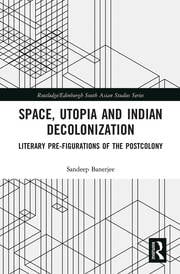
245 10|aSpace, utopia and Indian decolonization :|bliterary pre-figurations of the postcolony /|cSandeep Banerjee.
264 1|aAbingdon, Oxon ;|aNew York :|bRoutledge,|c2019.
300 |a1 online resource.
336 |atext|btxt|2rdacontent
337 |acomputer|bc|2rdamedia
338 |aonline resource|bcr|2rdacarrier
490 0 |aRoutledge/Edinburgh South Asian studies series
505 0 |aCover; Half Title; Series; Title; Copyright; Contents; Acknowledgements; Note on the use of Bengali, Hindi, and Sanskrit; List of figures; Introduction: spatial desire in the age of empire; 1 Of good and evil: the anxiety of utopianism; 2 Tales of a city: writing colonial Calcutta; 3 That magnificent song: between the performative and the pedagogic; 4 A sense of place: narrating knowable communities; Epilogue: that im/possible spatial desire called decolonization; Appendix: Jana Gana Mana by Rabindranath Tagore; Bibliography; Index
520 |aThe book illuminates the spatial utopianism of South Asian anti-colonial texts by showing how they refuse colonial spatial imaginaries to re-imagine the British Indian colony as the postcolony in diverse and contested ways. Focusing on the literary field of South Asia between, largely, the 1860s and 1920s, it underlines the centrality of literary imagination and representation in the cultural politics of decolonization. This book spatializes our understanding of decolonization while decoupling and complicating the easy equation between decolonization and anti-colonial nationalism. The author utilises a global comparative framework and reads across the English-vernacular divide to understand space as a site of contested representation and ideological contestation. He interrogates the spatial desire of anti-colonial and colonial texts across a range of genres, namely, historical romances, novels, travelogues, memoirs, poems, and patriotic lyrics. The book is the first full-length literary geographical study of South Asian literary texts and will be of interest to an interdisciplinary audience in the fields of Postcolonial and World Literature, Asian Literature, Victorian Literature, Modern South Asian Historiography, Literature and Utopia, Literature and Decolonization, Literature and Nationalism, Cultural Geography, and South Asian Studies.
588 |aOCLC-licensed vendor bibliographic record.
650 0|aSouth Asian literature|xHistory and criticism|xTheory, etc.
650 0|aSpace and time in literature.
650 0|aColonies in literature.
650 0|aNationalism in literature.
650 7|aLITERARY CRITICISM / Asian / General|2bisacsh
650 7|aSOCIAL SCIENCE / Ethnic Studies / Asian American Studies|2bisacsh
856 40|3Taylor & Francis|uhttps://www.taylorfrancis.com/books/9780429401626
856 42|3OCLC metadata license agreement|uhttp://www.oclc.org/content/dam/oclc/forms/terms/vbrl-201703.pdf
901 |aTaylor & Francis