LEADER 03996cam a22005898i 4500
001 800834
003 TR_AnAIT
005 20260123021441
006 m o d
007 cr |||||||||||
008 200306s2020 enk ob 001 0 eng
020 |a9781003051800|q(ebk)
020 |a1003051804|q(ebk)
020 |a9781000097061|q(electronic bk. : PDF)
020 |a1000097064|q(electronic bk. : PDF)
020 |a9781000097092|q(electronic bk. : Mobipocket)
020 |a1000097099|q(electronic bk. : Mobipocket)
020 |a9781000097122|q(electronic bk. : EPUB)
020 |a1000097129|q(electronic bk. : EPUB)
020 |z9780367509170|q(hbk)
035 |a(OCoLC)1143842675
035 |a(OCoLC-P)1143842675
040 |aOCoLC-P|beng|erda|cOCoLC-P
041 |aeng
049 |aTürk Tarih Kurumu Kütüphanesi
050 00|aHJ4652
072 7|aBUS|x069030|2bisacsh
072 7|aBUS|x023000|2bisacsh
072 7|aHIS|x002010|2bisacsh
072 7|aKCBM|2bicssc
082 00|a339.50938/5|223
100 1 |aBitros, George,|eauthor.
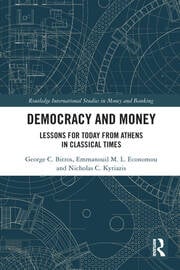
245 10|aDemocracy and money :|blessons for today from Athens in classical times /|cGeorge C. Bitros, Emmanouil M. L. Economou and Nicholas C. Kyriazis.
264 1|aAbingdon, Oxon ;|aNew York, NY :|bRoutledge,|c2020.
300 |a1 online resource.
336 |atext|btxt|2rdacontent
337 |acomputer|bn|2rdamedia
338 |aonline resource|bnc|2rdacarrier
490 1 |aRoutledge international studies in money and banking
520 |a"The authors of this book argue that post-war fiscal and monetary policies in the U.S. are prone to more frequent and more destabilizing domestic and international financial crises. So, in the aftermath of the one that erupted in 2008, they propose that now we are sleepwalking into another, which under the prevailing institutional circumstances could develop into a worldwide financial Armageddon. Thinking ahead of such a calamity, this book presents for the first time a model of democratic governance with privately produced money based on the case of Athens in Classical times, and explains why, if it is conceived as a benchmark for reference and adaptation, it may provide an effective way out from the dreadful predicament that state managed fiat money holds for the stability of Western-type democracies and the international financial system. As the U.S. today, Athens at that time reached the apex of its military, economic, political, cultural, and scientific influence in the world. But Athens triumphed through different approaches to democracy and fundamentally different fiscal and monetary policies than the U.S. Thus the readers will have the opportunity to learn about these differences and appreciate the potential they offer for confronting the challenges contemporary democracies face under the leadership of the U.S. The book will find audiences among academics, university students, and researchers across a wide range of fields and subfields, as well as legislators, fiscal and monetary policy makers, and economic and financial consultants"--|cProvided by publisher.
588 |aOCLC-licensed vendor bibliographic record.
650 0|aFiscal policy|zUnited States|xHistory|y21st century.
650 0|aMonetary policy|zUnited States|xHistory|y21st century.
650 0|aFinancial crises|zUnited States|xHistory|y21st century.
650 0|aFiscal policy|zGreece|zAthens|xHistory.
650 0|aMonetary policy|zGreece|zAthens|xHistory.
650 0|aFinancial crises|zGreece|zAthens|xHistory.
650 7|aBUSINESS & ECONOMICS / Economics / Theory|2bisacsh
650 7|aBUSINESS & ECONOMICS / Economic History|2bisacsh
650 7|aHISTORY / Ancient / Greece|2bisacsh
700 1 |aEconomou, Emmanouil Marios N.,|eauthor.
700 1 |aKyriazis, Nicholas C.,|eauthor.
856 40|3Taylor & Francis|uhttps://www.taylorfrancis.com/books/9781003051800
856 42|3OCLC metadata license agreement|uhttp://www.oclc.org/content/dam/oclc/forms/terms/vbrl-201703.pdf
901 |aTaylor & Francis