LEADER 03566cam a2200553Ki 4500
001 800864
003 TR_AnAIT
005 20260123021512
006 m o d
007 cr cnu---unuuu
008 200817s2021 nyua ob 000 0 eng d
020 |a9781000200119|qelectronic book
020 |a1000200116|qelectronic book
020 |a9781000200072|qelectronic book
020 |a1000200078|qelectronic book
020 |a9781000200096|qelectronic book
020 |a1000200094|qelectronic book
020 |a9781003097143|qelectronic book
020 |a1003097146|qelectronic book
020 |z9780367562816|qhardcover
024 7 |a10.4324/9781003097143|2doi
035 |a(OCoLC)1197755230|z(OCoLC)1191078856|z(OCoLC)1197743225
035 |a(OCoLC-P)1197755230
040 |aOCoLC-P|beng|erda|epn|cOCoLC-P
041 |aeng
049 |aTürk Tarih Kurumu Kütüphanesi
050 4|aHM1263|b.N67 2021eb
072 7|aHIS|x044000|2bisacsh
072 7|aHIS|x054000|2bisacsh
072 7|aHBJD|2bicssc
082 04|a305.52094809021|223
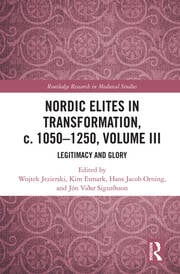
245 00|aNordic elites in transformation, c. 1050-1250.|nVolume III,|pLegitimacy and glory /|cedited by Wojtek Jezierski, Kim Esmark, Hans Jacob Orning, Jón Viõar Sigurõsson.
264 1|aNew York, NY :|bRoutledge,|c2021.
300 |a1 online resource.
336 |atext|btxt|2rdacontent
337 |acomputer|bc|2rdamedia
338 |aonline resource|bcr|2rdacarrier
490 1 |aRoutledge research in medieval studies ;|v17
520 |aThis book explores the practical and symbolic resources of legitimacy which the elites of medieval Scandinavia employed to establish, justify, and reproduce their social and political standing between the end of the Viking Age and the rise of kingdoms in the thirteenth century. Geographically the chapters cover the Scandinavian realms and Free State Iceland. Thematically the authors cover a wide palette of cultural practices and historical sources: hagiography, historiography, spaces and palaces, literature, and international connections, which rulers, magnates or ecclesiastics used to compete for status and to reserve haloing glory for themselves. The volume is divided in three sections. The first looks at the sacral, legal, and acclamatory means through which privilege was conferred onto kings and ruling families. Section Two explores the spaces such as aristocratic halls, palaces, churches in which the social elevation of elites took place. Section Three explores the traditional and novel means of domestic distinction and international cultural capital which different orders of elites - knights, powerful clerics, ruling families etc. - wrought to assure their dominance and set themselves apart vis--vis their peers and subjects. A concluding chapter discusses how the use of symbolic capital in the North compared to wider European contexts.
588 |aOCLC-licensed vendor bibliographic record.
650 0|aElite (Social sciences)|zScandinavia|xHistory|yTo 1500.
650 0|aSocial classes|zScandinavia|xHistory|yTo 1500.
650 7|aHISTORY / Europe / Scandinavia|2bisacsh
650 7|aHISTORY / Social History|2bisacsh
651 0|aScandinavia|xSocial conditions.
700 1 |aJezierski, Wojtek,|d1979-|eeditor.
700 1 |aEsmark, Kim,|eeditor.
700 1 |aOrning, Hans Jacob,|eeditor.
700 0 |aJón Viðar Sigurðsson,|d1958-|eeditor.
856 40|3Taylor & Francis|uhttps://www.taylorfrancis.com/books/9781003097143
856 42|3OCLC metadata license agreement|uhttp://www.oclc.org/content/dam/oclc/forms/terms/vbrl-201703.pdf
901 |aTaylor & Francis