LEADER 03859cam a22005418i 4500
001 801076
003 TR_AnAIT
005 20260123021837
006 m o d
007 cr |||||||||||
008 230405s2023 nyu ob 001 0 eng
020 |a9781003379263|q(ebook)
020 |a1003379265
020 |a9781000913323|q(electronic bk. : PDF)
020 |a1000913325|q(electronic bk. : PDF)
020 |a9781000913361|q(electronic bk. : EPUB)
020 |a1000913368|q(electronic bk. : EPUB)
020 |z9781032459172|q(hardback)
020 |z9781032459202|q(paperback)
024 7 |a10.4324/9781003379263|2doi
035 |a(OCoLC)1381733731
035 |a(OCoLC-P)1381733731
040 |aOCoLC-P|beng|erda|cOCoLC-P
041 |aeng
049 |aTürk Tarih Kurumu Kütüphanesi
050 00|aPR508.S3
072 7|aHIS|x010000|2bisacsh
072 7|aHIS|x037030|2bisacsh
072 7|aHIS|x054000|2bisacsh
072 7|aPDX|2bicssc
082 00|a821/.7|223/eng/20230608
100 1 |aDavies, Keith G.,|eauthor.
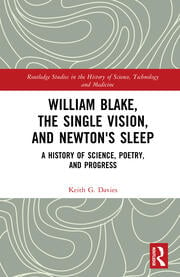
245 10|aWilliam Blake, the single vision, and Newton's sleep :|ba history of science, poetry, and progress /|cKeith G. Davies.
264 1|aNew York, NY :|bRoutledge,|c2024.
300 |a1 online resource.
336 |atext|btxt|2rdacontent
337 |acomputer|bc|2rdamedia
338 |aonline resource|bcr|2rdacarrier
490 1 |aRoutledge studies in the history of science, technology and medicine
520 |aThe history and philosophy of scientific ideas and the role poisis and imagination play in our understanding of science and progressare widely explored in this book. By examining the views of William Blake and other poets in the context of twentieth-century philosophers Hannah Arendt, Jacob Bronowski, Martin Heidegger, Bruno Latour and Karl Popper, amongst others, the book takes an eclectic approach drawing on examples from biology, history, literature, philosophy and economics, arguing for the reestablishment of imagination as a central attribute of science that may help to resolve some of our most pressing ecological problems as seen in the context of science and technology studies and what is loosely developing into the discipline of environmental humanities. Today, influential scientists looking at consciousness dismiss imagination regarding it at best as a mere epiphenomenon, a ghost in the machine, or at worst non-existent and to be denied. In this book, Keith G. Davies, who sees C. P. Snow's debate on the separation of the arts and sciences as alive and well, traces the schism back to Plato but more importantly to the seventeenth century and David Hume's removal of imagination in the conjunction between our observation of causes and their effects. Through extensive research and use of poetry, this book offers an alternate understanding of science with imagination and its continued significance in today's world. This book is an excellent reference book for postgraduate students, professional researchers, William Blake scholars and the pejoratively labelled interested laymen with concerns in ecology and environmental humanities through offering a new perspective on the history of science and the role of imagination within this field.
588 |aOCLC-licensed vendor bibliographic record.
600 10|aBlake, William,|d1757-1827|xCriticism and interpretation.
650 0|aLiterature and science.
650 0|aEnglish poetry|xHistory and criticism.
650 7|aHISTORY / Europe / General|2bisacsh
650 7|aHISTORY / Modern / General|2bisacsh
650 7|aHISTORY / Social History|2bisacsh
830 0|aRoutledge studies in the history of science, technology, and medicine.
856 40|3Taylor & Francis|uhttps://www.taylorfrancis.com/books/9781003379263
856 42|3OCLC metadata license agreement|uhttp://www.oclc.org/content/dam/oclc/forms/terms/vbrl-201703.pdf
901 |aTaylor & Francis