LEADER 03278cam a22005178i 4500
001 801128
003 TR_AnAIT
005 20260123021925
006 m o d
007 cr |||||||||||
008 240405s2025 nyu ob 001 0 eng
020 |a9781003477679|q(ebook)
020 |a1003477674
020 |a9781040097014|q(electronic bk. : PDF)
020 |a1040097014|q(electronic bk. : PDF)
020 |a9781040097021|q(electronic bk. : EPUB)
020 |a1040097022|q(electronic bk. : EPUB)
020 |z9781032762333|q(hardback)
020 |z9781032762326|q(paperback)
024 7 |a10.4324/9781003477679|2doi
035 |a(OCoLC)1435754516
035 |a(OCoLC-P)1435754516
040 |aOCoLC-P|beng|erda|cOCoLC-P
041 |aeng
049 |aTürk Tarih Kurumu Kütüphanesi
050 00|aBD621
072 7|aPHI|x009000|2bisacsh
072 7|aPHI|x013000|2bisacsh
072 7|aHP|2bicssc
082 00|a114|223/eng/20240510
100 1 |aVermeiren, Florian,|eauthor.
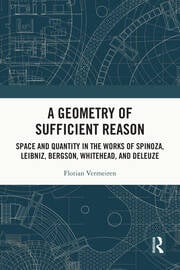
245 12|aA geometry of sufficient reason :|bspace and quantity in the works of Spinoza, Leibniz, Bergson, Whitehead, and Deleuze /|cFlorian Vermeiren.
250 |a1.
264 1|aNew York, NY :|bRoutledge,|c2025.
300 |a1 online resource
336 |atext|btxt|2rdacontent
337 |acomputer|bc|2rdamedia
338 |aonline resource|bcr|2rdacarrier
520 |a"This book explores and compares the reflections on space and quantity found in the works of five philosophers: Spinoza, Leibniz, Bergson, Whitehead, and Deleuze. What unites these philosophers is a series of metaphysical concerns rooted in 17th-century rationalism and embraced in 20th-century philosophies of process and difference. At the heart of these concerns is the need for a comprehensive metaphysical account of the diversity and individuality of things. This demand leads to a shared critique of Cartesian and Newtonian conceptions of space. The most problematic aspect of those notions of space is homogeneity. In essence, uniform space fails to explain the differences between locations, thus violating the principle of sufficient reason. Cartesian and Newtonian theories of space thereby fail to meet the metaphysical requirement for explaining diversity and individuality. The traditional concept of quantity faces similar issues. Motivated by these problems, these five philosophers develop an alternative conception of space and quantity. By examining these theories, the book sheds new light on an unexplored relation between rationalism and 20th-century Continental philosophy. A Geometry of Sufficient Reason will appeal to scholars and graduate students working in Continental philosophy, history of philosophy, metaphysics, and the history and philosophy of science"--|cProvided by publisher.
588 |aOCLC-licensed vendor bibliographic record.
650 0|aSpace.
650 0|aQuantity (Philosophy)
650 0|aRationalism|xHistory|y17th century.
650 0|aContinental philosophy.
650 7|aPHILOSOPHY / History & Surveys / General|2bisacsh
650 7|aPHILOSOPHY / Metaphysics|2bisacsh
856 40|3Taylor & Francis|uhttps://www.taylorfrancis.com/books/9781003477679
856 42|3OCLC metadata license agreement|uhttp://www.oclc.org/content/dam/oclc/forms/terms/vbrl-201703.pdf
901 |aTaylor & Francis