LEADER 03455cam a2200349Ii 4500
001 801462
003 TR_AnAIT
005 20260123022409
008 180706s2018 enk ob 001 0 eng d
020 |a9781315667850|q(e-book : PDF)
020 |a9781317359340|q(e-book: Mobi)
020 |z9781138945623|q(hardback)
024 7 |a10.4324/9781315667850 |2doi
035 |a(OCoLC)1011108861
040 |aFlBoTFG|cFlBoTFG|erda
041 |aeng
043 |ae-ur---
049 |aTürk Tarih Kurumu Kütüphanesi
050 4|aDK265.A553|bR48 2018
082 04|a947.0841072|bR438
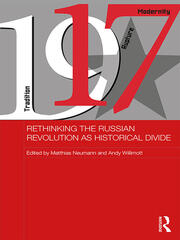
245 00|aRethinking the Russian Revolution as historical divide /|cedited by Matthias Neumann and Andy Willimott.
264 1|aLondon :|bRoutledge,|c2018.
300 |a1 online resource
336 |atext|2rdacontent
337 |acomputer|2rdamedia
338 |aonline resource|2rdacarrier
490 0 |aBASEES/Routledge series on Russian and East European studies
505 00|tchapter Crossing the divide: tradition, rupture, and modernity in revolutionary Russia /|rANDY WILLIMOTT -- |tpart PART I The new state, the past, and the people -- |tchapter 1 The problem of persistence /|rJ. ARCH GETTY -- |tchapter 2 How revolutionary was revolutionary justice? Legal culture in Russia across the revolutionary divide /|rMATTHEW RENDLE -- |tchapter 3 ‘Taking a leap across the tsarist throne’: revolutionizing the Russian circus MIRIAM NEIRICK -- |tchapter 4 The Communist youth league and the construction of Soviet obshchestvennost’ /|rMATTHIAS NEUMANN -- |tpart PART II The people, the past, and the new state -- |tchapter 5 For the people: the image of Ukrainian teachers as public servants /|rMATTHEW D. PAULY -- |tchapter 6 ‘The woman of the Orient is not the voiceless slave anymore’ – the non-Russian women of Volga-Ural region and ‘women’s question’ /|rYULIA GRADSKOVA -- |tchapter 7 Devotion and revolution: nursing values /|rSUSAN GRANT -- |tchapter 8 What did historians do at the time of the great revolution? /|rVERA KAPLAN -- |tchapter 9 Speaking more than Bolshevik: humour, subjectivity, and crosshatching in Stalin’s 1930s /|rJONATHAN WATERLOW.
520 |a"The Russian Revolution of 1917 has often been presented as a complete break with the past, with everything which had gone before swept away, and all aspects of politics, economy, and society reformed and made new. Recently, however, historians have increasingly come to question this view, discovering that Tsarist Russia was much more entangled in the processes of modernisation, and that the new regime contained much more continuity than has previously been acknowledged. This book presents new research findings on a range of different aspects of Russian society, both showing how there was much change before 1917, and much continuity afterwards, and also going beyond this to show that the new Soviet regime established in the 1920s, with its vision of the New Soviet Person, was in fact based on a complicated mixture of new Soviet thinking and ideas developed before 1917 by a variety of non-Bolshevik movements."--Provided by publisher.
651 0|aRussia|xHistory|yFebruary Revolution, 1917|xHistoriography.
651 0|aSoviet Union|xHistory|yRevolution, 1917-1921|xHistoriography.
651 0|aSoviet Union|xHistory|yRevolution, 1917-1921.
700 1 |aNeumann, Matthias,|eeditor.
700 1 |aWillimott, Andy,|eeditor.
776 08|iPrint version: |z9781138945623
856 40|uhttps://www.taylorfrancis.com/books/9781315667850|zClick here to view.
901 |aTaylor & Francis