LEADER 04335cam a22006018i 4500
001 801755
003 TR_AnAIT
005 20260123022835
006 m d | |
007 cr |||||||||||
008 191226s2020 enk ob 001 0 eng
020 |a9780429438691|q(ebook)
020 |a0429438699
020 |a9780429797750|q(electronic bk. : Mobipocket)
020 |a0429797753|q(electronic bk. : Mobipocket)
020 |a9780429797767|q(electronic bk. : EPUB)
020 |a0429797761|q(electronic bk. : EPUB)
020 |a9780429797774|q(electronic bk. : PDF)
020 |a042979777X|q(electronic bk. : PDF)
020 |z9781138344112|q(hardback)
035 |a(OCoLC)1135090446
035 |a(OCoLC-P)1135090446
040 |aOCoLC-P|beng|erda|cOCoLC-P
041 |aeng
049 |aTürk Tarih Kurumu Kütüphanesi
050 00|aDF853
072 7|aHIS|x010000|2bisacsh
072 7|aHIS|x042000|2bisacsh
072 7|aPOL|x011000|2bisacsh
072 7|aGTJ|2bicssc
082 00|a949.507/5|223
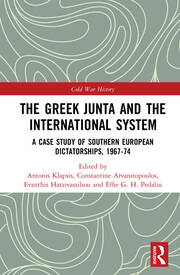
245 04|aThe Greek junta and the international system :|ba case study of southern European dictatorships, 1967-74 /|cedited by Antonis Klapsis, Constantine Arvanitopoulos, Evanthis Hatzivassiliou, Effie G. H. Pedaliu.
264 1|aAbingdon, Oxon ;|aNew York :|bRoutledge,|c2020.
300 |a1 online resource.
336 |atext|btxt|2rdacontent
337 |acomputer|bn|2rdamedia
338 |aonline resource|bnc|2rdacarrier
490 1 |aCold War history
520 |a"This book examines the international dimensions of the Greek military dictatorship of 1967-74 and uses it as a case study to evaluate the major shifts occurring in the international system during a period of rapid change. The policies of the major nation-states in both East and West were determined by realistic Cold War considerations. At the same time, the Greek junta, a profoundly anti-modernist force, failed to cope with an evolving international agenda and moves towards international cooperation. Denouncing it became a rallying point both for international organizations and for human rights activists, and it enabled the EEC to underscore the notion that democracy was an integral characteristic of the European identity. This volume is an original in-depth study of an under-researched subject and the multiple interactions of a complex era. It is divided into three sections: Part I deals with the interaction of the Colonels with state actors; Part II deals with the responses of international organizations and the rising transnational human rights agenda for which the Greek junta became a totemic rallying point; Part III compares and contrasts the transitions to democracy in Southern Europe, and analyses the different models of transition, region building and how they intersected with attempts to foster a European identity. The Greek dictatorship may have been a parochial military regime, but its rise and fall interacted with significant international trends and can therefore serve as a salient case study for promoting a better understanding of international and European trends during the 1960s and 1970s. This book will be of much interest to students of Cold War studies, international history, foreign policy, transatlantic relations and International Relations, in general."--|cProvided by publisher.
588 |aOCLC-licensed vendor bibliographic record.
647 7|aCoup d'état|c(Greece :|d1967 December 13)|2fast|0(OCoLC)fst01352588
650 0|aDictators|zEurope, Southern|xHistory|y20th century.
650 0|aCold War.
650 7|aHISTORY / Europe / General|2bisacsh
650 7|aHISTORY / Europe / Greece (see also Ancient / Greece)|2bisacsh
650 7|aPOLITICAL SCIENCE / International Relations / General|2bisacsh
651 0|aGreece|xPolitics and government|y1967-1974.
651 0|aGreece|xForeign relations|y1967-1974.
651 0|aGreece|xHistory|yCoup d'état, 1967 (December 13)
700 1 |aKlapsēs, Antōnios V.,|eeditor.
700 1 |aArvanitopoulos, Constantine,|eeditor.
700 1 |aChatzēvasileiou, Euanthēs,|d1966-|eeditor.
700 1 |aPedaliu, Effie G. H.,|d1959-|eeditor.
856 40|3Taylor & Francis|uhttps://www.taylorfrancis.com/books/9780429438691
856 42|3OCLC metadata license agreement|uhttp://www.oclc.org/content/dam/oclc/forms/terms/vbrl-201703.pdf
901 |aTaylor & Francis