LEADER 03588cam a2200469 i 4500
001 801777
003 TR_AnAIT
005 20260123022857
006 m o d
007 cr cnu---unuuu
008 200309s2021 enkab ob 001 0 eng
020 |a9781003001263|qelectronic book
020 |a1003001262|qelectronic book
020 |a9781000094084|qelectronic book
020 |a1000094081|qelectronic book
020 |a9781000093902|q(electronic bk. : PDF)
020 |a1000093905|q(electronic bk. : PDF)
020 |a9781000093995|q(electronic bk. : Mobipocket)
020 |a1000093999|q(electronic bk. : Mobipocket)
020 |z9780367431099|qhardcover
035 |a(OCoLC)1145086463
035 |a(OCoLC-P)1145086463
040 |aOCoLC-P|beng|erda|cOCoLC-P
041 |aeng
049 |aTürk Tarih Kurumu Kütüphanesi
050 04|aDT434.T86|bD47 2021eb
072 7|aHIS|x001030|2bisacsh
072 7|aHD|2bicssc
082 00|a967.62/004965522|223
100 1 |aDerbyshire, Samuel F.|q(Samuel Frederick),|d1989-|eauthor.
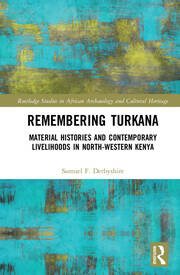
245 10|aRemembering Turkana :|bmaterial histories and contemporary livelihoods in north-western Kenya /|cSamuel F. Derbyshire.
264 1|aAbingdon, Oxon ;|aNew York, NY :|bRoutledge,|c2021.
300 |a1 online resource (xx, 233 pages).
336 |atext|btxt|2rdacontent
337 |acomputer|bc|2rdamedia
338 |aonline resource|bcr|2rdacarrier
490 1 |aRoutledge studies in African archaeology and cultural heritage
520 |a"This book explores aspects of the socio-economic and political history of the Turkana of northern Kenya, examining the making and re-making of the regional economy via the trajectories of socio-material interaction that have structured key practices, relationships and livelihoods over the past century. Traversing Turkana's constituent livelihoods and examining the historical relationships between them in relation to shifting economic, ecological and political factors, the book asks what perspective emerges from an in-depth understanding of the everyday things that have taken part in processes of substantial socio-cultural transformation. By setting out a series of new examples established through long-term research in the region, it offers a characterisation of Turkana's iterative transformation as the articulation of a set of long-term continuities. Investigating quotidian personal and community histories, it argues that Turkana's complex network of livelihood interactions has, on the whole, strengthened over time through its continual reformulation, as identities, livelihood practices and social institutions have been re-imagined and reshaped with each new generation in order to reconstruct accumulated memory and knowledges. Remembering Turkana provides a wide-ranging socio-historical overview of the Turkana region and people, situating critical contemporary issues within diverse bodies of literature. The characterisation of long-term change and continuity, as articulated and enacted via material culture production, use and exchange, that it offers will be of significance to a broad array of scholarly disciplines, including archaeology, history, anthropology and political science"--|cProvided by publisher.
588 |aOCLC-licensed vendor bibliographic record.
650 0|aTurkana (African people)
650 7|aHISTORY / Africa / North|2bisacsh
651 0|aTurkana (Kenya)|xHistory.
856 40|3Taylor & Francis|uhttps://www.taylorfrancis.com/books/9781003001263
856 42|3OCLC metadata license agreement|uhttp://www.oclc.org/content/dam/oclc/forms/terms/vbrl-201703.pdf
901 |aTaylor & Francis