LEADER 03641cam a22005418i 4500
001 801850
003 TR_AnAIT
005 20260123023018
006 m d | |
007 cr |||||||||||
008 201203s2021 nyu ob 001 0 eng
020 |a9781003098348|q(ebook)
020 |a1003098347
020 |a1000378039|q(electronic bk.)
020 |a9781000378030|q(electronic bk.)
020 |a9781000377996|q(PDF ebook)
020 |a1000377997
020 |z9780367565565|q(hardback)
024 7 |a10.4324/9781003098348|2doi
035 |a(OCoLC)1226075246
035 |a(OCoLC-P)1226075246
040 |aOCoLC-P|beng|erda|cOCoLC-P
041 |aeng
049 |aTürk Tarih Kurumu Kütüphanesi
050 00|aDL766
072 7|aPER|x011000|2bisacsh
072 7|aPER|x000000|2bisacsh
072 7|aPER|x011020|2bisacsh
072 7|aAN|2bicssc
082 00|a948.5/0381|223
100 1 |aBerlova, Maria,|eauthor.
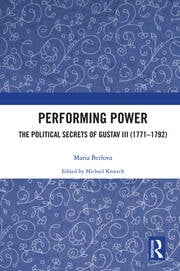
245 10|aPerforming power :|bthe political secrets of Gustav III (1771-1792) /|cMaria Berlova ; edited by Michael Kroetch.
264 1|aAbingdon, Oxon ; New York :|bRoutledge,|c2021.
300 |a1 online resource
336 |atext|btxt|2rdacontent
337 |acomputer|bn|2rdamedia
338 |aonline resource|bnc|2rdacarrier
505 0 |aIntroduction: performing royalty -- Theories of playing and performing -- The king as performer -- Court playing culture: brokering power and the nobility -- Public pageant: displaying power to the people -- Royal encounters: communicating power for consensus -- Monarchs in play -- Monarchs in play -- Conclusion: the tragic finale.
520 |a"Performing Power explores 18th century fabrication of the royal image by focusing on the example of King Gustav III (1746-1792) - one of Sweden's most acclaimed and controversial monarchs - who conspicuously chose theater as the primary media for his image-making and role construction. The text postulates that Gustav III was motivated by theater's ability to aid him in fulfilling Enlightenment's tenet of broadly educating the populace and inculcating it with royal ideology. That he was an amateur actor, stage director, and playwright were other engines driving his choice. The project challenges and expands the commonly accepted perception of Gustav III's contribution to Swedish theater, which has generally been limited to founding its National Opera, developing its national drama, and forming its national dramatic repertoire. Maria Berlova presents Gustav III as a performing King who strategically used political events as a framework through which he could embody the image of the ideal or enlightened monarch as presented by Voltaire. Through this, Performing Power explores the tight relationship and complex bond between theatrical arts and politics. This unique study will be of great interest to students and scholars in theatre studies, 18th century culture and politics"--|cProvided by publisher.
588 |aOCLC-licensed vendor bibliographic record.
600 00|aGustav|bIII,|cKing of Sweden,|d1746-1792.
650 0|aTheater|xPolitical aspects|zSweden|xHistory|y18th century.
650 7|aPERFORMING ARTS / Theater / General|2bisacsh
650 7|aPERFORMING ARTS / General|2bisacsh
650 7|aPERFORMING ARTS / Theater / History & Criticism|2bisacsh
651 0|aSweden|xHistory|yGustav III, 1771-1792.
651 0|aSweden|xPolitics and government|y1718-1772.
700 1 |aKroetch, Michael,|eeditor.
856 40|3Taylor & Francis|uhttps://www.taylorfrancis.com/books/9781003098348
856 42|3OCLC metadata license agreement|uhttp://www.oclc.org/content/dam/oclc/forms/terms/vbrl-201703.pdf
901 |aTaylor & Francis