

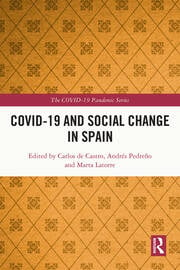
COVID-19 and social change in Spain / edited by Carlos de Castro, Andrés Pedreño and Marta Latorre.
ISBN
9781003281719 (ebook)
1003281710
9781000782004 (electronic bk. : EPUB)
100078200X (electronic bk. : EPUB)
9781000781960 (electronic bk. : PDF)
1000781968 (electronic bk. : PDF)
9781032251295 (hardback)
9781032251301 (paperback)
1003281710
9781000782004 (electronic bk. : EPUB)
100078200X (electronic bk. : EPUB)
9781000781960 (electronic bk. : PDF)
1000781968 (electronic bk. : PDF)
9781032251295 (hardback)
9781032251301 (paperback)
Dil Kodu
İngilizce
Yayın Bilgisi
Abingdon, Oxon ; New York, NY : Routledge, 2023.
Fiziksel Niteleme
1 online resource.
Dizi
The COVID-19 pandemic series
Özet, vb.
"Originating in the popular Sociología en Cuarantena blog, this volume provides a detailed and multifaceted analysis of the social impact of the COVID-19 pandemic in Spain. This book originates in the great upheaval caused by the COVID-19 pandemic, when the unprecedented announcement of global lockdowns paralyszed the world and put social relations on hold. In response, a loose collective of sociologists, historians and philosophers from various Spanish universities began to share their reflections on the pandemic on the Sociología en Cuarantena blog. This book takes some of those thoughts and delves deeper into the recurring themes as they relate to the Spanish experience of the pandemic. The chapters in the first part of the book address the social and political context of the various measures put in place by the government to deal with the health, economic and social effects of the pandemic. Subsequently, several chapters examine how the pandemic led to important reflections on uncertainty and authority in processes of scientific knowledge production. Other chapters analyse the effects of the pandemic on demographics, the organization of care, the education system, the organisation of work and the recognition of essential workers, immigration policies, and the digitalization of society. Collectively, the contributions call into question the narrative of exceptionalism that views the pandemic as a singular event that is uniquely responsible for the present situation of uncertainty and instability. They also draw attention to the fragility of social prestige and trust in neglected and weakened public institutions, as well as identifying a growing socio-political polarization that may be highly significant in the future. This collection will appeal to students and researchers with an interest in contemporary Spain and the socio-political effects of the COVID-19 pandemic"-- Provided by publisher.
Konu
COVID-19 Pandemic, 2020- __ Social aspects __ Spain.
Social change __ Spain.
SOCIAL SCIENCE / Sociology / General __ bisacsh
Spain __ Social conditions __ 21st century.
Spain __ Economic conditions __ 21st century.
Social change __ Spain.
SOCIAL SCIENCE / Sociology / General __ bisacsh
Spain __ Social conditions __ 21st century.
Spain __ Economic conditions __ 21st century.
Veritabanı
