LEADER 03994cam a2200601 i 4500
001 802032
003 TR_AnAIT
005 20260123023318
006 m o d
007 cr cnu---unuuu
008 220825t20232023enk ob 001 0 eng
020 |a9781003355625|qelectronic book
020 |a1003355625|qelectronic book
020 |a9781000830378|qelectronic book
020 |a1000830373|qelectronic book
020 |a9781000830392|qelectronic book
020 |a100083039X|qelectronic book
020 |z9781032409726|qhardcover
020 |z9781032409733|qpaperback
024 7 |a10.4324/9781003355625|2doi
035 |a(OCoLC)1343160580
035 |a(OCoLC-P)1343160580
040 |aOCoLC-P|beng|erda|cOCoLC-P
041 |aeng
049 |aTürk Tarih Kurumu Kütüphanesi
050 04|aHG3200.L74|bB18533 2023
072 7|aBUS|x004000|2bisacsh
072 7|aBUS|x023000|2bisacsh
072 7|aBUS|x045000|2bisacsh
072 7|aKCBM|2bicssc
082 00|a332.109469/42|223/eng/20220825
100 1 |aCardoso, José Luís,|eauthor.
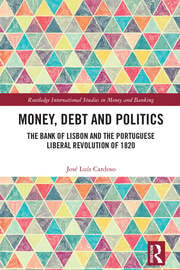
245 10|aMoney, debt and politics :|bthe bank of Lisbon and the Portuguese liberal revolution of 1820 /|cJosé Luís Cardoso.
264 1|aAbingdon, Oxon ;|aNew York, NY :|bRoutledge,|c2023.
264 4|c©2023
300 |a1 online resource (viii, 112 pages)
336 |atext|btxt|2rdacontent
337 |acomputer|bc|2rdamedia
338 |aonline resource|bcr|2rdacarrier
490 1 |aRoutledge international studies in money and banking
520 |a"This book presents an innovative history of the first Portuguese public bank, by exploring the relationship between banking activities and the political context. It provides an overview of the origins of the banking system in Portugal, and also in Brazil, and explores new archive materials related to the first years of activity of the Bank of Lisbon and to the public debates on monetary and public finance topics. It discusses the main features of the Bank of Lisbon: a private bank with a mandate to issue banknotes for the purposes of regulating monetary circulation, and with the function of financing the State for current payments, as well as for the amortisation of public debt and the creation of new debt. The aim of contributing to the re-establishment of public trust and credit conferred upon the Bank of Lisbon the status of a quasi-central bank with the obligations of lending and issuing money. This historical case study offers new insights for a better understanding of the role of banks on the regulation of monetary circulation and on the management of sovereign debt. By stressing the relevance of the political context, it also illustrates the key issues of trust, independence and rules associated to decision-making processes in the study of European banking history. The main focus is the link between banking practices and the political environment. However, the reader will also engage in discussions on theoretical and economic policy issues on the main economic topics under survey: money, paper-money, public debt, credit system"--|cProvided by publisher.
588 |aOCLC-licensed vendor bibliographic record.
610 20|aBanco de Lisboa|xHistory.
647 7|aRevolution|c(Portugal :|d1820)|2fast|0(OCoLC)fst01354565
650 0|aBanks and banking|zPortugal|xHistory|y19th century.
650 0|aEconomics|zPortugal|xHistory.
650 0|aEconomics|zBrazil|xHistory.
650 0|aBanks and banking|zBrazil|xHistory|y19th century.
650 7|aBUSINESS & ECONOMICS / Banks & Banking|2bisacsh
650 7|aBUSINESS & ECONOMICS / Economic History|2bisacsh
650 7|aBUSINESS & ECONOMICS / Money & Monetary Policy|2bisacsh
651 0|aPortugal|xHistory|yRevolution, 1820.
830 0|aRoutledge international studies in money and banking.
856 40|3Taylor & Francis|uhttps://www.taylorfrancis.com/books/9781003355625
856 42|3OCLC metadata license agreement|uhttp://www.oclc.org/content/dam/oclc/forms/terms/vbrl-201703.pdf
901 |aTaylor & Francis