LEADER 03594cam a22005658i 4500
001 802063
003 TR_AnAIT
005 20260123023351
006 m o d
007 cr |||||||||||
008 240405s2024 nyu ob 001 0deng
020 |a9781003403845|q(ebk)
020 |a1003403840
020 |a9781040085516|q(electronic bk. : PDF)
020 |a1040085512|q(electronic bk. : PDF)
020 |a9781040085554|q(electronic bk. : EPUB)
020 |a1040085555|q(electronic bk. : EPUB)
020 |z9781032517643|q(hbk)
020 |z9781032517698|q(pbk)
024 7 |a10.4324/9781003403845|2doi
035 |a(OCoLC)1430201240
035 |a(OCoLC-P)1430201240
040 |aOCoLC-P|beng|erda|cOCoLC-P
041 |aeng
049 |aTürk Tarih Kurumu Kütüphanesi
050 00|aGN21.R46
072 7|aSOC|x026000|2bisacsh
072 7|aJHB|2bicssc
082 00|a301.092|223/eng/20240412
100 1 |aMiglievich-Ribeiro, Adelia,|eauthor.
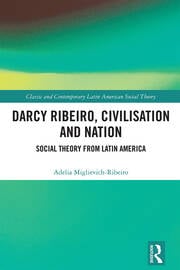
245 10|aDarcy Ribeiro, civilisation and nation :|bsocial theory from América Latina /|cAdelia Miglievich-Ribeiro ; [translated by Marcelo Henrique Santana Telles].
264 1|aNew York :|bRoutledge,|c2024.
300 |a1 online resource.
336 |atext|btxt|2rdacontent
337 |acomputer|bc|2rdamedia
338 |aonline resource|bcr|2rdacarrier
490 0 |aClassic and contemporary Latin American social theory
505 2 |aPart 1. Darcy Ribeiro's Pathways -- Part 2. The Civilizational Process -- Part 3. The Americas, Latin America and Brazil -- Part 4. Promising Dialogues and Epistemological Turns.
520 |a"This book introduces the life and work of Darcy Ribeiro (1922-1997), one of the foremost exponents of Brazilian/Latin American social thought in the twentieth century. Ribeiro was an anthropologist, indigenist ethnographer, social scientist, planner and creator of universities and schools, and held various political offices. This book examines Ribeiro's work in conversation with other great names of Latin American critical thought, and introduces the contemporary epistemological movement he inspired, 'Modernity-Coloniality-Decoloniality'. It presents the 12 years of Latin American exile to which he was subjected in the 1960s-70s, highlighting the fame he gained as a reformer of universities on the continent. Finally, the book builds two new dialogues unheard of, one with black Brazilian intellectuals and the other with contemporary post(de)colonial studies. This book will appeal to all those interested in studying global asymmetries, social inequalities, and obstacles to development in Latin America. Scholars and students of sociology, social theory, anthropology, Latin American studies, political history, and education will find it useful"--|cProvided by publisher.
588 |aOCLC-licensed vendor bibliographic record.
600 10|aRibeiro, Darcy.
650 0|aCritical thinking|zLatin America.
650 0|aEducational anthropology|zLatin America.
650 0|aAnthropologists|zBrazil|zMontes Claros (Minas Gerais)
650 0|aEducators|zBrazil|zMontes Claros (Minas Gerais)
650 0|aSocial scientists|zBrazil|zMontes Claros (Minas Gerais)
650 0|aPoliticians|zBrazil|zMontes Claros (Minas Gerais)
650 0|aNovelists, Brazilian|y20th century.
650 7|aSOCIAL SCIENCE / Sociology / General|2bisacsh
651 0|aLatin America|xSocial conditions|y20th century.
856 40|3Taylor & Francis|uhttps://www.taylorfrancis.com/books/9781003403845
856 42|3OCLC metadata license agreement|uhttp://www.oclc.org/content/dam/oclc/forms/terms/vbrl-201703.pdf
901 |aTaylor & Francis