

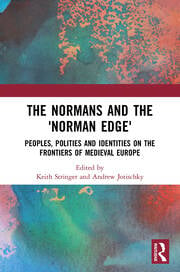
The Normans and the Norman Edge [electronic resource] : Peoples, Polities and Identities on the Frontiers of Medieval Europe.
ISBN
9781317022541
1317022548
131702253X
9781317022527 (Mobipocket ebook)
1317022521
9781315555072 (ebook)
1315555077
9781317022534 (electronic bk.)
9781472459787 (hbk.)
1317022548
131702253X
9781317022527 (Mobipocket ebook)
1317022521
9781315555072 (ebook)
1315555077
9781317022534 (electronic bk.)
9781472459787 (hbk.)
Dil Kodu
İngilizce
Fiziksel Niteleme
1 online resource (361 p.)
Genel Not
Description based upon print version of record.
İçindekiler Notu
Cover; Half Title; Title Page; Copyright Page; Table of Contents; List of contributors; Editorial notes; Abbreviations; Prologue: The Norman Edge in context; 1 Norman identity and the identity of Normandy, c.900-c.1300; Medieval identities and ethnogenesis; The problems of the sources for Norman identity; The changing meanings and uses of the term 'Norman'; First stage; Second stage; Third stage; Fourth stage; Fifth stage; The distinguishing features of Norman identity; Normans, Anglo-Normans or English?; Were there distinctive Norman characteristics?; Conclusions; 2 The Normans in the North
3 Names on the Norman Edge: The persistence of Gaelic names in 'middle Britain'The survival of Insular personal names; The Gàidhealtachd of south-western Scotland; The western seaboard and the Isle of Man; The kingdom of the Scots; Conclusions; 4 The shape of the Norman principality of Gwynedd; Norman Gwynedd; A principality?; Domesday Book; Englefield; Bistre; North Wales; Conclusions; 5 Exogamy and miscegenation in the Norman worlds; Exogamy as a strategy to enable integration at the elite level; Exogamy as a follow-up policy encouraging acculturation; Banning exogamy and miscegenation
Conclusions6 South Italian Normans and the crusader states in the twelfth century; Additional bibliography; 7 The nobility of the principality of Antioch, 1098-1187: Names, origins and identity; Names and origins; Identities; Prosopographical appendix: The nobility of the principality of Antioch, 1098-1187; Abbreviations; 8 Saints' cults and devotions on the Norman Edge: The case of St Katherine of Alexandria; The Passio of St Katherine; The cult of St Katherine in the Norman world; Re-exporting St Katherine to the East: the shrine on Mt Sinai
The roles of St Katherine in the Norman devotional world9 The Norman Edge: Some reflections on Norman expansion into 'Outer Europe'; Bibliography; Index
3 Names on the Norman Edge: The persistence of Gaelic names in 'middle Britain'The survival of Insular personal names; The Gàidhealtachd of south-western Scotland; The western seaboard and the Isle of Man; The kingdom of the Scots; Conclusions; 4 The shape of the Norman principality of Gwynedd; Norman Gwynedd; A principality?; Domesday Book; Englefield; Bistre; North Wales; Conclusions; 5 Exogamy and miscegenation in the Norman worlds; Exogamy as a strategy to enable integration at the elite level; Exogamy as a follow-up policy encouraging acculturation; Banning exogamy and miscegenation
Conclusions6 South Italian Normans and the crusader states in the twelfth century; Additional bibliography; 7 The nobility of the principality of Antioch, 1098-1187: Names, origins and identity; Names and origins; Identities; Prosopographical appendix: The nobility of the principality of Antioch, 1098-1187; Abbreviations; 8 Saints' cults and devotions on the Norman Edge: The case of St Katherine of Alexandria; The Passio of St Katherine; The cult of St Katherine in the Norman world; Re-exporting St Katherine to the East: the shrine on Mt Sinai
The roles of St Katherine in the Norman devotional world9 The Norman Edge: Some reflections on Norman expansion into 'Outer Europe'; Bibliography; Index
Özet, vb.
Modern historians of the Normans have tended to treat their enterprises and achievements as a series of separate and discrete histories. Such treatments are valid and valuable, but historical understanding of the Normans also depends as much on broader approaches akin to those adopted in this book. As the successor volume to Norman Expansion: Connections, Continuities and Contrasts, it complements and significantly extends its findings to provide a fuller appreciation of the roles played by the Normans as one of the most dynamic and transformative forces in the history of medieval Outer Europe'. It includes panoramic essays that dissect the conceptual and methodological issues concerned, suggest strategies for avoiding associated pitfalls, and indicate how far and in what ways the Normans and their legacies served to reshape sociopolitical landscapes across a vast geography extending from the remoter corners of the British Isles to the Mediterranean basin. Leading experts in their fields also provide case-by-case analyses, set within and between different areas, of themes such as lordship and domination, identities and identification, naming patterns, marriage policies, saints' cults, intercultural exchanges, and diaspora- homeland connections. The Normans and the Norman Edge' therefore presents a potent combination of thought-provoking overviews and fresh insights derived from new research, and its wide-ranging comparative focus has the advantage of illuminating aspects of the Norman past that traditional regional or national histories often do not reveal so clearly. It likewise makes a major contribution to current Norman scholarship by reconsidering the links between Norman expansion and state-formation'; the extent to which Norman practices and priorities were distinctive; the balance between continuity and innovation; relations between the Normans and the indigenous peoples and cultures they encountered; and, not least, forms of Norman identity and their resilience over time. An extensive bibliography is also one of this book's strengths.
Konu
Normans __ Europe.
Civilization, Medieval.
Normans __ Great Britain.
Normans __ Italy.
Group identity __ Europe __ History.
HISTORY / General __ bisacsh
HISTORY / Medieval __ bisacsh
Europe __ History __ 476-1492.
Civilization, Medieval.
Normans __ Great Britain.
Normans __ Italy.
Group identity __ Europe __ History.
HISTORY / General __ bisacsh
HISTORY / Medieval __ bisacsh
Europe __ History __ 476-1492.
Diğer Yazarlar
Veritabanı
Eseri Alıntıla
Referansları kullanmadan önce gözden geçirmeniz ve varsa gerekli düzeltmeleri yapmanız önerilir.
Dijital Kaynak
MARC Görünümü
LEADER 06010cam a2200625Mu 4500
001 802340
003 TR_AnAIT
005 20260123023822
006 m d
007 cr cnu---unuuu
008 191130s2019 xx o 000 0 eng d
020 |a9781317022541
020 |a1317022548
020 |a131702253X
020 |a9781317022527|q(Mobipocket ebook)
020 |a1317022521
020 |a9781315555072|q(ebook)
020 |a1315555077
020 |a9781317022534|q(electronic bk.)
020 |z9781472459787 (hbk.)
024 7 |a10.4324/9781315555072|2doi
035 |a(OCoLC)1129165110
035 |a(OCoLC-P)1129165110
040 |aOCoLC-P|beng|cOCoLC-P
041 |aeng
049 |aTürk Tarih Kurumu Kütüphanesi
050 4|aD148
072 7|aHIS|x000000|2bisacsh
072 7|aHIS|x037010|2bisacsh
072 7|aHBLC1|2bicssc
082 04|a940.0439500902|223
100 1 |aStringer, K. J.|q(Keith John)
245 14|aThe Normans and the Norman Edge|h[electronic resource] :|bPeoples, Polities and Identities on the Frontiers of Medieval Europe.
260 |aMilton :|bRoutledge,|c2019.
300 |a1 online resource (361 p.)
336 |atext|2rdacontent
336 |astill image|2rdacontent
337 |acomputer|2rdamedia
338 |aonline resource|2rdacarrier
500 |aDescription based upon print version of record.
505 0 |aCover; Half Title; Title Page; Copyright Page; Table of Contents; List of contributors; Editorial notes; Abbreviations; Prologue: The Norman Edge in context; 1 Norman identity and the identity of Normandy, c.900-c.1300; Medieval identities and ethnogenesis; The problems of the sources for Norman identity; The changing meanings and uses of the term 'Norman'; First stage; Second stage; Third stage; Fourth stage; Fifth stage; The distinguishing features of Norman identity; Normans, Anglo-Normans or English?; Were there distinctive Norman characteristics?; Conclusions; 2 The Normans in the North
505 8 |a3 Names on the Norman Edge: The persistence of Gaelic names in 'middle Britain'The survival of Insular personal names; The Gàidhealtachd of south-western Scotland; The western seaboard and the Isle of Man; The kingdom of the Scots; Conclusions; 4 The shape of the Norman principality of Gwynedd; Norman Gwynedd; A principality?; Domesday Book; Englefield; Bistre; North Wales; Conclusions; 5 Exogamy and miscegenation in the Norman worlds; Exogamy as a strategy to enable integration at the elite level; Exogamy as a follow-up policy encouraging acculturation; Banning exogamy and miscegenation
505 8 |aConclusions6 South Italian Normans and the crusader states in the twelfth century; Additional bibliography; 7 The nobility of the principality of Antioch, 1098-1187: Names, origins and identity; Names and origins; Identities; Prosopographical appendix: The nobility of the principality of Antioch, 1098-1187; Abbreviations; 8 Saints' cults and devotions on the Norman Edge: The case of St Katherine of Alexandria; The Passio of St Katherine; The cult of St Katherine in the Norman world; Re-exporting St Katherine to the East: the shrine on Mt Sinai
505 8 |aThe roles of St Katherine in the Norman devotional world9 The Norman Edge: Some reflections on Norman expansion into 'Outer Europe'; Bibliography; Index
520 |aModern historians of the Normans have tended to treat their enterprises and achievements as a series of separate and discrete histories. Such treatments are valid and valuable, but historical understanding of the Normans also depends as much on broader approaches akin to those adopted in this book. As the successor volume to Norman Expansion: Connections, Continuities and Contrasts, it complements and significantly extends its findings to provide a fuller appreciation of the roles played by the Normans as one of the most dynamic and transformative forces in the history of medieval Outer Europe'. It includes panoramic essays that dissect the conceptual and methodological issues concerned, suggest strategies for avoiding associated pitfalls, and indicate how far and in what ways the Normans and their legacies served to reshape sociopolitical landscapes across a vast geography extending from the remoter corners of the British Isles to the Mediterranean basin. Leading experts in their fields also provide case-by-case analyses, set within and between different areas, of themes such as lordship and domination, identities and identification, naming patterns, marriage policies, saints' cults, intercultural exchanges, and diaspora- homeland connections. The Normans and the Norman Edge' therefore presents a potent combination of thought-provoking overviews and fresh insights derived from new research, and its wide-ranging comparative focus has the advantage of illuminating aspects of the Norman past that traditional regional or national histories often do not reveal so clearly. It likewise makes a major contribution to current Norman scholarship by reconsidering the links between Norman expansion and state-formation'; the extent to which Norman practices and priorities were distinctive; the balance between continuity and innovation; relations between the Normans and the indigenous peoples and cultures they encountered; and, not least, forms of Norman identity and their resilience over time. An extensive bibliography is also one of this book's strengths.
588 |aOCLC-licensed vendor bibliographic record.
650 0|aNormans|zEurope.
650 0|aCivilization, Medieval.
650 0|aNormans|zGreat Britain.
650 0|aNormans|zItaly.
650 0|aGroup identity|zEurope|xHistory.
650 7|aHISTORY / General|2bisacsh
650 7|aHISTORY / Medieval|2bisacsh
651 0|aEurope|xHistory|y476-1492.
700 1 |aJotischky, Andrew,|d1965-
856 40|3Taylor & Francis|uhttps://www.taylorfrancis.com/books/9781315555072
856 42|3OCLC metadata license agreement|uhttp://www.oclc.org/content/dam/oclc/forms/terms/vbrl-201703.pdf
901 |aTaylor & Francis
001 802340
003 TR_AnAIT
005 20260123023822
006 m d
007 cr cnu---unuuu
008 191130s2019 xx o 000 0 eng d
020 |a9781317022541
020 |a1317022548
020 |a131702253X
020 |a9781317022527|q(Mobipocket ebook)
020 |a1317022521
020 |a9781315555072|q(ebook)
020 |a1315555077
020 |a9781317022534|q(electronic bk.)
020 |z9781472459787 (hbk.)
024 7 |a10.4324/9781315555072|2doi
035 |a(OCoLC)1129165110
035 |a(OCoLC-P)1129165110
040 |aOCoLC-P|beng|cOCoLC-P
041 |aeng
049 |aTürk Tarih Kurumu Kütüphanesi
050 4|aD148
072 7|aHIS|x000000|2bisacsh
072 7|aHIS|x037010|2bisacsh
072 7|aHBLC1|2bicssc
082 04|a940.0439500902|223
100 1 |aStringer, K. J.|q(Keith John)
245 14|aThe Normans and the Norman Edge|h[electronic resource] :|bPeoples, Polities and Identities on the Frontiers of Medieval Europe.
260 |aMilton :|bRoutledge,|c2019.
300 |a1 online resource (361 p.)
336 |atext|2rdacontent
336 |astill image|2rdacontent
337 |acomputer|2rdamedia
338 |aonline resource|2rdacarrier
500 |aDescription based upon print version of record.
505 0 |aCover; Half Title; Title Page; Copyright Page; Table of Contents; List of contributors; Editorial notes; Abbreviations; Prologue: The Norman Edge in context; 1 Norman identity and the identity of Normandy, c.900-c.1300; Medieval identities and ethnogenesis; The problems of the sources for Norman identity; The changing meanings and uses of the term 'Norman'; First stage; Second stage; Third stage; Fourth stage; Fifth stage; The distinguishing features of Norman identity; Normans, Anglo-Normans or English?; Were there distinctive Norman characteristics?; Conclusions; 2 The Normans in the North
505 8 |a3 Names on the Norman Edge: The persistence of Gaelic names in 'middle Britain'The survival of Insular personal names; The Gàidhealtachd of south-western Scotland; The western seaboard and the Isle of Man; The kingdom of the Scots; Conclusions; 4 The shape of the Norman principality of Gwynedd; Norman Gwynedd; A principality?; Domesday Book; Englefield; Bistre; North Wales; Conclusions; 5 Exogamy and miscegenation in the Norman worlds; Exogamy as a strategy to enable integration at the elite level; Exogamy as a follow-up policy encouraging acculturation; Banning exogamy and miscegenation
505 8 |aConclusions6 South Italian Normans and the crusader states in the twelfth century; Additional bibliography; 7 The nobility of the principality of Antioch, 1098-1187: Names, origins and identity; Names and origins; Identities; Prosopographical appendix: The nobility of the principality of Antioch, 1098-1187; Abbreviations; 8 Saints' cults and devotions on the Norman Edge: The case of St Katherine of Alexandria; The Passio of St Katherine; The cult of St Katherine in the Norman world; Re-exporting St Katherine to the East: the shrine on Mt Sinai
505 8 |aThe roles of St Katherine in the Norman devotional world9 The Norman Edge: Some reflections on Norman expansion into 'Outer Europe'; Bibliography; Index
520 |aModern historians of the Normans have tended to treat their enterprises and achievements as a series of separate and discrete histories. Such treatments are valid and valuable, but historical understanding of the Normans also depends as much on broader approaches akin to those adopted in this book. As the successor volume to Norman Expansion: Connections, Continuities and Contrasts, it complements and significantly extends its findings to provide a fuller appreciation of the roles played by the Normans as one of the most dynamic and transformative forces in the history of medieval Outer Europe'. It includes panoramic essays that dissect the conceptual and methodological issues concerned, suggest strategies for avoiding associated pitfalls, and indicate how far and in what ways the Normans and their legacies served to reshape sociopolitical landscapes across a vast geography extending from the remoter corners of the British Isles to the Mediterranean basin. Leading experts in their fields also provide case-by-case analyses, set within and between different areas, of themes such as lordship and domination, identities and identification, naming patterns, marriage policies, saints' cults, intercultural exchanges, and diaspora- homeland connections. The Normans and the Norman Edge' therefore presents a potent combination of thought-provoking overviews and fresh insights derived from new research, and its wide-ranging comparative focus has the advantage of illuminating aspects of the Norman past that traditional regional or national histories often do not reveal so clearly. It likewise makes a major contribution to current Norman scholarship by reconsidering the links between Norman expansion and state-formation'; the extent to which Norman practices and priorities were distinctive; the balance between continuity and innovation; relations between the Normans and the indigenous peoples and cultures they encountered; and, not least, forms of Norman identity and their resilience over time. An extensive bibliography is also one of this book's strengths.
588 |aOCLC-licensed vendor bibliographic record.
650 0|aNormans|zEurope.
650 0|aCivilization, Medieval.
650 0|aNormans|zGreat Britain.
650 0|aNormans|zItaly.
650 0|aGroup identity|zEurope|xHistory.
650 7|aHISTORY / General|2bisacsh
650 7|aHISTORY / Medieval|2bisacsh
651 0|aEurope|xHistory|y476-1492.
700 1 |aJotischky, Andrew,|d1965-
856 40|3Taylor & Francis|uhttps://www.taylorfrancis.com/books/9781315555072
856 42|3OCLC metadata license agreement|uhttp://www.oclc.org/content/dam/oclc/forms/terms/vbrl-201703.pdf
901 |aTaylor & Francis
Materyaller
Depodan talep edilen materyal sadece kütüphane içerisinde kullanılmaktadır.
Materyal dışarıya ödünç verilmemektedir.
Materyal dışarıya ödünç verilmemektedir.
